De'Longhi Magnifica Start review: big-machine espresso, a true Americano button and a steam wand for hand-made milk
The De'Longhi Magnifica Start Automatic Espresso Machine is De'Longhi's simplest touch-panel machine, built on the same brew unit as its pricier models. Its espresso is rich, its one-touch Americano is the best big cup in the range, and it's very easy to clean, but the 2x button is weak and milk is all hands-on.

Michael Reynolds
Hands-on review
Hands-on testing, research, specs
4 weeks
23 minutes
Jargon helpNew to espresso? Tap any dotted term to see what it means.
In this review
Yes, if you mostly drink espresso or big mugs of black coffee. The Magnifica Start shares its brew unit with De'Longhi's more expensive machines, so the espresso is rich and consistent, and its one-touch Americano makes a sweeter, fuller long cup than a standard long coffee button. Cleaning is simple, with no milk carafe and no tablets. The 2x button makes a weak drink, the hopper lid isn't sealed, and milk drinks mean steaming by hand.
Magnifica Start at a glance
Magnifica Start pros and cons
- Rich espresso from the same brew unit as pricier models
- One-touch Americano makes a sweet, full long cup
- Simple to clean, with hot water straight from the wand
- 2x button grinds once, so drinks are weak
- Hopper lid has no seal, so beans go stale faster
- Milk frothing is manual and takes practice
Who should buy the Magnifica Start?
- Americano and big-mug black coffee drinkers
- First-time bean-to-cup buyers
- Tea drinkers who want instant hot water too
- Households that drink lattes every day
- Anyone who wants a strong double at one touch
- People who like to keep the hopper full for a week
First impressions of the De'Longhi Magnifica Start
The Magnifica Start is De'Longhi's front door into bean-to-cup coffee.
It's built for people who want fresh-ground espresso without learning how to grind, dose or tamp.
The version I tested is the one with a manual steam wand and three one-touch drinks: Espresso, Coffee and Americano.
Out of the box, the De'Longhi Magnifica Start looks neat and modern.
My unit was black, with a mix of matte and glossy panels and a clean touch panel with backlit icons.
There's no color screen and no menus to scroll through, just a handful of icons.
My first espresso was thin, which is normal while a new machine calibrates its dose.
By the fifth shot, after nudging the grinder finer, I had a properly dark, dense crema and a sweet, chocolatey espresso.
The real surprise came the next morning, when I pressed the Americano button.
It made a noticeably better big cup than the long coffee buttons on most automatic machines, and it became my daily drink for the rest of the month.
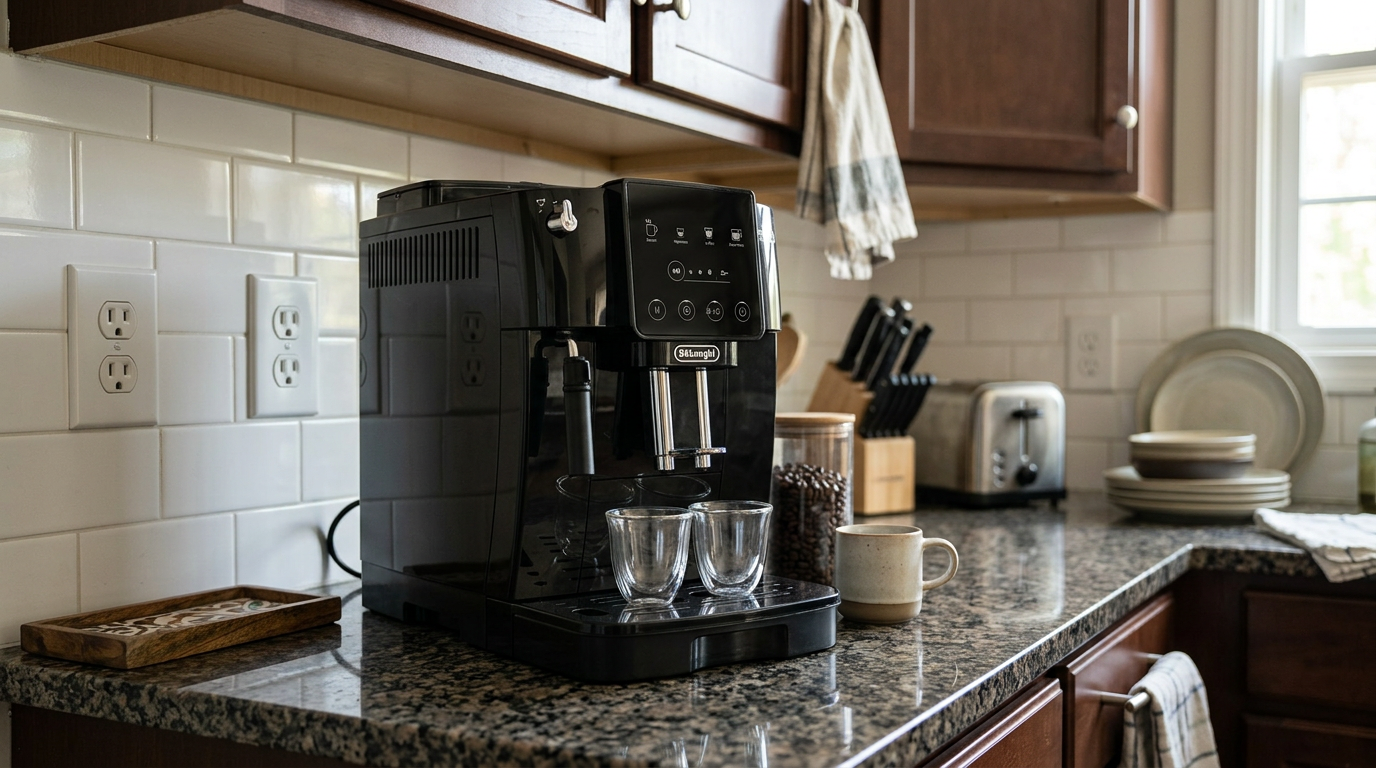
The Magnifica Start's twin spouts pouring two espressos on my first full morning with it.
What the Magnifica Start actually is
The Magnifica Start is a fully automatic, bean-to-cup espresso machine.
You fill the hopper with whole beans, fill the tank and press a button.
It grinds, doses, presses the coffee into a puck, brews and drops the used puck into an internal drawer.
Two versions, one core
De'Longhi sells the Magnifica Start in two main versions that share exactly the same insides.
One has the automatic LatteCrema milk carafe and one-touch cappuccinos.
The other, which I tested, has a classic Panarello wand✕Panarello wandA steam wand with a plastic sleeve that has a small air hole near the top. It sucks in air automatically as you steam, so you get foam without needing barista technique. and a one-touch Americano button instead.
The pump, heating, brew unit and water path are identical. What changes is how you handle milk and hot water.
| Feature | Manual wand version (tested) | LatteCrema version |
|---|---|---|
| One-touch drinks | Espresso, Coffee, Americano | Espresso, Coffee, Cappuccino, Latte Macchiato |
| Milk | You froth it with the steam wand | Automatic carafe |
| Hot water | Any time, straight from the wand | Swap in a hot water spout |
| Daily cleaning | Wipe and purge the wand | Carafe rinse and lid wash |
| Best for | Black coffee and Americano drinkers | Daily milk drinkers |
What's inside
A thermoblock✕ThermoblockA compact heater that warms water as it flows through, instead of keeping a whole boiler hot. It heats up fast and uses less standby energy. heats water on demand in about 40 seconds.
The pump is rated at 15 bar.
The brew unit✕Brew unitThe chamber inside an automatic machine that receives the ground coffee, presses it into a puck, pushes hot water through it and then ejects the used grounds. is De'Longhi's familiar removable design, shared across its automatic range.
Magnifica Start design and setup
The Magnifica Start measures about 9.4 × 17.3 × 13.8 inches (W × D × H) and weighs around 19 pounds.
It's narrow, and it fits comfortably under standard wall cabinets.
Like all bean-to-cup machines, it's deep, so measure your counter before you buy.
Water tank and drip tray
The water tank sits on the right and pulls out from the front, so you don't have to move the machine to fill it.
It holds about 60 ounces, roughly 1.8 liters.
An internal float tracks the level and lights a warning before the pump runs dry.
The drip tray slides out from the front, with the grounds drawer nested inside and a small float that pops up when it's full.
The touch panel
The panel uses capacitive touch icons with LED backlighting.
There's Espresso, Coffee, Americano, a steam button, a 2x button and three bean icons for strength.
It's about as clear as a coffee machine can be. I didn't need the manual for daily drinks at all.
The bean hopper lid
This is the one place the Start shows where De'Longhi saved money.
The hopper lid is a simple drop-in plastic lid with no rubber seal.
It doesn't keep air out completely, and it lets more grinder noise escape.
I'll come back to what that means for your beans.
First-time setup
Setup took about 15 minutes: rinse the tank, fit the filter, set the water hardness with the test strip and prime the circuit.
Expect the first three to five drinks to be weaker while the machine's software settles on the right dose and press.
Our tip: Don't change any settings until you've pulled at least five espressos. The Start needs a few cycles to calibrate its dose.
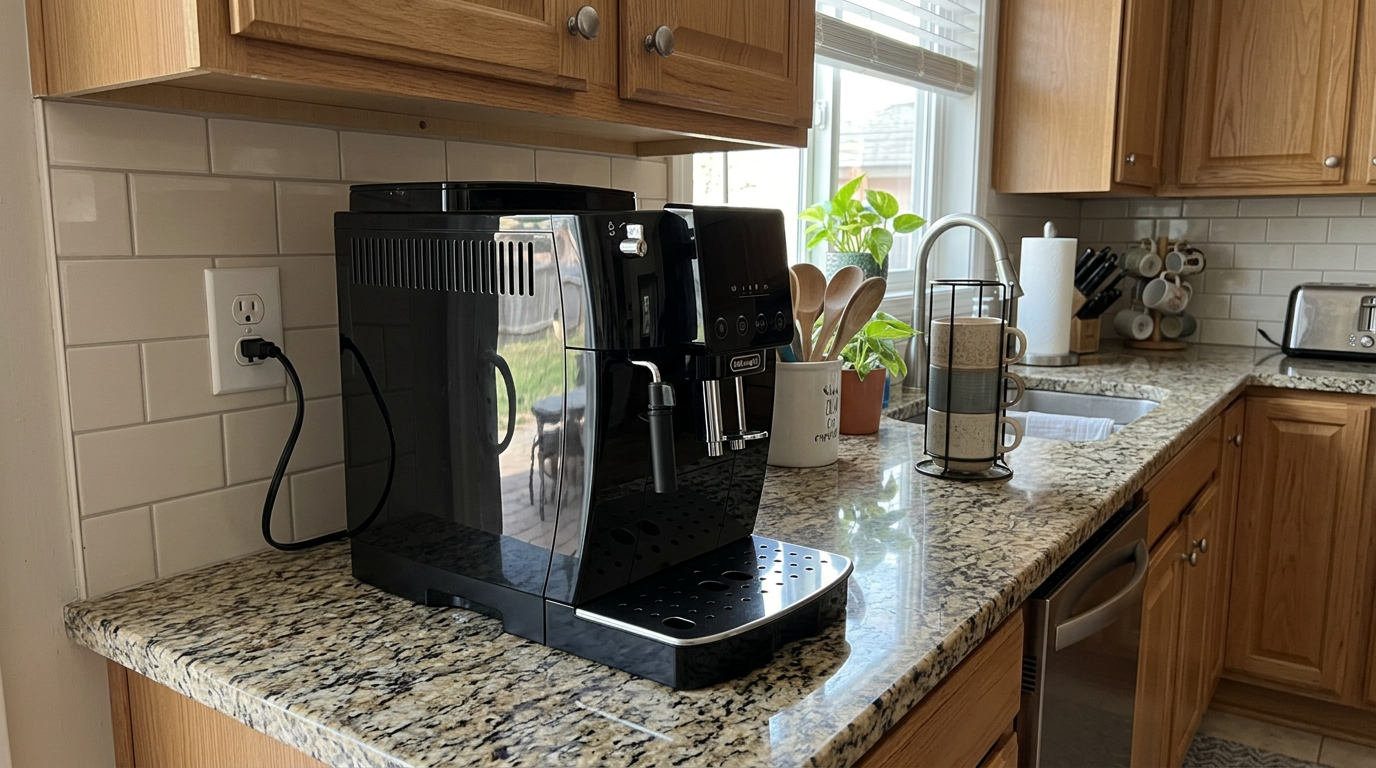
At about 9.4 inches wide, the Start slots neatly between other appliances.
The built-in grinder
The Start uses a steel conical burr✕Conical burrsA cone-shaped cutting part that turns inside a ring. They grind evenly at fairly low speed, which keeps heat and noise down. grinder with 13 stepped settings.
The adjustment knob sits inside the bean hopper.
Lower numbers grind finer, which slows the shot and adds body. Higher numbers grind coarser and speed it up.
Bars show how much resistance the coffee puts up. Medium-dark beans on the strongest dose.
Only turn it while grinding
Turn the knob only while the grinder is running.
Turning it with the burrs stopped can jam bean fragments and strain the mechanism.
I moved it one or two steps at a time and judged the result two shots later.
Strength: three bean icons
The bean icons on the panel set how much coffee goes into each shot.
One bean is light, two is the factory default, and three is the strongest dose.
You pick the strength before you press a drink, and the machine remembers it until you change it.
I used three beans for everything except the long Coffee button.
Our tip: Use the three-bean strength for espresso and Americano. The extra coffee makes more difference than any other setting.
Magnifica Start espresso performance
Because the Start uses the same brew unit as De'Longhi's more expensive machines, like the Dinamica Plus, its espresso is in the same league.
That was the most important finding of my test.
How it tasted
With a medium-dark blend at grind setting 3 and three beans of strength, my espresso had a thick, dark, persistent crema✕CremaThe golden-brown foam on top of an espresso. It forms when pressure pushes gases and oils out of freshly ground coffee..
The body was full and concentrated.
I tasted dark chocolate and toasted nuts, with low acidity and just a little bitterness at the very end.
Once the machine was warm, back-to-back shots were consistent.
Temperature
The Start brews hot out of the box, straight from the thermoblock.
You can change the coffee temperature from a secondary settings menu, with low, medium, high and maximum levels.
I set it to high, warmed my cups and ran a quick rinse before the first shot. That made a clear difference to how long the espresso stayed hot.
| What you taste or see | Likely cause | First change |
|---|---|---|
| Weak or watery | Machine still calibrating, or grind too coarse | Pull 5 shots, then grind 1–2 steps finer |
| Sour, thin | Under-extraction | Grind finer and use three beans |
| Bitter, harsh | Over-extraction | Grind one step coarser |
| Sputtering or very slow | Grind too fine or scale build-up | Grind coarser, then descale if needed |
| Flat, dull flavor | Beans going stale in the unsealed hopper | Load only a day or two of beans |
The 2x button is not a true double
This is the most useful thing I learned about the Start.
The 2x button does not grind twice.
It grinds a single dose and pushes twice as much water through it.
The result is a bigger but noticeably milder and more diluted drink, not a proper double-strength shot.
When I wanted a real double espresso, I made two singles back to back.
My strength ratings on a 10-point scale with the same beans and settings.
Coffee vs Americano: the button that matters
This is where the Start stands out, so I spent a full week comparing the two long drinks side by side.
They look similar in the cup, but they're made in completely different ways.
The Coffee button
The Coffee button grinds once and then pushes the whole volume of water through that one puck.
That long contact time pulls more bitter compounds out toward the end of the pour.
The result is lighter in body, softer and more diluted, with a thin crema that fades quickly.
The Americano button
The Americano button grinds once and pulls a normal, concentrated espresso.
Then it switches its internal valves and pumps fresh hot water into the cup, bypassing the coffee entirely.
That preserves the sweetness, clarity and body of the espresso while making it longer and gentler.
It's a button I missed on the Magnifica XS, where I made Americanos by hand with water from the steam wand.
Some crema stays around the edge of the cup, and none of the harsh, over-extracted flavors make it in.
| Quality | Coffee button | Americano button |
|---|---|---|
| How it brews | All the water through one puck | Espresso, then clean hot water |
| Body | Light, thin | Fuller, rounder |
| Flavor | Soft, slightly bitter finish | Sweet, clean, balanced |
| Crema | Fades quickly | Partly retained at the edge |
| My pick for a big mug | Occasionally | Every day |
My ratings for a big mug of black coffee, out of 10.
Our tip: If you mostly drink big mugs of black coffee, use the Americano button and set it to three beans. It's the best long drink this machine makes.
Milk frothing with the Panarello wand
The steam wand is the trade-off in this version of the Start.
You get full control over your milk, but you do the work.
It's the same style of wand you'll find on the Magnifica XS, and the sleeve-off trick below works on both.
How it works
You pull your espresso first.
Then you fill a small steel jug about a third full of cold milk, hold the wand in the milk and press the steam button.
The thermoblock heats up to steam temperature, and after a short purge of water, a steady jet of steam comes out.
The plastic sleeve on the wand has a small air hole that pulls in air automatically, so the milk foams without any special technique.
When it's hot enough, you close the valve, switch off steam and pour the milk into your coffee.
What the foam is like
With the sleeve on, the wand makes thick, stiff foam quickly.
It's great for a classic dry cappuccino.
It's harder to get the fine, glossy microfoam✕MicrofoamMilk foam with bubbles so small you can't see them. It feels silky and blends into the coffee instead of sitting on top like froth. you need for flat whites or latte art, because the sleeve's air hole limits how you can spin the milk.
You control the temperature
This is a real upside over an automatic carafe.
You decide how hot the milk gets.
Stop early for a drink you can sip right away, or keep going for a very hot latte.
Milk types
Cold whole milk gave the richest, most stable foam.
Barista-style oat milk worked well. Standard oat and other thin plant drinks foamed poorly and collapsed quickly.
My ratings on a 10-point scale for texture and stability, sleeve on.
Hot water on demand
The wand doubles as a hot water tap.
Open the valve without pressing the steam button, and hot water flows straight out.
I used it for tea, for warming cups and for topping up drinks, with no spouts to swap.
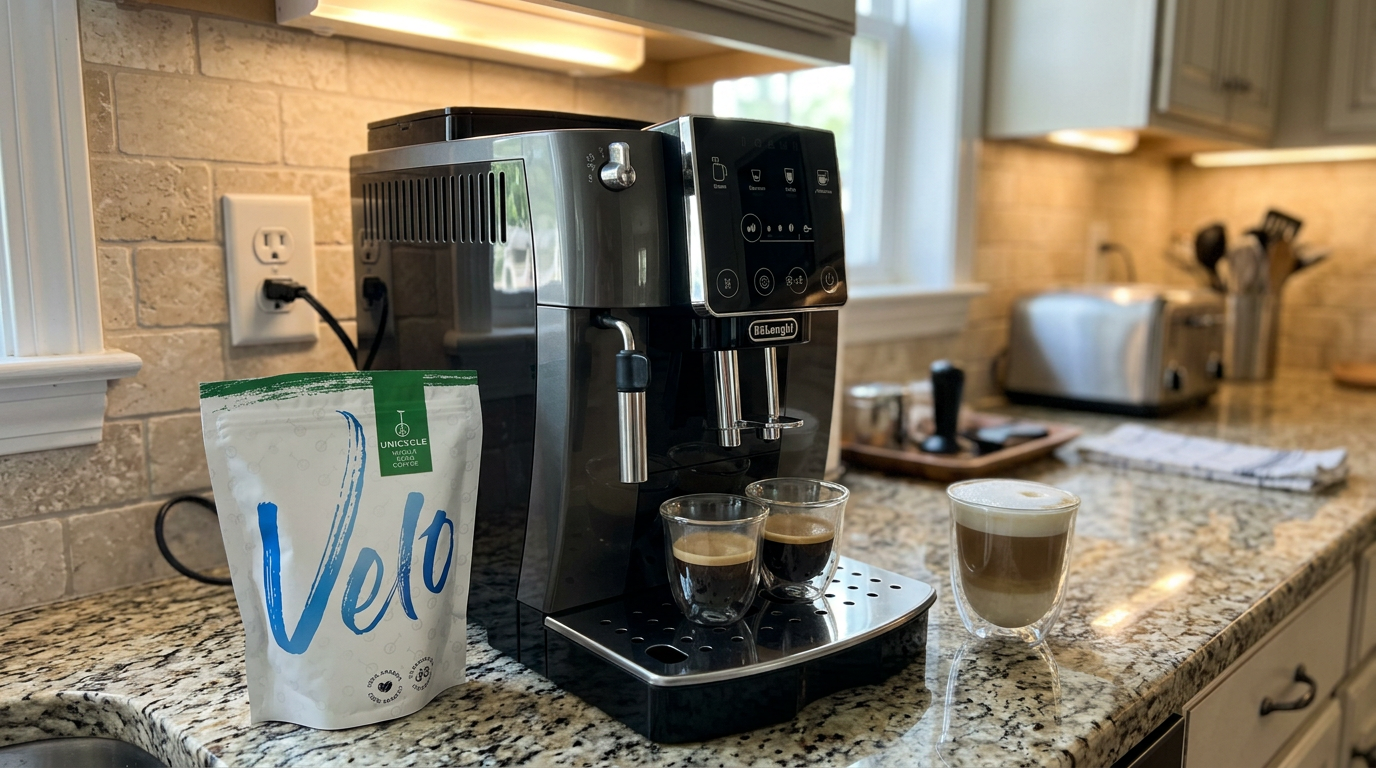
Two espressos and a hand-steamed latte, a typical weekend round from the Start.
How I steam milk on the Start, step by step
After four weeks of daily practice, this is the routine that worked best for me.
| Step | What I do | Why |
|---|---|---|
| 1. Brew first | Pull the espresso into a warmed cup | The machine brews before switching to steam temperature |
| 2. Fill the jug | Cold milk to about a third of a small steel jug | Room for the milk to grow |
| 3. Heat up | Press steam and wait for it to be ready | The thermoblock needs to reach steam temperature |
| 4. Purge | Open the valve briefly over the drip tray | Clears condensed water first |
| 5. Froth | Tip just under the surface, then sink it slightly | Adds air, then folds it in |
| 6. Stop | Close the valve when the jug is too hot to hold | Around 140 to 150°F tastes sweetest |
| 7. Clean | Purge again and wipe the wand right away | Stops milk drying inside the tip |
First week vs fourth week
In week one, my cappuccinos had a stiff, dry cap of foam over thin milk.
By week two, I was getting a smoother texture with the sleeve on by keeping the tip shallower for less time.
In weeks three and four, with the sleeve off, the milk became silky and glossy.
My foam quality over the test, rated out of 10.
Programming, settings and lights
Daily use is as simple as it gets: pick a strength, press a drink.
Setting your own cup sizes
Press and hold a drink button. The machine starts grinding and brewing.
When the icon starts flashing, it's recording. Press again when your cup reaches the level you want.
The Start then remembers that volume for that button.
You can only store one size per drink, and there are no user profiles.
If people in your house use very different mugs, someone will be adjusting volumes by hand.
Settings and warnings
Temperature and water hardness live in a secondary menu you open from standby, using button combinations in the manual.
Warnings use icons on the panel: empty tank, full grounds drawer, descale needed.
They're clearer than older machines, though a text display would still be easier.
Our tip: Set your cup volumes on day one with your real mugs. One minute of programming saves you stopping drinks by hand every morning.
Pre-ground coffee and decaf
A bypass chute next to the hopper takes one level scoop of pre-ground coffee✕Pre-ground bypassA separate chute that sends already-ground coffee straight to the brew unit, skipping the grinder. Handy for decaf without emptying the bean hopper..
It's useful for decaf without emptying the beans.
Don't add more than one scoop, because overloading it can clog the brew unit's intake.
Beans, the hopper lid and freshness
Because the hopper lid has no rubber seal, beans left in the machine for days are exposed to air.
In my test, beans that sat in the hopper for most of a week tasted noticeably flatter than fresh ones from a sealed bag.
The fix is simple: only load as many beans as you'll use in a day or two.
My flavor ratings on a 10-point scale with the same bag and settings.
| Bean type | Result on the Start | My setting |
|---|---|---|
| Medium-dark blend | Thick crema, chocolate and nuts | Grind 3, three beans |
| Medium roast | Sweeter and brighter | Grind 3–4, three beans |
| Light roast | Can taste sour | Grind 2–3, three beans, shorter volume |
| Very dark, oily | Bitter, sticks in the hopper | Not recommended |
Water
Use fresh, cold water, changed daily, and the included filter if your water is hard.
Avoid distilled water, because coffee needs some minerals to taste full.
Cleaning and maintaining the Magnifica Start
The manual wand version is one of the easiest automatic machines to keep clean.
There's no milk carafe with tubes and small passages, just a wand you purge and wipe.
The brew unit
The brew unit sits behind the side access door, beside the water tank.
Switch the machine off, remove the tank, open the door, press the two release buttons together and slide it out.
Rinse it under warm water only. No soap, no detergent and no dishwasher, because those strip the food-grade lubricant from its moving tracks.
Check the steel shower screen for packed coffee fines, then slide it back until it clicks.
There are no cleaning tablets to buy.
| When | Task | Why it matters |
|---|---|---|
| After steaming | Purge the wand and wipe it | Stops milk drying in the tip |
| Daily | Empty the drip tray and grounds drawer | Prevents mold and odors |
| Daily | Change the tank water | Keeps the water fresh |
| Weekly | Rinse the brew unit and wash the wand sleeve | Clears fines and milk residue |
| Every few months | Grease the brew unit rails | Keeps the mechanism smooth |
| When the light comes on | Descale | Protects the thermoblock and pump |
Descaling
The descale icon lights up based on usage and your water hardness.
You add a liquid descaler and water to the tank, put a large container of at least half a gallon under the outlets and start the program.
The machine alternates pumping and pausing, then you rinse the tank and flush it with fresh water.
My estimate of hands-on cleaning time per day.
What daily use is really like
My mornings: switch on, let it heat up for about 40 seconds and rinse, choose three beans and press Americano.
A big Americano took under a minute.
On weekends, I made cappuccinos with the wand, which took about three minutes including cleanup.
Tank and noise
The 60-ounce tank lasted two to three days for two of us.
The grinder is noticeably loud, partly because the unsealed hopper lid lets more noise escape.
It's a short burst on every drink, enough to hear from the next room.
Rough maths from a 60 oz tank, allowing for rinses. Actual numbers depend on cup size.
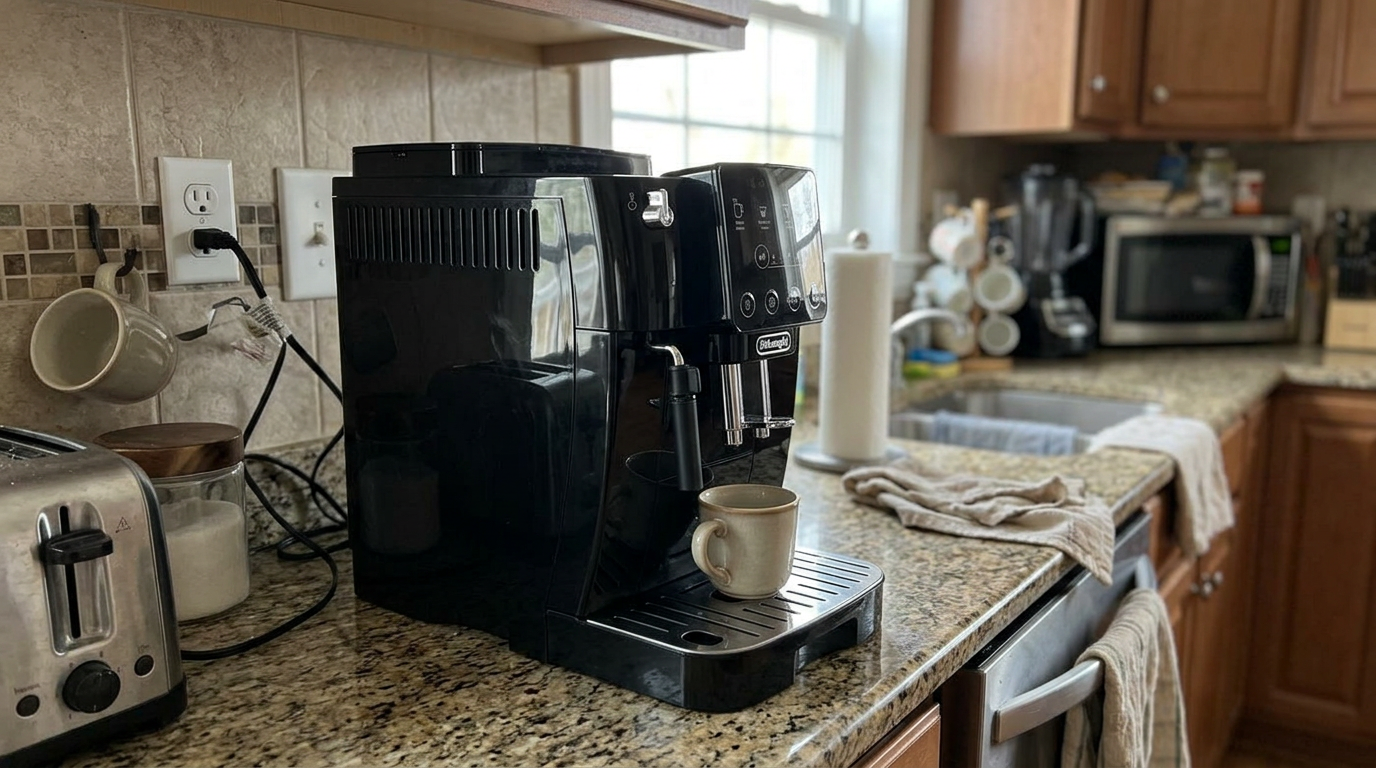
My daily spot for the Start: a cup under the spouts for the morning rinse.
The drinks I made most often
By the end of the month, I'd settled on a short list of drinks with settings that worked every time.
They're a good starting point if you're new to the machine.
| Drink | Strength and grind | How I made it | Notes |
|---|---|---|---|
| Morning Americano | Three beans, grind 3 | Americano button, volume set to my mug | Sweet and full, my everyday cup |
| Espresso | Three beans, grind 3 | Espresso button, volume shortened | Dense crema, chocolate and nuts |
| Double espresso | Three beans, grind 3 | Two singles into one cup | Far stronger than the 2x button |
| Weekend cappuccino | Three beans, grind 3 | Espresso plus foam, sleeve on | Classic tall foam cap |
| Flat white | Three beans, grind 3 | Espresso plus silky milk, sleeve off | Took a week of practice |
| Afternoon tea | None | Hot water straight from the wand | No spouts to swap |
A homemade iced coffee
The Start has no iced drink button, but you can still make a good one.
I brewed two single espressos into a small cup, let them sit for a minute and poured them over a tall glass packed with ice.
A splash of cold milk finished it off.
Pouring hot espresso directly onto a few ice cubes made a watery drink, so a full glass of ice is the key.
Our tip: For iced coffee, brew two singles into a cup first and pour them over a glass filled right to the top with ice.
Living with it: week one to week four
In the first week, I focused on the grinder and the strength icons.
Moving from the middle of the range down to setting 3, with three beans, transformed the espresso.
In the second week, I compared the Coffee and Americano buttons every morning.
By midweek I'd stopped using Coffee for anything except a quick mild mug.
In the third week, I took the sleeve off the steam wand and started practicing proper microfoam.
The first few attempts were messy. By the end of the week, my flat whites were silky and glossy.
In the fourth week, I tested bean freshness by leaving beans in the hopper for several days.
That's when I changed my habit to loading only a day or two of beans at a time.
How I rated each drink by the end of the test, out of 10.
Serving guests
For black coffee, the Start keeps up well with a group.
I made four Americanos in about four minutes for a family breakfast, each one as hot and sweet as the last.
Milk drinks are slower. Each cappuccino meant brewing, steaming, pouring and wiping the wand.
Four cappuccinos took me closer to twelve minutes.
What helped
I pulled all the espressos first, then steamed one larger jug of milk and split it between the cups.
That cut the time almost in half and gave everyone the same foam.
Our tip: Steaming for several people? Brew all the espressos first, then froth one bigger jug of milk and share it out.
Who will enjoy the hands-on side
If you like a small morning ritual, steaming your own milk is genuinely satisfying, and the control over temperature is a real plus.
If you'd rather press one button and walk away, the LatteCrema version of the Start will suit you better.
Pulling the espressos first, then steaming one jug of milk, made weekend rounds much quicker.
Build quality and long-term ownership
The Start's housing is mostly composite plastic in matte and glossy black.
It looks tidy on the counter and wipes clean easily, though the glossy panels show fingerprints.
The drip tray and grounds drawer slide in and out smoothly, and the float indicator made it obvious when the tray needed emptying.
Why it should last
The removable brew unit, grinder and thermoblock are the same proven parts De'Longhi uses across its automatic range.
You rinse the brew unit with water instead of running chemical tablets through it, and spare parts are widely available.
The manual-wand version also has fewer electronic milk parts to wear out than a carafe model.
Grinder rattle
If the grinder sounds rattly, check that the hopper lid is seated squarely on its ridge.
Without a gasket, a slightly crooked lid lets more of the motor's vibration escape.
Common mistakes to avoid
The Magnifica Start is simple to use, but these habits will hold it back.
| Mistake | What happens | Better habit |
|---|---|---|
| Using 2x for a strong double | One dose, double water, weak drink | Brew two singles back to back |
| Using Coffee for a big mug | Thin, slightly bitter finish | Use the Americano button |
| Filling the hopper for the week | Beans go stale under the unsealed lid | Load a day or two at a time |
| Turning the grind knob while stopped | Burrs can jam | Adjust only while grinding |
| Washing the brew unit with soap | Strips the lubricant | Rinse with water only |
| Leaving milk on the wand | The air hole clogs | Purge and wipe after each use |
What I would change
A sealed hopper lid would keep beans fresher and cut grinder noise.
A true double-shot option on the 2x button would make it more useful.
And a simple text display for settings would remove the need for the manual.
Is the Magnifica Start worth the money?
For black coffee drinkers, yes, and especially for Americano lovers.
You get espresso from the same brew unit as De'Longhi's pricier machines, a genuinely excellent Americano button, an easy touch panel and very simple cleaning.
What you give up is one-touch milk and a sealed hopper.
Ask yourself three questions before you buy.
Do you mostly drink espresso or big mugs of black coffee? Are you happy steaming milk by hand when you want a cappuccino? And do you value simple controls over screens and profiles?
If the answers are yes, the manual-wand Start is one of the easiest machines in the range to live with.
It's also a smart choice if you're not sure yet how much you'll use an automatic machine.
The controls take minutes to learn, the cleaning takes minutes a week and the coffee is genuinely good from the first week.
If you drink milk drinks every day, look at the LatteCrema version or the Magnifica Evo instead.
Those save you the steaming, the jug and the wiping, at the cost of a carafe to clean.
How it compares with other De'Longhi machines
Since they share the same core brew unit, the fairest comparison is with the rest of De'Longhi's range.
| Feature | Magnifica Start (wand) | Magnifica XS | Magnifica Evo | Dinamica Plus |
|---|---|---|---|---|
| Espresso quality | Excellent | Excellent | Excellent | Excellent, most tunable |
| One-touch Americano | Yes | No | No, hot water tap | No |
| Milk system | Manual Panarello wand | Manual Panarello wand | LatteCrema carafe | Thermal LatteCrema carafe |
| Interface | Backlit touch icons | Buttons and dial | Touch icons | 3.5-inch color touchscreen |
| One-touch drinks | 3 | Espresso, long coffee | 7, including iced | 16, including iced |
| User profiles | No | No | No | 3 plus guest |
| Best for | Americano and black coffee drinkers | Simplicity and longevity | Milk drinks on a budget | Households with different tastes |
| You mostly drink | Is the Start a fit? | Why |
|---|---|---|
| Big mugs of black coffee | Excellent | True Americano button |
| Espresso | Excellent | Shared brew unit, rich crema |
| Occasional cappuccino | Good | Panarello wand works with practice |
| Daily lattes for several people | Fair | Manual steaming takes time |
| Tea and hot water | Very good | Hot water straight from the wand |
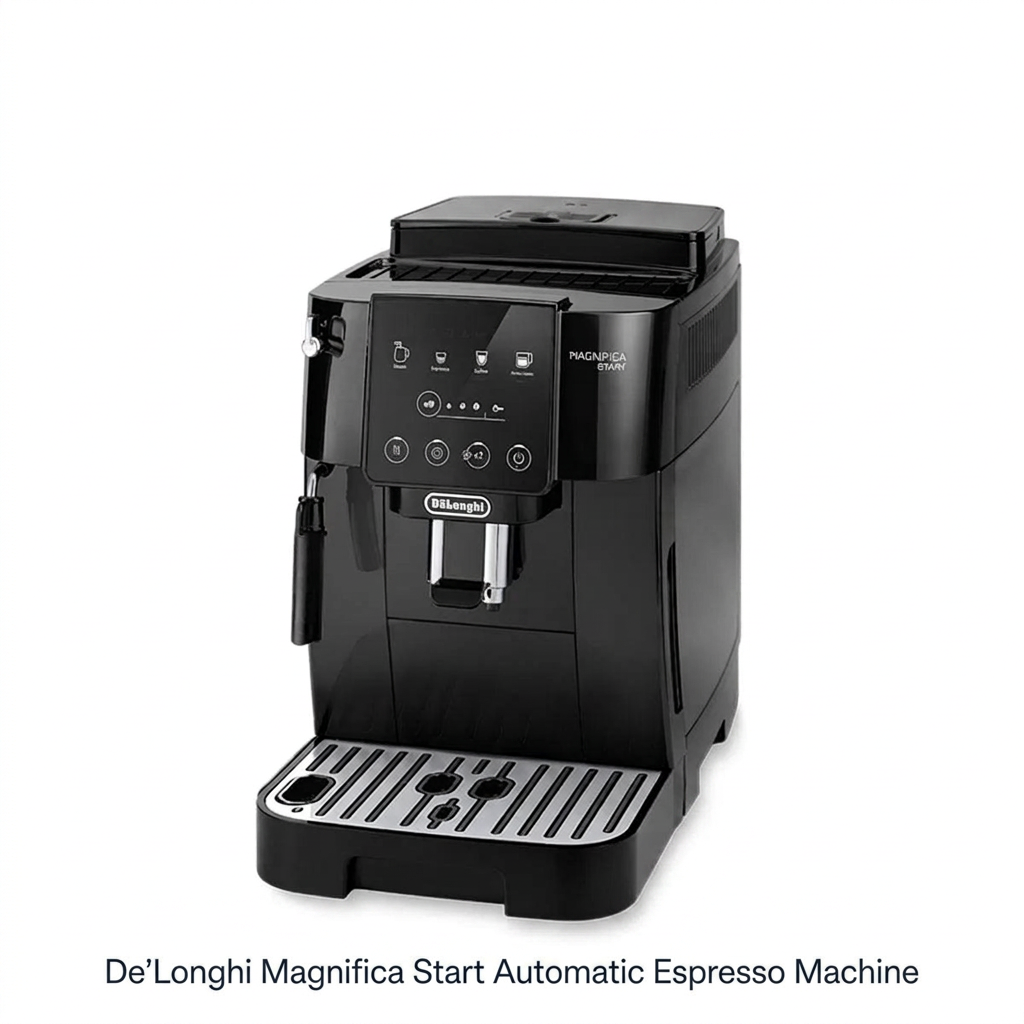
The full package: backlit touch panel, twin spouts and the Panarello steam wand.
Other De'Longhi machines I tested
If you want one-touch cappuccinos, see my Magnifica Evo review.
For the simplest, longest-lasting option, my Magnifica XS review covers a button-and-dial machine with the same espresso.
For a touchscreen, profiles and an app, read my Dinamica Plus review.
Which one is right for you: is the Magnifica Start your match?
4 quick questionsMagnifica Start specifications
From manufacturer data and my own testing.
How I tested and scored the Magnifica Start
For four weeks, I used the Magnifica Start as my everyday machine for espresso, Coffee, Americano, 2x drinks, cappuccinos, flat whites and hot water for tea.
I worked through the grind range, compared all three strength levels, reprogrammed every cup volume and compared the Coffee and Americano buttons side by side for a full week.
I steamed whole, semi-skimmed, barista oat and regular oat milk with the Panarello sleeve on and off, tested bean freshness in the unsealed hopper, rinsed the brew unit weekly and tracked how long a tank lasted.
I then checked my notes against De'Longhi's specifications and owner documentation.
- Espresso (8.4): body, crema, temperature and consistency, plus the 2x and Americano drinks.
- Milk drinks (6.6): foam with and without the Panarello sleeve, milk temperature control and effort.
- Ease of use (8.2): touch panel, strength icons, volume programming, warnings and setup.
- Cleaning (8.5): brew unit rinse, wand care, daily emptying and descaling.
The overall score of 7.8 is an editorial rating that reflects those four areas.
Magnifica Start FAQ
Is the De'Longhi Magnifica Start worth it?
Yes, if you mostly drink espresso or black coffee. It shares its brew unit with pricier De'Longhi machines and its Americano button is excellent. If you drink milk drinks daily, choose a LatteCrema model.
What is the difference between Coffee and Americano?
Coffee pushes all the water through one puck, which gives a lighter, slightly bitter drink. Americano brews an espresso first and then adds clean hot water, which keeps it sweeter and fuller.
Does the 2x button make a double espresso?
Not really. It grinds one dose and pushes twice the water through it, so the drink is bigger but milder. Brew two singles for a true double.
Does the Magnifica Start have an automatic milk frother?
The version I tested has a manual Panarello steam wand. De'Longhi also sells a version with the automatic LatteCrema carafe.
Can I get hot water from the Magnifica Start?
Yes. Open the steam wand valve without pressing the steam button and hot water flows out.
How many grind settings does it have?
13, on a steel conical burr grinder inside the hopper. Only change the setting while it is grinding.
Why does my coffee taste weak at first?
A new machine needs three to five drinks to calibrate. After that, grind one or two steps finer and use three beans.
Is the bean hopper sealed?
No. The lid has no rubber seal, so load only as many beans as you will use in a day or two.
How do I clean the brew unit?
Switch off, remove the tank, open the side door, press the two release buttons and slide it out. Rinse it with warm water only.
Can I use pre-ground coffee?
Yes, there is a bypass chute for one level scoop.
Does it have user profiles?
No. Each drink button stores one saved volume for everyone.
Can the Magnifica Start make iced coffee?
There is no iced drink button. Brew two single espressos into a cup and pour them over a glass filled to the top with ice.
How long does it take to heat up?
About 40 seconds from cold, followed by a short automatic rinse.
Is the Magnifica Start loud?
The grinder gives a short, noticeable burst on every drink, partly because the hopper lid has no seal. Brewing itself is quieter.
Kitchen & coffee tester
Michael spent six years as a line cook in restaurants in Chicago and New York, and he has tested kitchen appliances for HouseholdMe since 2018, from air fryers to coffee makers. He holds an SCA certificate in barista skills and used the Magnifica Start as his everyday coffee machine for four weeks for this review.
- Four weeks of hands-on testing of the De'Longhi Magnifica Start
- De'Longhi product specifications and owner documentation
- General espresso brewing and maintenance guidance