De'Longhi Eletta Explore review: hot foam, cold foam and cold brew from one machine
The De'Longhi Eletta Explore Espresso Machine makes hot lattes, iced cappuccinos and a quick cold brew from the same compact body. It's quiet, generous with coffee and easy to live with, although the app is slow and the milk carafes need regular hand cleaning.
Jargon helpNew to espresso? Tap any dotted term to see what it means.
In this review
Yes, if your household drinks milk coffee hot in winter and iced in summer. The De'Longhi Eletta Explore has a dedicated carafe for each, a real cold extraction mode and a grinder quiet enough for early mornings. The espresso is rich for an automatic machine, but the app lags and the milk system needs a proper wash every few days. For variety with very little effort, it's one of the most complete bean-to-cup machines I've used.
De'Longhi Eletta Explore at a glance
De'Longhi Eletta Explore pros and cons
- Two dedicated carafes for hot foam and cold foam
- Cold brew-style drinks in about three minutes
- Quiet grinder that doses up to 16 grams
- The app is slow to connect and to save changes
- Milk carafes need a full wash every 2 to 3 days
- Deep footprint takes real counter space
Who should buy the De'Longhi Eletta Explore?
- Households that switch between hot lattes and iced coffee
- Families where everyone wants a different drink
- Early risers who need a quiet grinder
- Small kitchens with shallow counters or low cabinets
- Espresso purists who want manual control
- Anyone hoping to start coffee remotely from bed
First impressions of the Eletta Explore
Most automatic espresso machines are built around one idea: hot coffee, with hot milk if you want it.
Iced drinks are usually an afterthought, which means a hot shot poured over a glass of ice and a lot of hoping.
The De'Longhi Eletta Explore is one of the few machines I've used that treats cold drinks as a real job.
Two milk carafes came in the box, one for hot foam and one for cold foam.
That told me more about the machine's priorities than any spec sheet could.
The second thing I noticed was the sound, or rather the lack of it.
My first grind of the morning came in under 65 decibels on my meter, with a low hum instead of the sharp whine I expect from bean-to-cup grinders.
The third was how quickly I stopped thinking about the machine at all.
The touchscreen groups drinks into hot, cold and to-go, and most of what I wanted was one or two taps away.
That's the core appeal here.
It doesn't ask you to become a barista. It asks what you feel like drinking, and then mostly gets it right.
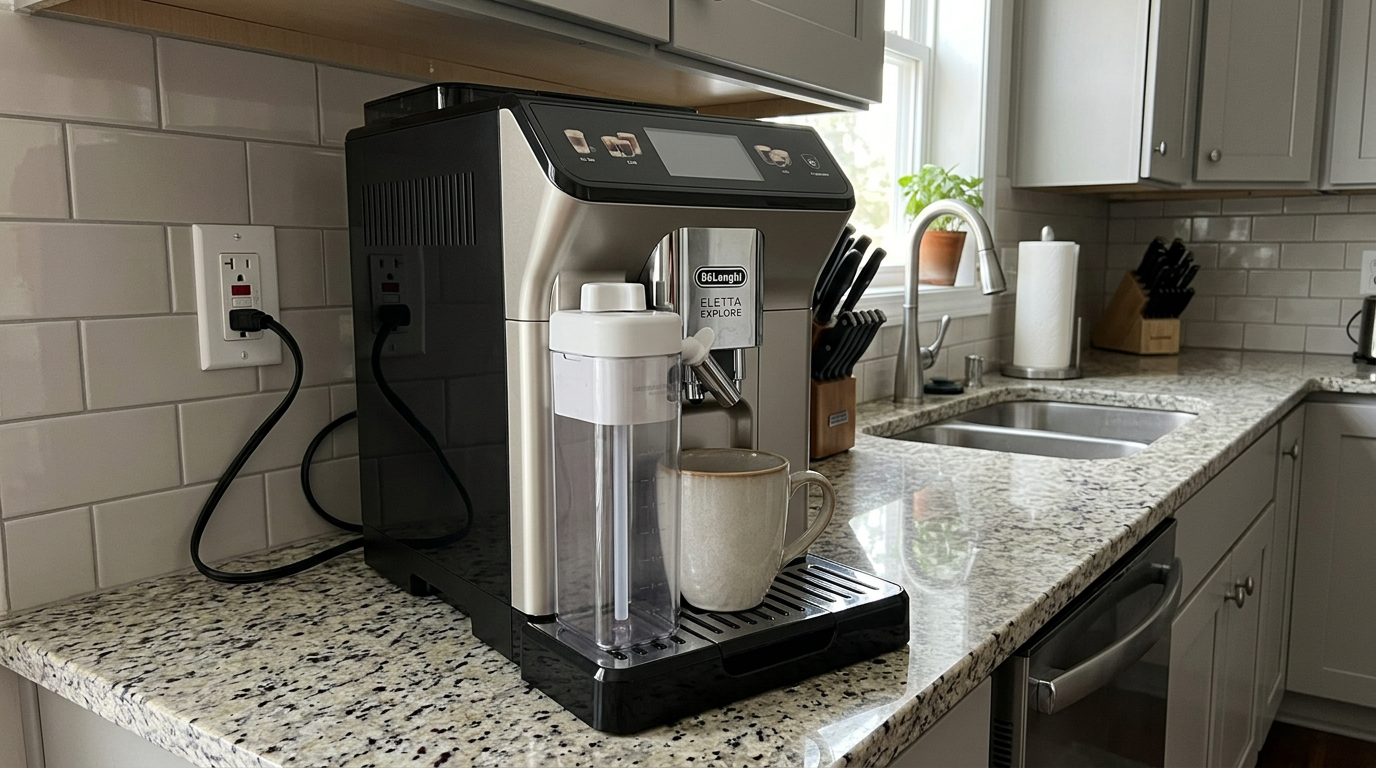
The Eletta Explore is narrow from the front, but it runs deep toward the wall.
What the Eletta Explore actually is
The Eletta Explore is a fully automatic, bean-to-cup espresso machine made in Italy.
It grinds the beans, tamps the coffee, brews the shot, froths the milk and dumps the used puck, all on its own.
Your job is filling the water tank and bean hopper, choosing a drink and keeping the milk parts clean.
Inside is a thermoblock✕ThermoblockA compact heater that warms water as it flows through, instead of keeping a tank of water hot. It heats up fast and uses less standby energy. that heats water on demand, plus a pump rated at 19 bar.
That 19-bar figure is the pump's maximum, not the brewing pressure.
During a normal shot, the coffee sees roughly 9 bar, which is the classic espresso target.
What sets this model apart is the cold side.
De'Longhi combines a cold foam carafe with what it calls Cold Extraction Technology, a low-temperature brewing mode that produces a cold brew-style coffee in about three minutes.
Add the hot foam carafe and you get more than 50 hot and cold recipes on the machine itself.
The companion app lists more than 100.
Eletta Explore design and setup
From the front, the Eletta Explore looks surprisingly slim at about 10.2 inches wide.
The catch is depth.
De'Longhi lists it at 260 × 450 × 385 mm, so it reaches almost 18 inches back toward the wall.
Measure your counter before you buy, and remember the bean hopper lid needs room to open under any wall cabinets.
Setup is guided on the 3.5-inch touchscreen.
It walks you through language, water hardness and the optional water filter, then runs a rinse before the first drink.
Test your water hardness with the included strip, because that setting decides how often the machine asks you to descale.
The 1.8-liter water tank slides out of the front, which I appreciated more than I expected.
I never had to drag the machine forward to refill it.
The 300-gram bean hopper sits on top, with the grind dial inside.
Cup clearance is generous for an automatic machine.
With the drip tray adjusted out of the way, I fit a 7-inch travel tumbler under the spouts, and De'Longhi includes a travel mug for the to-go recipes.
Our tip: Leave a hand's width of space above the hopper so you can refill beans without pulling the machine out.
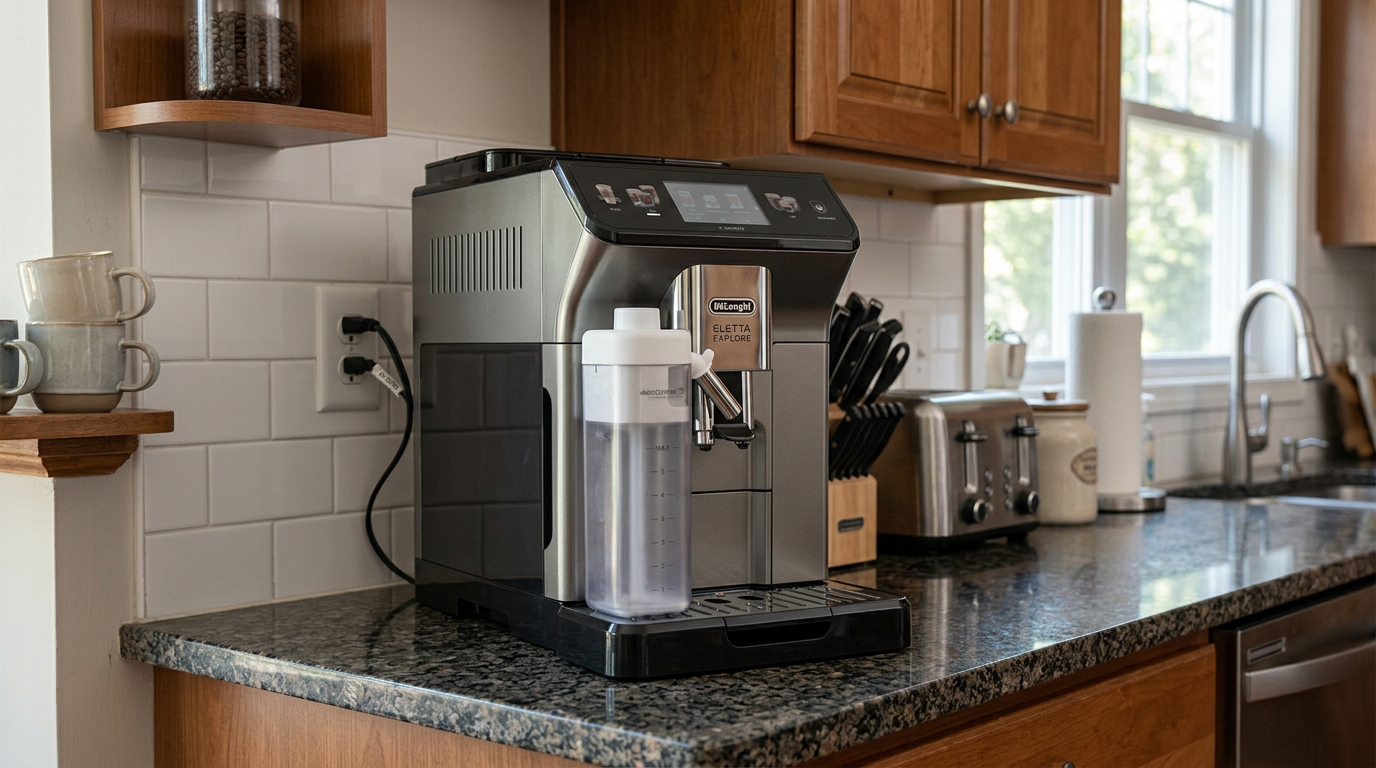
Under standard wall cabinets, the hopper lid still opens, but only just.
The built-in grinder
The grinder is where many automatic machines cut corners, so I spent a lot of time with this one.
The Eletta Explore uses steel conical burrs✕Conical burrsA cone-shaped grinding part that turns inside a ring. They grind evenly at low speed, which keeps noise and heat down. with 13 grind settings on a dial inside the hopper.
With fresh beans, I got my best results between settings 2.0 and 4.0.
The grinder is stronger than its quiet sound suggests.
At its finest setting with a large dose, it produced coffee fine enough to stall the pump completely.
That sounds like a fault, but it's actually reassuring.
It means the grinder has enough range and torque that thin, watery shots are never down to the grinder running out of fineness.
How the dose works
Like most automatic machines, the Eletta Explore doses by time rather than weight.
I timed the grinder at roughly 1.5 grams per second and weighed the output at each strength level.
My measurements at about 1.5 grams per second. Actual weights shift with bean density and moisture.
A single test at the highest intensity weighed 13.6 grams of dry coffee.
Other runs went as high as 15 grams, depending on the beans.
That's a generous range for a bean-to-cup machine and one of the reasons the espresso has real body.
The variation also tells you something useful: denser, darker beans weigh more per second than light, airy ones.
If you switch bags and the coffee suddenly tastes weaker, the dose may have dropped even though the setting didn't change.
Quiet enough for early mornings
Noise is the grinder's other strength.
Bean-to-cup grinders typically register around 68 to 70 decibels, and this one stayed under 65 in my kitchen.
Five decibels may not sound like much, but the decibel scale is logarithmic.
More important to me was the pitch: a lower, rounder sound that didn't cut through the house at 6 a.m.
Our tip: Only turn the grind dial while the grinder is running, so the burrs move freely and don't jam.
Eletta Explore espresso performance
For my main espresso tests, I used a medium-dark blend of 60% Arabica and 40% Robusta✕RobustaA hardier coffee species with more caffeine and bitterness than Arabica. It adds body and thick crema to espresso blends., roasted about four weeks earlier.
My target was a classic 2:1 ratio: 15 grams of dry coffee in and 30 grams of espresso out.
The machine starts each shot with a short pre-infusion✕Pre-infusionA short, gentle soak of the coffee before full pressure. It lets the puck swell evenly so water doesn’t rush through weak spots. that wets and swells the coffee before full pressure arrives.
It's a small step, but it helps the water move through the puck evenly.
I set the shot volume so the scale under my cup read about 22 grams when the pump stopped.
The last drips then carried it to almost exactly 30 grams.
Learning that gap took a few shots, and it's worth knowing if you like to weigh your espresso.
How it tasted
The result was better than I expected from a fully automatic machine.
A thick crema✕CremaThe golden-brown foam on top of an espresso. It forms when pressure pushes gases and oils out of fresh coffee. sat on top, with tight, dense bubbles that held for minutes.
In the cup I tasted milk chocolate, macadamia and nougat, with low acidity and no harsh, drying finish.
That's a flattering profile for a blend like this, and it makes a great base for milk drinks.
It still isn't a manual espresso machine.
You don't get the clarity, texture or fine control of a commercial-style portafilter setup, because you can't adjust the puck prep or pressure profile yourself.
For a machine that does everything at the touch of a button, though, this is top-tier espresso.
Temperature in the cup
Without preheating anything, my espresso measured around 76°C, or 169°F, in the cup.
That's a normal reading for an automatic machine, but a cold ceramic cup pulls a lot of heat from a small shot.
| What you taste or see | Likely cause | First change |
|---|---|---|
| Sour, thin, watery | Under-extraction | Grind one step finer or raise intensity |
| Bitter, harsh, drying | Over-extraction | Grind one step coarser |
| Shot runs very fast | Grind too coarse or old beans | Grind finer and check freshness |
| Pump struggles or stops | Grind too fine for the dose | Grind coarser, around setting 4 |
| Lukewarm shot | Cold cup and spouts | Preheat the cup with hot water |
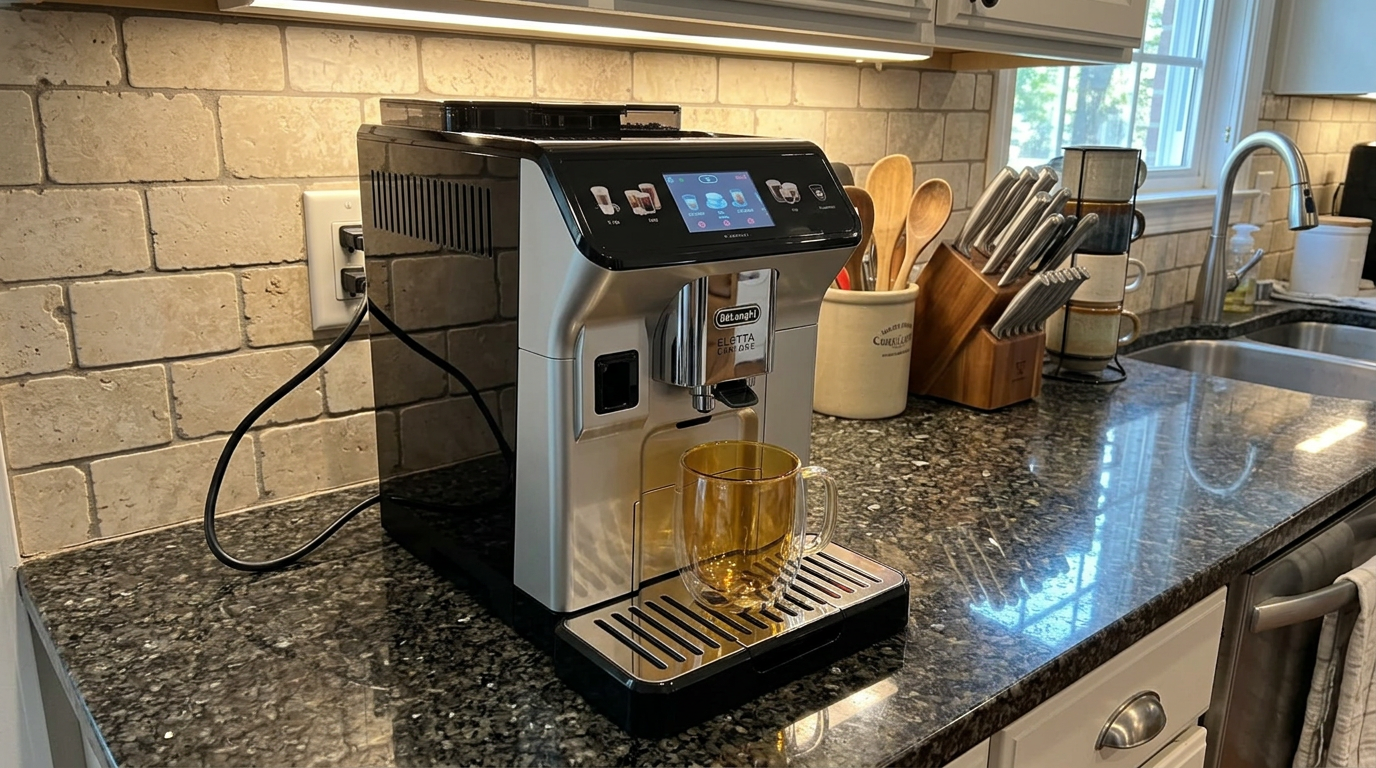
Without the carafe attached, the central spouts handle espresso, americano and coffee crema.
Our tip: Rinse your cup with hot water from the machine first, and your espresso stays warm for noticeably longer.
Specialty coffee drinks I tested
Beyond a straight espresso, the black coffee options are where an automatic machine earns its keep on a busy morning.
The Eletta Explore handles them in different ways, and the differences matter for taste.
Coffee crema
This is a long coffee of about 5 to 6 fluid ounces, brewed at full pressure.
It came out with a deep, lasting crema head, closer to a big espresso than to drip coffee.
With very fresh beans, I had to loosen the grind to around setting 4.0 to keep the pump from choking.
Americano
The americano is done properly here.
The machine pulls a real espresso shot first, then adds clean hot water through the central spouts.
Because the water isn't pushed through the coffee, you avoid the bitter, over-extracted taste that some machines give a long black.
Long (caffè lungo)
The lungo runs two grinding and brewing cycles of about 6.5 seconds each.
The water arrives in short, gentle bursts over a longer time, which spreads the extraction across two pucks instead of over-working one.
Doppio+
The Doppio+ grinds for a full 9 to 10 seconds and packs a dense puck of 15 to 16 grams.
It's the strongest drink on the menu, with the most TDS✕TDS (total dissolved solids)How much coffee material ends up dissolved in your cup. Higher TDS means a stronger, heavier-tasting drink. and caffeine.
If you find milk drinks too mild, building them on a Doppio+ is the fix.
More coffee in the puck means a stronger, heavier cup.
Hot milk foam with the LatteCrema Hot carafe
The two carafes are the heart of this machine, so it's worth being clear about which does what.
On my test unit, the black carafe assembly is set up for hot milk and the white one for cold.
They clip onto the front in seconds, and the machine recognizes which drink menu to offer.
The hot carafe holds about 500 ml, enough for several drinks before refilling.
A selector on top changes how much air goes into the milk.
Turning it left gives denser, flatter milk for a flat white, while turning it right adds air for a tall, thick foam head.
My favorite setting was about 75% of the way toward thick foam.
That produced sweet, fine microfoam✕MicrofoamMilk foam with bubbles so small you can’t see them. It feels silky and blends into the coffee instead of sitting on top like froth. with tiny, even bubbles that blended into the espresso instead of sitting on top like soap suds.
It's noticeably better than the basic suction-tube frothers found on cheaper automatic machines.
Latte macchiato layering
The latte macchiato is the most theatrical drink on the menu, and the machine gets the sequence right.
It pours the foamed milk first, then pauses so the foam and liquid milk can separate in the glass.
The espresso follows through the center, settling between the layers and leaving the classic brown "stain" on top.
Serve it in a tall glass and you'll see the layers clearly.
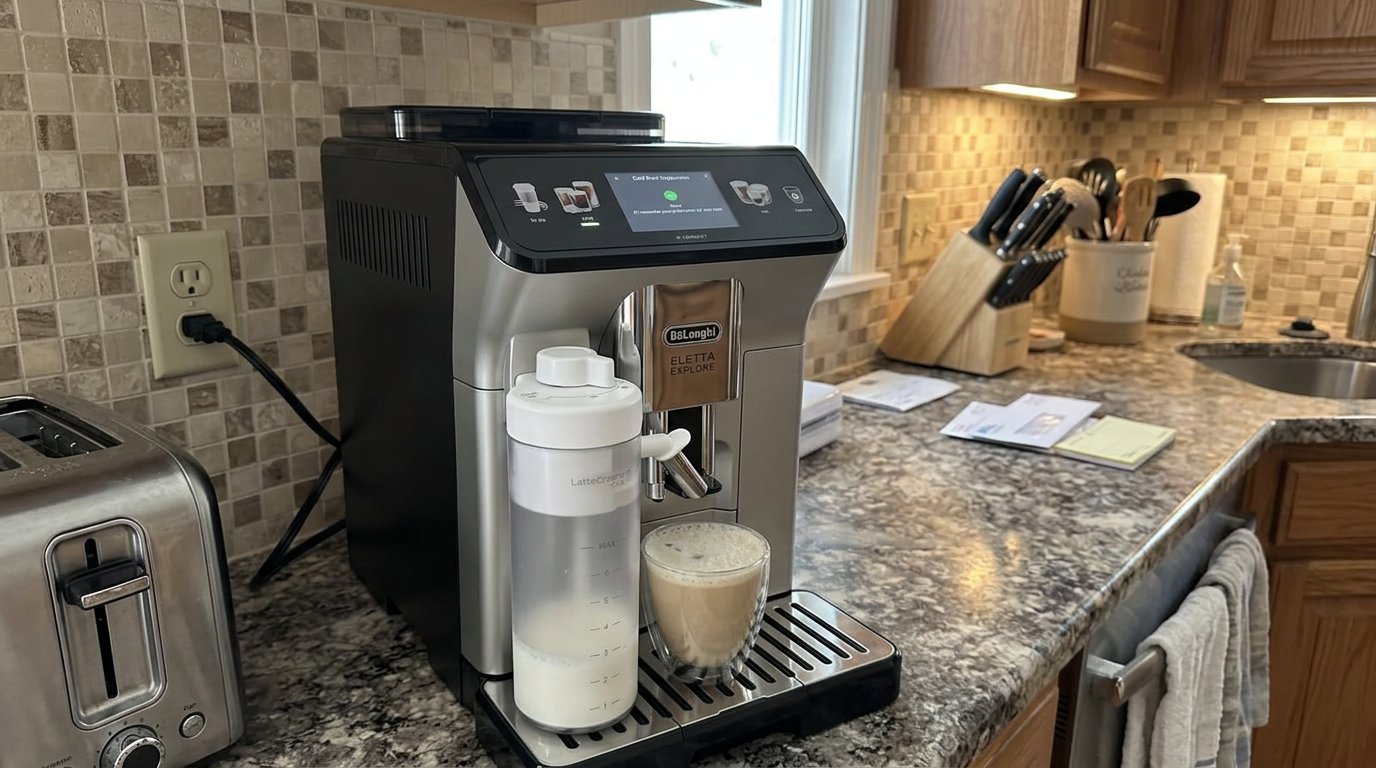
The carafe pours foam straight into the glass, so a latte needs no jug or extra steps.
Milk drinks come out at a pleasant drinking temperature rather than scalding.
That's ideal for sipping straight away, but people who like their latte very hot may want to preheat the glass.
Our tip: Store the filled carafe in the fridge between drinks, since its lid seals and it fits on most fridge shelves.
Cold foam and iced drinks
This is where the Eletta Explore really separates itself from ordinary bean-to-cup machines.
Steam always heats milk, so most machines simply can't make cold foam.
The cold carafe aerates the milk without heating it, creating a foam that's thick enough to float on an iced latte.
It holds about 390 ml, a little less than the hot carafe.
For iced espresso drinks such as a cold cappuccino, the machine brews a normal warm shot directly over ice.
The screen tells you how much ice to add, usually between 4 and 8 standard cubes.
In my glass, that brought the drink down to about 25°C, or 77°F, before most of the ice had melted.
Topped with cold foam, it was a genuinely good iced cappuccino.
Oat and skimmed milk both foamed well cold in my testing, which is good news if you're dairy-free.
| Cold drink | How it is made | Ice to add |
|---|---|---|
| Cold espresso | Warm shot brewed over ice | 4–6 cubes |
| Cold cappuccino | Shot over ice, topped with cold foam | 6–8 cubes |
| Cold flat white | Shot over ice with thinner cold milk | 6–8 cubes |
| Cold brew | Cold extraction, no hot water | Glass filled with ice |
| Cold milk foam | Cold carafe only, no coffee | None |
Follow the on-screen ice prompt for each recipe. Too little ice and the drink ends up lukewarm and diluted.
Our tip: Use large, solid ice cubes, because they chill the coffee fast while melting more slowly than small, cloudy ones.
Cold brew in about three minutes
Traditional cold brew steeps coffee in cold water for 12 hours or more.
The Eletta Explore's cold extraction✕Cold extractionBrewing coffee with cool water instead of hot. It pulls out fewer bitter compounds and less acidity, for a smoother, sweeter drink. mode does something different in a few minutes.
First, the machine purges its thermoblock with water to cool it down.
Then it skips the usual heating and pushes water through the coffee in slow, low-pressure pulses over an extended time.
The water left the spouts at about 37°C, or 98°F, which is roughly half the temperature of a hot espresso.
Poured over ice, my finished cold brew settled at 2 to 3°C, or 35.6 to 37.4°F.
My own readings. Bars are scaled to the hottest output.
Is it identical to an overnight cold brew? Not quite.
It's lighter in body, and it doesn't have the deep, syrupy concentration of a long steep.
What it does have is the smoothness, low bitterness and sweet aromatics that make cold brew so drinkable.
The difference is that you can have it on a whim, instead of planning a day ahead.
Cold brew with a splash of cold foam became my default afternoon drink during testing.
Tea, hot cocoa and hot water
A machine that only makes coffee leaves non-coffee drinkers out of the morning.
The Eletta Explore covers them better than most.
Its tea settings dispense water at specific temperatures for different types of tea.
In black tea mode, the water ran continuously between 93 and 95°C, or 199 to 203°F, which is right for a strong brew.
Hot cocoa is a neat trick.
You put cocoa powder in the bottom of the cup and let the hot carafe dispense steamed milk straight onto it.
My cocoa came out at about 57°C, or 135°F, which is warm enough to enjoy and safe for kids to drink right away.
Give it a quick stir, because the powder settles at the bottom if you don't.
Touchscreen, buttons and user profiles
The 3.5-inch color touchscreen is responsive and easy to read.
Below and beside it are capacitive shortcut buttons for Hot, Cold, To-Go and Favorites.
Those four buttons do most of the navigation for you.
Drinks are grouped logically, so I rarely had to dig through sub-menus for daily drinks.
The machine stores up to four user profiles, each with its own name, color and icon.
Every profile remembers its own coffee volume, strength and foam preference.
In a family where one person drinks a short Doppio+ and another wants a mild, milky latte, that's a real convenience.
Each person taps their icon and gets their drink without adjusting anything.
Our tip: Save your perfected drinks to your profile's Favorites, so your best recipe is always one tap away.
The app and smart features
This is the weakest part of the Eletta Explore experience.
The app uses Wi-Fi to register the machine and Bluetooth to send settings to it.
In practice, connecting was slow, and saving even a simple change took several seconds.
Adjusting my cappuccino strength or coffee volume from the phone felt sluggish compared with tapping the same setting on the machine.
Remote start is the bigger disappointment.
You can switch the machine on over Wi-Fi, but every startup triggers an automatic rinse that pushes hot water out of the spouts.
Unless you left a cup underneath the night before, that water ends up in the drip tray, or worse, splashed on the counter.
That makes truly remote coffee preparation impractical.
Where the app does help
The best part of the app is the bean setup tool.
It asks for your roast level, the Arabica-to-Robusta ratio and your starting grind setting.
After a test shot, you tell it whether the coffee tasted weak and sour or bitter and harsh.
It then suggests grind and temperature changes, which De'Longhi calls Bean Adapt.
For anyone new to dialing in coffee, it's a helpful way to learn what each adjustment does.
The app's recipe library also adds dozens of drinks beyond the 50-plus on the machine.
Cleaning and maintaining the Eletta Explore
Daily care is mostly automatic, but the milk system needs more attention than the marketing suggests.
The machine rinses its coffee path with hot water whenever it turns on or off.
For the milk, you turn the carafe dial to "Clean" after use, and it flushes hot water and steam through the lid and spout.
Here's the part that matters: that cycle does not clean the milk tube inside the carafe or the milk container itself.
Every 2 to 3 days, I took each carafe completely apart, including the spout, stem, dial and intake tube.
Then I washed the parts by hand or put them in the dishwasher.
Skip that, and milk residue sours and builds up inside the parts you can't see.
With two carafes, it's twice the work if you use both regularly.
The brew group
The brewing unit slides out from behind a side door next to the water tank.
Once a week, I rinsed it under warm tap water, without soap, and let it air dry before putting it back.
That removes the coffee oils and fine grounds that build up over time.
The machine asks for descaling✕DescalingRunning a mild acid solution through the machine to dissolve mineral scale left by hard water. Scale slows heating and can block pipes. every 2 to 4 months, depending on the water hardness you set.
| When | Task | Why it matters |
|---|---|---|
| After each milk drink | Run the carafe Clean cycle | Flushes milk from the spout |
| Daily | Empty grounds bin and drip tray | Prevents mold and odors |
| Every 2–3 days | Take apart and wash both carafes | Cleans the hidden milk tube |
| Weekly | Rinse the brew group without soap | Removes coffee oils |
| Every 2–4 months | Descale when prompted | Controls mineral scale |
Our tip: Set a phone reminder for the carafe deep clean, because the machine won't remind you about it.
What daily use is really like
My typical morning started with switching the machine on and putting a cup under the spouts for the rinse.
Then I tapped my profile and chose a drink.
For a cappuccino, the whole process from button to cup took about a minute.
The machine handled the grind, shot and foam, and my only real decision was which carafe to clip on.
| Step | Who does the work | What you control |
|---|---|---|
| Startup rinse | Machine | Placing a cup underneath |
| Grind and dose | Machine | Intensity level and grind setting |
| Brewing | Machine | Coffee volume |
| Milk foam | Machine, via carafe | Foam dial and milk type |
| Cleanup | Mostly machine | Carafe Clean cycle and emptying bins |
Making several drinks in a row
Back-to-back drinks worked smoothly.
The thermoblock recovers quickly, so I could make two cappuccinos and an americano without waiting.
The grounds bin holds about 14 used pucks, and the 1.8-liter tank covers a family's morning before it needs refilling.
Switching between hot and cold drinks takes a little more thought.
You swap carafes, and the cold brew mode needs a short purge to cool the system first.
It's not a problem, but it does mean an iced drink right after a hot one takes a bit longer.
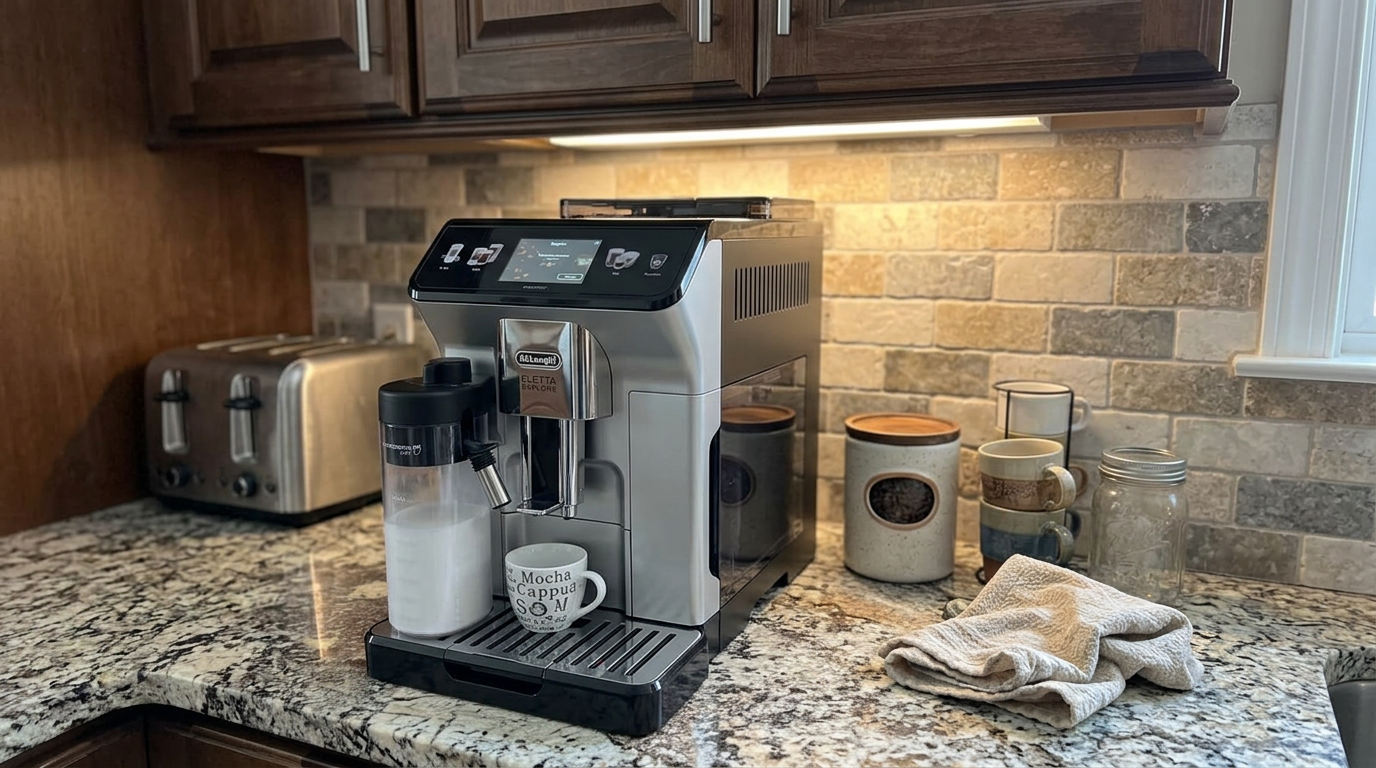
Swapping carafes takes seconds, and each one remembers its own foam setting on the dial.
Beans, water and small upgrades
The Eletta Explore is good enough that your beans make an obvious difference.
Freshly roasted whole beans are the starting point, ideally used within a few weeks of the roast date.
Avoid very oily, dark beans.
Their oils can coat the grinder and hopper, which leads to clogging and stale flavors over time.
A medium or medium-dark roast is the sweet spot for this machine, for both hot espresso and cold brew.
If you prefer lighter roasts, grind finer and choose a higher intensity to avoid sour, thin shots.
There's also a bypass chute for pre-ground coffee, handy for a single decaf in the evening.
Water matters more than most people think
Coffee is mostly water, and the water also decides how fast scale builds up inside.
The included test strip tells you your hardness in under a minute.
Using the compatible water filter makes sense if your tap water is moderately hard or harder.
Avoid distilled water, because coffee needs some minerals to taste full.
What I would actually add
Very little.
A small kitchen scale helps if you want to check your doses, and a tall glass shows off the latte macchiato.
A spare bottle brush makes the carafe deep clean quicker, since the milk tube is narrow.
Common mistakes to avoid
The Eletta Explore is forgiving, but a few habits will hold it back.
| Mistake | What happens | Better habit |
|---|---|---|
| Leaving no cup for the startup rinse | Hot water lands in the tray or on the counter | Keep a cup under the spouts |
| Grinding very fine with a big dose | The pump stalls | Back off to around setting 4 |
| Only running the carafe Clean cycle | Milk builds up in the hidden tube | Fully wash carafes every 2–3 days |
| Skipping the ice prompt | Iced drinks taste warm and watery | Add the ice the screen asks for |
| Using very oily beans | Grinder clogs and coffee tastes stale | Choose medium roasts |
| Ignoring water hardness | Scale builds faster | Set hardness and use the filter |
The first week is mostly about learning your preferred intensity and grind.
Change one setting at a time, taste, and adjust again.
Remember the grinder only shows a difference after two or three drinks, since some old coffee is still in the chute.
What I would change
A faster app is at the top of my list.
I'd also love a remote start that skips the rinse, or a way to catch that water automatically.
And a milk system with fewer small parts would make the deep clean far less of a chore.
Is the De'Longhi Eletta Explore worth the money?
The Eletta Explore is a premium machine, and the cost is a real consideration.
The fair way to judge it is by how much you'll use what it offers.
If you only drink hot espresso, you'll be paying for a cold foam carafe and cold extraction you'll rarely touch.
A simpler automatic machine would serve you just as well.
If your household drinks iced lattes in summer and cappuccinos in winter, the math changes.
Making those drinks at home every day adds up quickly compared with buying them out.
The variety is the value: hot coffee, cold brew, two kinds of milk foam, tea, cocoa and travel-mug drinks from one footprint.
Think about three questions before you buy.
How many cold drinks do you really make? Who else in the house will use it? And are you happy to wash two carafes every few days?
If those answers line up, the Eletta Explore is easy to recommend.
Check the warranty terms where you buy, since coverage and registration offers can vary by retailer.
How it compares with other espresso setups
The most useful comparison isn't with one particular model.
It's with the kinds of machines you're most likely deciding between.
Where the De'Longhi Eletta Explore stands out is cold drinks and drink variety.
| Feature | Eletta Explore | Basic automatic machine | Manual machine and grinder |
|---|---|---|---|
| Grinding and brewing | Fully automatic | Fully automatic | You do it |
| Hot milk foam | Dedicated carafe | Often a simple frother | Steam wand, skill-dependent |
| Cold milk foam | Dedicated carafe | Usually no | No |
| Cold brew-style drinks | Yes, about 3 minutes | Usually no | No |
| User profiles | Up to 4 | Often none | No |
| Espresso control | Moderate | Limited | Full |
| Learning curve | Low | Low | Steep |
A basic automatic machine covers hot espresso and simple milk drinks for less.
A manual machine with a separate grinder gives you more control and clarity in the cup, at the cost of time and skill.
The Eletta Explore sits between them, with more variety than either one.
| Drink category | Examples I made | Carafe used |
|---|---|---|
| Hot espresso | Espresso, Doppio+, lungo, americano, coffee crema | None |
| Hot milk | Cappuccino, flat white, latte macchiato, cortado | Hot |
| Iced milk | Cold cappuccino, cold flat white, cold latte | Cold |
| Cold brew | Cold brew, cold brew latte | None or cold |
| Non-coffee | Tea water, hot cocoa, hot milk, cold milk foam | Hot or cold |
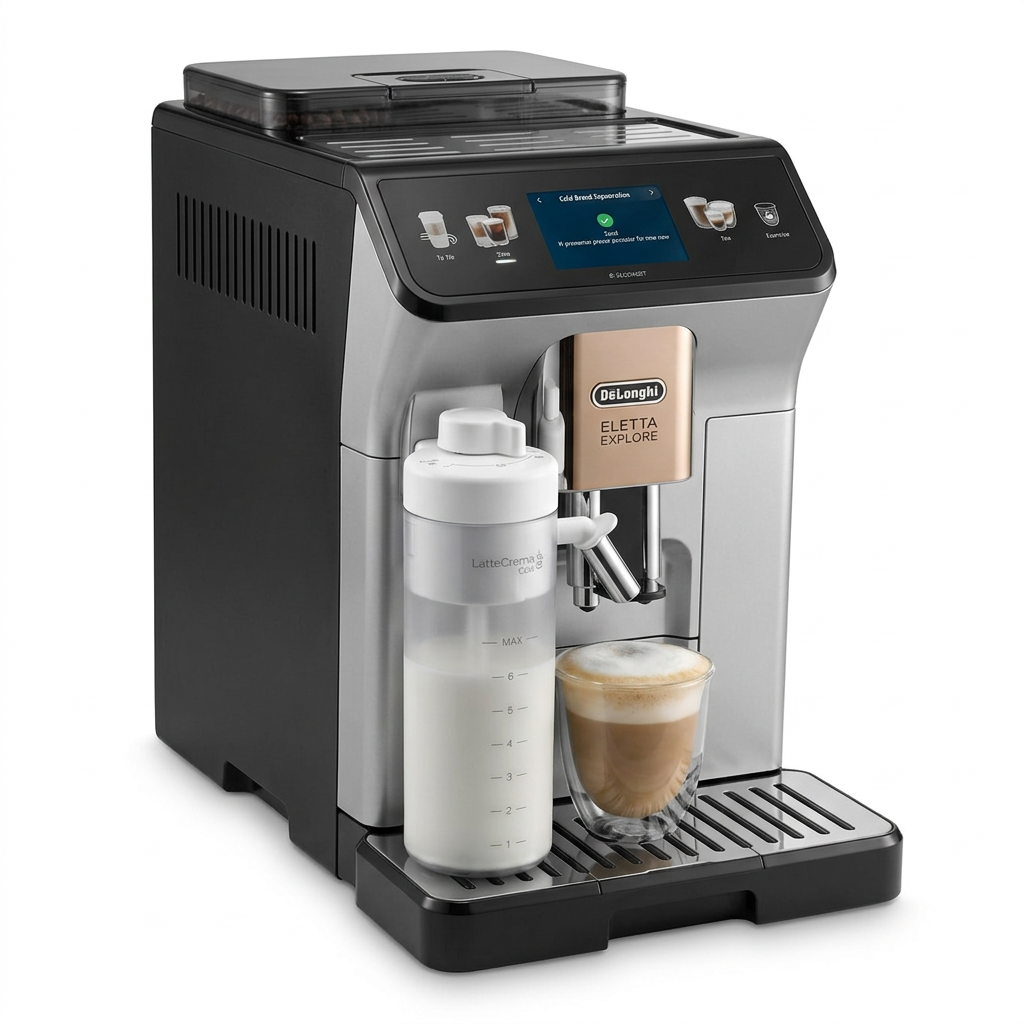
The full package: touchscreen up top, central spouts and the clip-on milk carafe at the front.
Which one is right for you: is the Eletta Explore your match?
4 quick questionsDe'Longhi Eletta Explore specifications
From manufacturer data and my own measurements.
How I tested and scored the Eletta Explore
I used the De'Longhi Eletta Explore as my everyday machine for hot espresso, milk drinks, iced drinks, cold brew, tea and cocoa.
I timed and weighed grinder doses at every intensity level, weighed espresso output and measured drink temperatures with a probe thermometer.
I measured grinder noise with a decibel meter, tested the app's settings and remote start, and followed the full cleaning routine.
I then checked my notes against the manufacturer's specifications.
- Espresso (8.4): body, crema, flavor, dose range and temperature.
- Hot & cold milk (9.1): foam quality, cold foam, iced drinks and cold brew.
- Ease of use (8.4): touchscreen, profiles, drink speed and the app.
- Cleaning (7.6): daily routine, carafe care and brew group access.
The overall score of 8.6 is an editorial rating that reflects those four areas.
De'Longhi Eletta Explore FAQ
Is the De'Longhi Eletta Explore worth it?
Yes, if you regularly drink both hot and iced milk coffee. The two carafes and cold extraction mode are its biggest strengths. If you only drink hot espresso, a simpler machine makes more sense.
Can the Eletta Explore make real cold brew?
It makes a cold brew-style coffee in about three minutes using cool water pulsed through the coffee. In my tests it left the spouts at about 37°C and reached 2 to 3°C over ice. It is smooth and low in bitterness, but lighter in body than a 12-hour steep.
What is the difference between the two milk carafes?
One carafe heats and froths milk for hot drinks such as cappuccinos and lattes. The other aerates milk without heating it, so you can top iced drinks with cold foam.
How loud is the Eletta Explore?
The grinder stayed under 65 decibels in my kitchen, quieter than the 68 to 70 decibels typical for bean-to-cup grinders, with a low, soft pitch.
How much coffee does it use per shot?
In my measurements the dose ranged from about 8 grams at the lowest intensity to 15 to 16 grams on the Doppio+, grinding at roughly 1.5 grams per second.
Does it fit a travel mug?
Yes. With the drip tray adjusted, I had about 7 inches (18 cm) of clearance, and a travel mug is included for the to-go recipes.
Can I start it remotely with the app?
You can power it on over Wi-Fi, but the automatic startup rinse dispenses hot water, so you need a cup under the spouts first. That makes remote coffee preparation impractical.
How often do I need to clean the milk carafes?
Run the Clean cycle after each use, and take each carafe completely apart for a hand or dishwasher wash every 2 to 3 days. The Clean cycle does not reach the internal milk tube.
How often does it need descaling?
The machine prompts you every 2 to 4 months, depending on the water hardness you set during setup.
Can I use plant-based milk?
Yes. Oat and skimmed milk both foamed well in my testing, hot and cold.
- Hands-on testing of the De'Longhi Eletta Explore
- De'Longhi product specifications and owner documentation
- General espresso brewing and maintenance guidance