Coway Airmega Mighty2 review
The Coway Airmega Mighty2 Air Purifier is the successor to one of the best-known air purifiers ever made, and it improves on it in the ways that matter. In three weeks it cleared smoke from my test room quickly, cleaned well at quiet speeds, and its laser sensor reacted almost instantly to cooking and dust. The buttons aren't backlit and there's no app, but it's one of the best traditional purifiers I've tested.

Emily Carter
Hands-on review
Hands-on testing, research, specs
3 weeks
25 minutes
Jargon helpNew to air purifiers? Tap any dotted term to see what it means.
In this review
Yes, if you want a reliable, mid-size purifier that cleans fast and stays quiet. The Coway Airmega Mighty2 cleared smoke from my test room in 23 minutes on its top speed and in 38 minutes at a quiet 42.6 decibels. Its laser sensor reacts quickly, the pre-filter slides out for easy cleaning, and the ionizer is gone. The controls aren't backlit, there's no app, and my first unit rattled at low speeds. The replacement was silent, and I'd happily keep it running all year.
Coway Airmega Mighty2 at a glance
Coway Airmega Mighty2 pros and cons
- Cleans quickly, even at quiet speeds
- Fast laser sensor and no ionizer
- Slide-out pre-filter is easy to clean
- Buttons aren't backlit
- No app support
- Whole filter is replaced at once
Who should buy the Coway Airmega Mighty2?
- Living rooms and bedrooms up to mid-size
- Pet owners who want easy pre-filter cleaning
- Anyone who wants to avoid an ionizer
- Smart-home fans who want an app
- Very large open-plan spaces
- People who adjust settings in the dark
First impressions of the Coway Airmega Mighty2
The original Coway Mighty was on the market for over ten years and became one of the most recommended air purifiers around.
So I had high expectations when the Coway Airmega Mighty2 arrived.
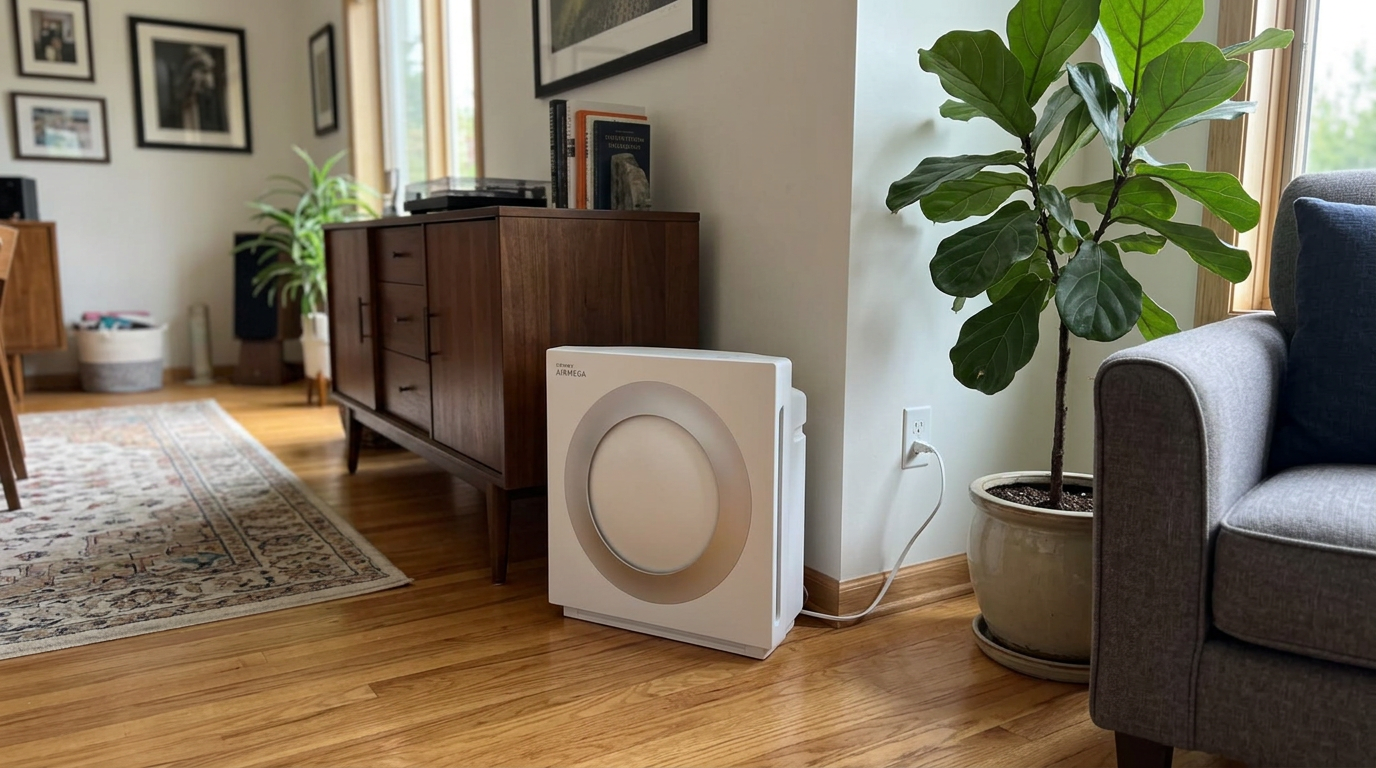
Out of the box, it looks more modern than its predecessor, with a square white body and a large round silver panel on the front.
It has a slightly retro feel that I really liked, and it blended into my living room far better than most purifiers.
There's a deep handle at the back, so moving it between rooms was easy.
Setup took a couple of minutes: remove the plastic wrap from the filter, put it back, plug in and switch on.
The first thing I noticed when it started was the air quality ring on top, which glowed blue once it had sampled the room.
Within a minute of switching to Auto, it had settled on a low, quiet fan speed, which told me the sensor was doing its job.
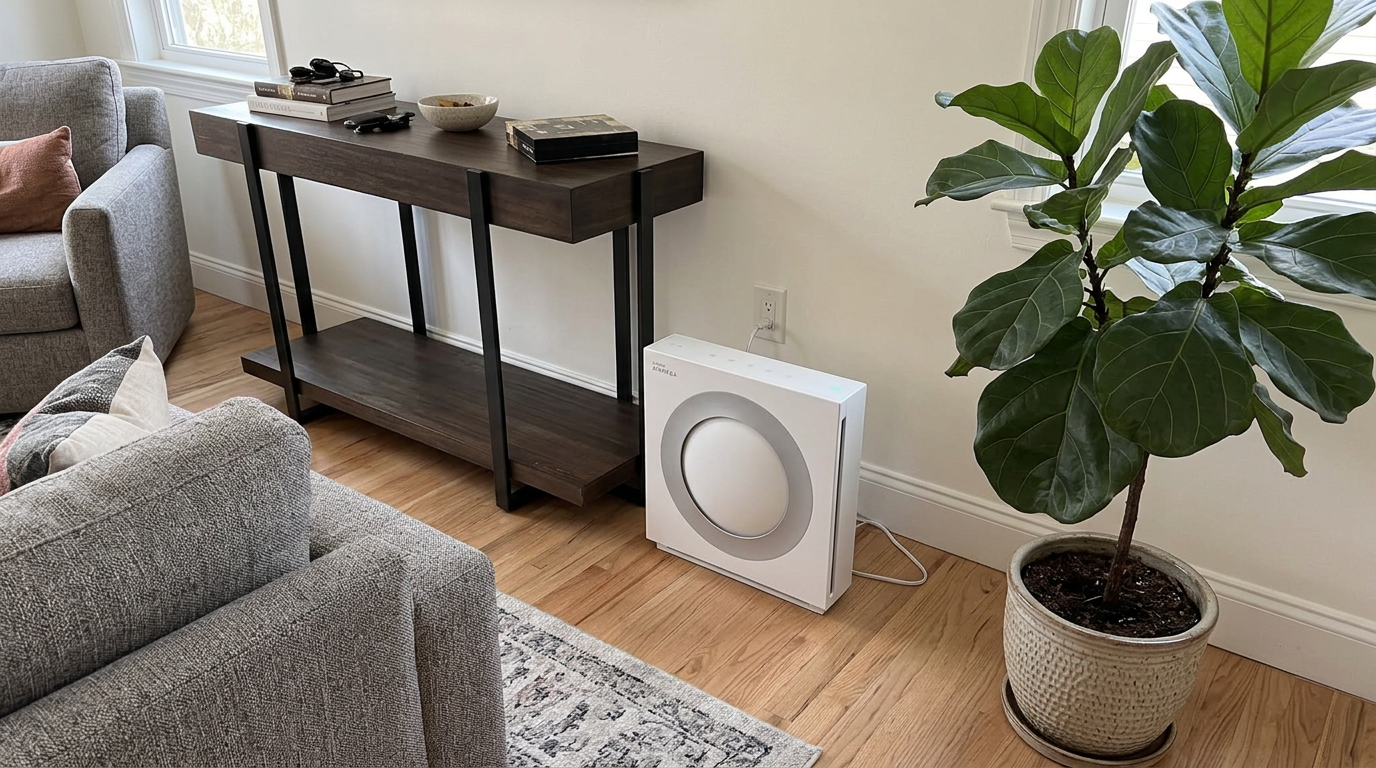
A retro-modern design that looks good in a living room.
What the Coway Airmega Mighty2 actually is
This is Coway's AP-1512N, released in March 2026 as the replacement for the original Mighty.
It's a mid-size purifier with a fan that pulls air through a pre-filter and a bonded main filter that combines particle and odor filtration.
The key number for any purifier is its CADR✕CADRClean Air Delivery Rate: how many cubic feet of cleaned air a purifier delivers per minute. Higher means it cleans a room faster., and Coway rates it at 240 CFM for smoke.
Coway says that's enough for about 375 square feet at 4.8 air changes per hour, or about 1,800 square feet at one change per hour.
What's new compared with the original
| Area | Mighty2 change | Why it matters |
|---|---|---|
| Ionizer | Removed | No ozone concerns |
| Sensor | Laser particle sensor | Faster, more accurate reactions |
| Pre-filter | Slides out from the side | Cleaner, easier maintenance |
| Main filter | Larger, bonded, pelleted carbon | Better odor removal |
| Quiet cleaning | Three speeds under 45 dB | Better for bedrooms |
| Design | Retro-modern look | Fits more rooms |
Our tip: Take the plastic bag off the main filter before the first run, because the purifier won't clean properly with it still wrapped.
Design, controls and daily usability
The Mighty2 is compact for its power, and it fit neatly beside a sofa, next to a bookshelf and at the foot of a bed.
It pulls air in from the sides and pushes clean air out of the top, so I kept a few inches of space on each side.
The controls
The buttons sit on top: power, fan speed, mode, timer and an info button for the air quality display.
They're simple and responsive, but they aren't backlit.
At night, I had to feel for the right button or turn on a lamp, which is my biggest everyday annoyance.
Air quality indicator
A ring of light on top changes color with air quality, and a small display can switch between PM1, PM2.5 and PM10 readings.
I found myself checking it after cooking or vacuuming, just to watch it react.
Our tip: Put a small dot of glow-in-the-dark tape next to the power button if you'll use the purifier in a bedroom, so you can find it without a lamp.
The laser sensor and Auto mode
The Mighty2 uses a laser particle sensor✕Laser particle sensorA sensor that shines a laser through sampled air and counts the particles by the light they scatter. It reacts faster and more accurately than older infrared optical sensors. instead of the slower optical sensor on most older Coway models.
In practice, the difference was obvious.
When I seared steak in the kitchen, the ring turned orange within seconds and Auto mode ramped up the fan straight away.
Once the air cleared, it dropped back down on its own.
It also doesn't need routine sensor cleaning, which older optical sensors often do.
What PM1, PM2.5 and PM10 mean
These are size groups of particles in micrometers.
PM2.5✕PM2.5Fine particles 2.5 micrometers or smaller, such as smoke and some pollution. They can travel deep into the lungs. covers fine particles like smoke, PM1 the very smallest, and PM10 larger dust and pollen.
| Reading | Particle size | Typical sources |
|---|---|---|
| PM1 | 1 micrometer or smaller | Smoke, cooking fumes |
| PM2.5 | 2.5 micrometers or smaller | Smoke, fine dust |
| PM10 | 10 micrometers or smaller | Dust, pollen, pet dander |
Adjusting sensitivity
Holding the mode and info buttons together for more than three seconds changes the sensor sensitivity.
I left it on the default setting, which reacted well without being twitchy.
Our tip: Raise the sensor sensitivity if you have allergies or pets, so Auto mode reacts to smaller changes in dust and dander.
Top-speed cleaning: how fast it cleared smoke
To test raw cleaning power, I filled a 728 cubic foot room with incense smoke and ran the purifier on its highest speed.
I tracked PM1 particles with an air quality monitor and timed how long it took to get back to zero.
The Coway Airmega Mighty2 cleared the room in 23 minutes.
That was faster than the original Mighty, and faster than some larger purifiers I've tested.
Based on that result, I estimate its real-world PM1 CADR at around 260 CFM, slightly above the official smoke rating.
That's enough to turn over the air about five times an hour in a room of roughly 390 square feet.
For a mid-size purifier, that's a genuinely strong result.
It means the Coway Airmega Mighty2 can handle a typical living room or large bedroom properly, not just freshen it.
PM1 back to zero in a 728 cu ft room. Shorter bars are better.
Noise at every fan speed
An air purifier on full power can sound like a vacuum cleaner, so noise matters as much as cleaning speed.
I measured sound levels from 3 feet away at each fan setting.
At Turbo, the Mighty2 reached 56.9 decibels✕Decibels (dB)A measure of loudness. A quiet library is around 40 dB and normal conversation around 60 dB. Every 10 dB sounds roughly twice as loud., which is quieter than I expected for a Coway of this size.
It's audible, but it's a steady whoosh rather than a whine.
| Setting | Measured at 3 ft | How it felt |
|---|---|---|
| Sleep | Below 45 dB | Barely there |
| Speed 1 | Below 45 dB | Soft background hum |
| Speed 2 | 42.6 dB | Quiet enough to read |
| Speed 3 | 49.3 dB | Noticeable, fine by day |
| Turbo | 56.9 dB | Steady whoosh |
My sound measurements from 3 feet away.
Our tip: Place the purifier a few feet from your bed or sofa rather than right next to it, because noise drops noticeably with every extra foot of distance.
Quiet cleaning under 45 decibels
I use 45 decibels as my line for a purifier you can live with all day, or sleep next to.
The Mighty2 has three settings below that line, which is a real step forward for Coway.
To test how well it cleans quietly, I repeated the smoke test on speed 2, at 42.6 decibels.
It cleared the room in 38 minutes.
That beat every other traditional purifier I've tested at a similar noise level, by about eight minutes.
Older mid-size Coway models often struggled at quiet speeds, so this was the result that impressed me most.
In daily life, that's what really counts.
Most people won't run a purifier on Turbo all day, because it's too loud to live with.
A purifier that still cleans well at a whisper-level setting does far more good over a whole day than one that's only strong when it's noisy.
Time to clear my test room at a quiet fan speed. Shorter is better.
The rattle on my first unit
There was one real problem during testing, and I want to be upfront about it.
After the performance tests, I moved my first unit to the bedroom for overnight use.
On the first night, a persistent rattling started on Sleep mode and continued on speeds 1 and 2.
Speed 3 stopped the rattle, but at 49.3 decibels it was too loud to sleep with, so I stopped the bedroom test after two nights.
Coway told me the rattle wasn't a known issue, and I suspect the unit was damaged in shipping.
To check, I tested a second Mighty2.
It had no rattle at all, on any setting, and it ran silently in the bedroom for the rest of the test.
| Setting | First unit | Second unit |
|---|---|---|
| Sleep | Rattle | Silent |
| Speed 1 | Rattle | Silent |
| Speed 2 | Rattle | Silent |
| Speed 3 | No rattle, but too loud for sleep | Normal |
The filter: bonded, bigger and carbon-rich
The original Mighty used separate filter layers.
The Mighty2 uses a single bonded filter that combines particle filtration and odor removal.
It's noticeably larger and thicker than filters in other mid-size purifiers, and it uses pelleted activated carbon✕Activated carbonCarbon treated to have a huge surface area full of tiny pores. It traps odors and gases such as cooking smells and VOCs that particle filters can't catch. rather than a thin carbon-coated fabric.
In my kitchen, that showed: frying smells and the dog's wet-coat smell faded faster than I'm used to.
The trade-off of a bonded filter
With a bonded filter, you replace the whole thing at once.
The carbon usually runs out before the particle filter does, so you may replace some particle capacity early.
The upside is a tight seal, which helps air go through the filter rather than around it.
A note on the HEPA claim
Coway's marketing lists HEPA✕HEPAHigh-Efficiency Particulate Air. A filter standard that captures at least 99.97% of particles 0.3 micrometers in size in standard tests.-grade particle performance specifically on Sleep mode.
At higher speeds, more air passes through faster, so a little more slips through on each pass.
That's a sensible design choice: higher airflow means the whole room is cleaned more times per hour, which matters more than perfect single-pass capture.
Our tip: Write the install date on the edge of the new filter with a marker, so you always know how old it is when the indicator light comes on.
The slide-out pre-filter
This is one of my favorite changes.
The pre-filter slides straight out of the right side of the body, without opening the front cover.
That means less dust and pet hair puffs back into the room while you clean it.
Coway recommends cleaning it every two to four weeks, and more often in homes with pets.
With my dog shedding, I vacuumed it every two weeks, and it took less than a minute each time.
| Home | Clean the pre-filter | How |
|---|---|---|
| No pets | Every 3–4 weeks | Vacuum with a brush tool |
| One pet | Every 2 weeks | Vacuum, rinse if greasy |
| Several pets | Weekly | Vacuum, rinse and dry fully |
Our tip: If you rinse the pre-filter, let it dry completely before sliding it back in, because a damp pre-filter traps dust and can smell musty.
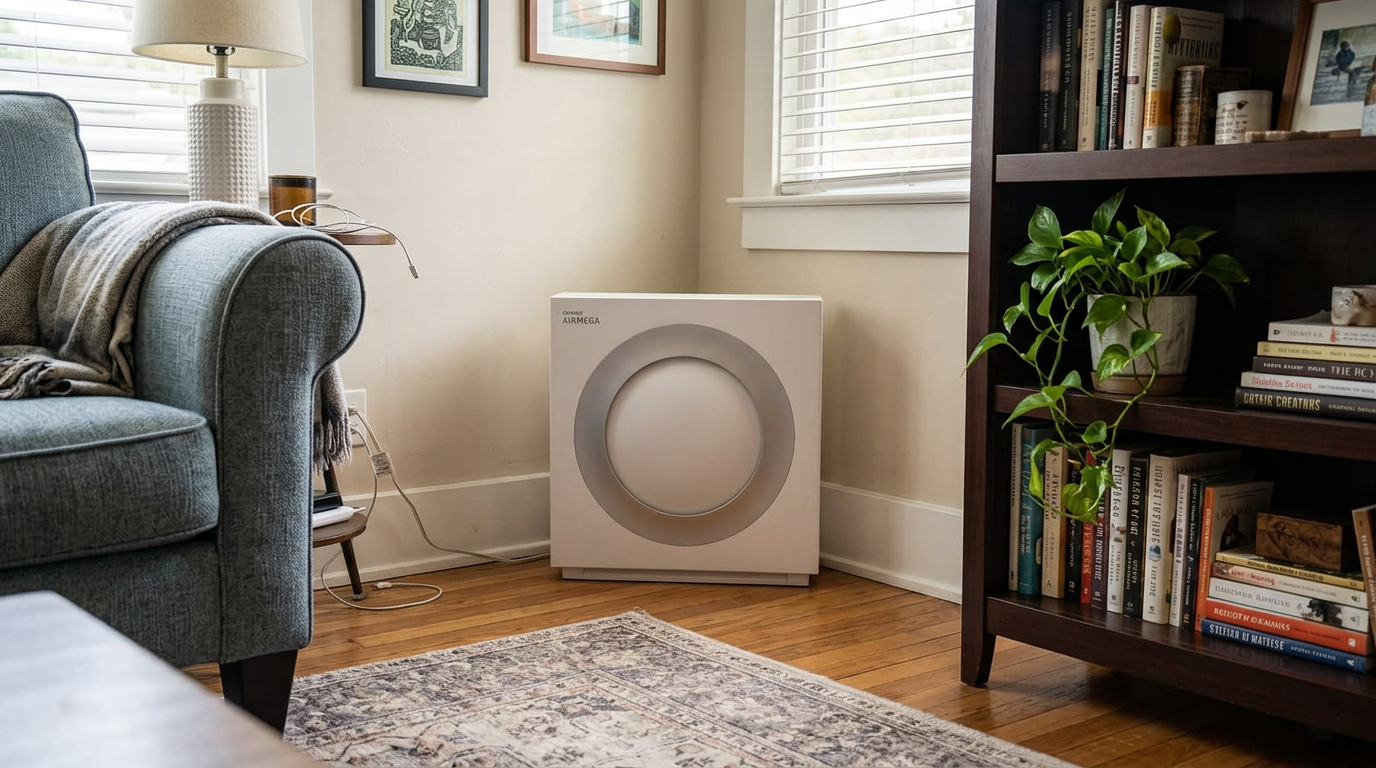
The pre-filter slides out from the side for quick cleaning.
Replacing the main filter
Changing the main filter is simple, and it took me about two minutes on a trial run.
You pull off the front cover, lift out the old filter, unwrap the new one and slot it in, with the arrows pointing the right way.
Then you hold the filter reset button until the indicator light turns off.
Coway suggests a new filter about every 12 months, but in a home with heavy cooking, pets or smoke, the carbon may wear out sooner.
If smells start lingering longer than they used to, that's usually the first sign the carbon is full, even before the indicator light comes on.
I'd keep a spare filter in the cupboard, so you're never running the purifier with a worn-out one while you wait for a delivery.
Our tip: Change the filter outdoors or over a bin bag, and seal the old one in the bag straight away, so the dust it has trapped doesn't escape back into the room.
Energy use
I measured power draw with a plug-in power meter at every setting.
At its highest speed, the Mighty2 drew 49.12 watts.
Running flat out, 24 hours a day for a year, that works out to about 430 kilowatt-hours.
In real life, mine spent most of its time in Auto at lower speeds, so it used far less.
Its efficiency sits around the middle of the mid-size purifiers I've tested, and it's clearly more efficient than older Coway models.
In standby, it drew very little, so leaving it plugged in and switched off overnight in the living room made almost no difference.
Estimated yearly energy use from my power meter readings.
Our tip: Leave the purifier in Auto rather than on a fixed high speed, because it spends most of the day at low power and only ramps up when the air needs it.
No app, but a smart plug helps
The Mighty2 doesn't have Wi-Fi or an app.
For most people that's fine, because Auto mode handles the day-to-day.
If you want schedules, I had good results with a basic smart plug.
The purifier remembers its last setting, so when the plug switches on, it starts in Auto again.
I used that to switch it on an hour before bedtime and off when I left for work.
A smart plug also lets you switch it on remotely before you get home, so the house is fresh when you walk in.
It's not as polished as a built-in app with air quality graphs, but it covers the basics for very little effort.
Room size and air changes per hour
Room coverage claims can be confusing, so it helps to understand air changes per hour✕Air changes per hour (ACH)How many times a purifier can filter the full volume of air in a room each hour. Four to five is a common target for allergies and smoke..
One air change means the purifier has filtered the room's full volume of air once.
Coway's 1,800 square foot figure is based on just one change per hour, which is fine for light freshening but too slow for allergies or smoke.
For those, four to five changes per hour is a much better target, and that brings the realistic room size down to about 375 to 390 square feet.
| Goal | Air changes per hour | Realistic room size |
|---|---|---|
| Light freshening | 1 | Up to about 1,800 sq ft |
| General use | 2–3 | About 600–900 sq ft |
| Allergies, pets, smoke | 4–5 | About 375–390 sq ft |
Based on Coway's ratings and my own estimate, with 8-foot ceilings.
Our tip: Choose a purifier by the 4 to 5 air changes figure for your room, not the biggest number on the box, if you're buying it for allergies or smoke.
Odors, cooking smells and VOCs
Particles are only half the story.
Smells from cooking, pets and cleaning products come from gases and VOCs✕VOCsVolatile organic compounds: gases released by things like cooking, paint, cleaning sprays and new furniture. Activated carbon can absorb many of them., which a particle filter can't catch.
That's where the thick, pelleted carbon in the Mighty2's filter helps.
After frying fish, the smell in my living room faded within about an hour with the purifier on speed 3, compared with most of an evening without it.
Wet-dog smell after walks cleared noticeably faster too.
The sensor doesn't measure gases, though, so Auto mode reacts to cooking smoke rather than the smell itself.
For strong odors, I manually turned up the fan for a while.
My own impressions in a living room next to an open kitchen.
Our tip: Turn the fan up manually after cooking strong-smelling food, because the particle sensor doesn't detect odors and Auto mode may settle down before the smell has gone.
Pets, dust and allergy season
With a medium-sized dog in the house, I paid close attention to pet hair and dander.
The pre-filter caught a visible layer of fur every couple of weeks, which kept it away from the main filter and helped airflow stay strong.
The sensor reacted quickly when the dog shook off after a walk, ramping up the fan within seconds.
Dust on my shelves and TV stand built up more slowly than usual during the test.
I don't have seasonal allergies myself, but my partner does, and said the bedroom felt easier to breathe in with the purifier running overnight.
| Situation | What I did | Result |
|---|---|---|
| Dog after a walk | Left it in Auto | Ramped up within seconds |
| Vacuuming | Auto mode | Caught the dust that was stirred up |
| Bedtime | Sleep mode | Quiet, display dimmed |
| High pollen days | Speed 2, windows closed | Fresher bedroom |
Our tip: Run the purifier on a higher speed for about half an hour after vacuuming or brushing a pet, because that's when the most dust and dander is floating in the air.
Using it in the bedroom at night
The replacement unit spent most of the test in my bedroom.
On Sleep mode, the fan dropped to a soft hum and the lights dimmed, so it didn't keep me awake.
Speed 2 was also quiet enough to sleep with once I'd got used to it, and it cleaned much faster than Sleep mode.
The one frustration was the unlit buttons: if I wanted to change settings in the dark, I had to switch on a bedside lamp.
My routine became simple: switch it to speed 2 an hour before bed to clean the room, then drop to Sleep mode when the lights went out.
Our tip: Clean the bedroom air on a higher speed for an hour before bedtime, then switch to Sleep mode, so the room is already clean when you lie down.
All my test results in one place
| Test | Result | My rating |
|---|---|---|
| Smoke clearing, Turbo | 23 min in 728 cu ft | 9.2 |
| Smoke clearing, quiet speed | 38 min at 42.6 dB | 9.3 |
| Noise at Turbo | 56.9 dB | 8.4 |
| Sensor response | Seconds after cooking | 9.3 |
| Power at Turbo | 49.12 W | 8 |
| Pre-filter cleaning | Under 1 min | 9 |
Where to put it
Placement makes a big difference to how well any purifier works.
The Mighty2 takes air in from the sides and pushes it out through the top, so it needs breathing room around it.
I got the best results with it out in the room, not tucked into a corner or behind furniture.
Our tip: Close the door of the room you're cleaning, because an open door makes the purifier try to clean the whole house and the room takes much longer to clear.
What daily use is really like
For three weeks, the Mighty2 ran in my living room by day and the replacement unit in my bedroom at night.
Most of the time it sat in Auto, and I hardly noticed it.
It ramped up during cooking, when I vacuumed and when the dog came in from the garden, then quietly settled back down.
The living room felt fresher, dust on the shelves built up more slowly, and cooking smells cleared faster.
Share of running time from my testing notes.
Three weeks with the Mighty2, week by week
Week 1: performance testing
The smoke tests and noise measurements showed straight away that this is a strong performer.
The first unit's rattle appeared when I moved it to the bedroom.
Week 2: the replacement unit
The second Mighty2 ran silently on Sleep mode, and I slept well next to it.
Week 3: everyday living
Auto mode, pet hair and cooking smells: it simply got on with the job.
From my testing notes.
Common mistakes to avoid
| Mistake | What happens | Better habit |
|---|---|---|
| Leaving the filter wrapped | Almost no cleaning | Remove the plastic first |
| Pushing it into a corner | Weak airflow | Space on all sides |
| Ignoring the pre-filter | Lower airflow, more noise | Vacuum every 2–4 weeks |
| Running with doors open | Room takes longer to clear | Close the door |
| Only testing on high | Missing low-speed noises | Try Sleep mode early |
| Fixed high speed all day | More energy, more noise | Use Auto mode |
What I would change
Backlit buttons would make night-time use much easier.
An optional app would suit smart-home users.
And a separate carbon layer would let you replace only the part that's worn out.
Three households, three verdicts
The family with a dog
Pet hair, muddy paws and cooking smells in a shared living space.
The fast sensor, carbon filter and slide-out pre-filter make this an excellent fit.
The light sleeper
A bedroom purifier that cleans well at quiet speeds.
A very good fit, as long as you test it on Sleep mode early and don't mind unlit buttons.
The smart-home fan
Wants schedules, remote control and air quality graphs on a phone.
It works with a smart plug, but an app-connected purifier will suit you better.
| Household | Fit | Main reason |
|---|---|---|
| Pet owners | Excellent | Easy pre-filter, carbon for odors |
| Light sleepers | Very good | Strong quiet-speed cleaning |
| Allergy sufferers | Very good | Fast sensor, strong CADR |
| Smart-home fans | Fair | No app |
Is the Coway Airmega Mighty2 worth the money?
It costs more upfront than many mid-size purifiers, and its yearly running costs sit at the higher end too.
In return, you get faster cleaning, especially at quiet speeds, than any other traditional purifier I've tested in this class.
You also get a three-year warranty, and a brand with a track record: many original Mighty owners report their units lasting ten years or more.
If you want the quietest possible cleaning above all else, or the lowest running costs, there are cheaper options.
Three questions to ask:
Will you run it in a bedroom or living room where quiet matters?
Do you want strong odor removal from a thick carbon filter?
And are you happy without an app?
How it compares with other types of purifier
| Feature | Coway Airmega Mighty2 | Typical mid-size purifier | PC-fan purifier |
|---|---|---|---|
| Top-speed cleaning | Very fast | Average | Fastest |
| Quiet-speed cleaning | Excellent for its type | Average | Excellent |
| Ionizer | None | Often included | Usually none |
| Sensor | Laser | Often optical | Varies |
| App | No | Sometimes | Rarely |
| Looks | Retro-modern | Plain | Boxy, DIY look |
Purifiers built around computer-style fans are still quieter and more powerful for their size, but they tend to look like a box of filters.
The Mighty2 is one of the strongest traditional purifiers you can buy, with a much nicer design.
| Your priority | Is the Mighty2 a fit? | Why |
|---|---|---|
| Fast, quiet cleaning | Excellent | 38 min at 42.6 dB |
| Pets and odors | Excellent | Pelleted carbon, easy pre-filter |
| No ionizer | Excellent | Removed entirely |
| Lowest running costs | Fair | Mid-range power and filters |
| App control | Poor | Smart plug only |
Which one is right for you: is the Coway Airmega Mighty2 your match?
4 quick questionsCoway Airmega Mighty2 specifications
From manufacturer data, retailer listings and my own testing.
How I tested and scored the Coway Airmega Mighty2
I tested two Mighty2 units over three weeks: one for performance testing, and a replacement after the first rattled at low speeds.
I measured smoke clearing in a 728 cubic foot room at top speed and at a quiet speed, tracking PM1 with an air quality monitor.
I measured noise from 3 feet at every setting and power draw with a plug-in meter.
The purifiers then ran in my living room and bedroom, with a dog in the house, while I cleaned the pre-filter and watched the sensor react to everyday life.
Finally, I checked my notes against Coway's specifications and user manual.
- Air cleaning (9.0): smoke clearing speed and real-world CADR.
- Quiet performance (8.8): noise levels and cleaning below 45 dB.
- Ease of use (8.2): controls, sensor, Auto mode and placement.
- Upkeep (8.0): pre-filter cleaning, filter replacement and energy use.
The overall score of 8.6 is an editorial rating that reflects those four areas.
Coway Airmega Mighty2 FAQ
Is the Coway Airmega Mighty2 worth it?
Yes, if you want fast, quiet cleaning in a small to medium room without an ionizer. Skip it if you need app control.
How big a room does it cover?
Coway rates it for about 375 square feet at 4.8 air changes per hour, or about 1,800 square feet at one change per hour.
How fast does it clean?
It cleared smoke from my 728 cubic foot test room in 23 minutes on Turbo and 38 minutes on a quiet speed.
How loud is it?
I measured 42.6 dB on speed 2 and 56.9 dB on Turbo, from 3 feet away.
Does it have an ionizer?
No. Coway removed the ionizer, so it filters purely mechanically.
Does it have an app?
No, but it works with a smart plug for simple schedules.
How often do I replace the filter?
About every 12 months. A light tells you when it's time.
How do I clean the pre-filter?
Slide it out from the side and vacuum it every two to four weeks, more often with pets.
What sensor does it use?
A laser particle sensor that shows PM1, PM2.5 and PM10 and reacts within seconds.
How much power does it use?
I measured 49.12 W at top speed, and much less in Auto mode.
Are the buttons backlit?
No, which makes them harder to use in the dark.
Is it good for pets?
Yes. The carbon filter helps with odors, and the slide-out pre-filter makes pet hair easy to clean.
Senior home appliance tester
Emily has tested home appliances for a living since 2016, first as a test coordinator at a national consumer advocacy group and, since 2021, at HouseholdMe. She has a degree in industrial design from Ohio State, so she looks at how a product is built, not just how it performs. She tested two Coway Airmega Mighty2 units in her living room and bedroom over three weeks for this review.
- Three weeks of hands-on testing of two Coway Airmega Mighty2 AP-1512N units
- Airmega Mighty2 product information, Coway
- Coway Airmega Mighty2 user manual