COMFEE Portable Countertop Dishwasher CDC17P0ABB review
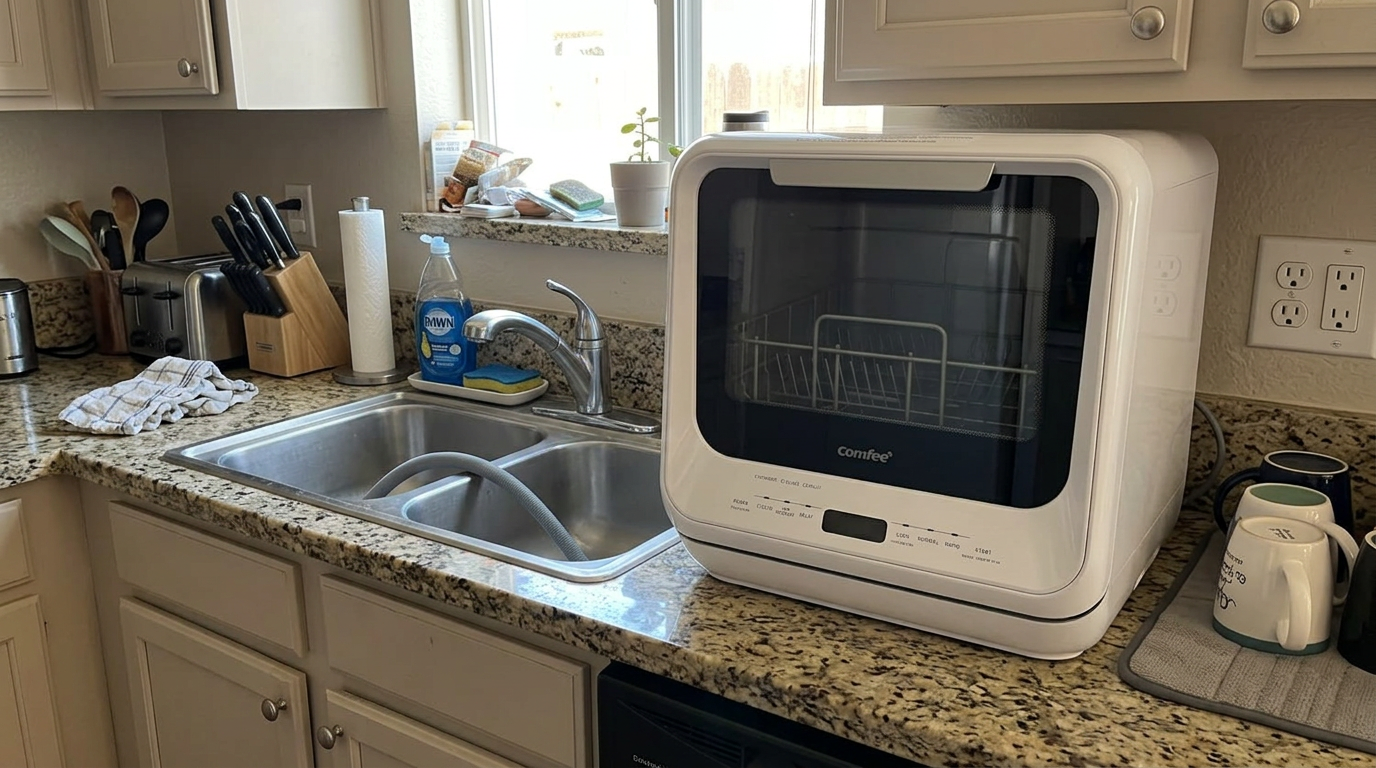
The COMFEE Portable Countertop Dishwasher 1.32 Gal CDC17P0ABB is a compact mini dishwasher with a 1.32-gallon built-in water tank, so it runs without any plumbing. You fill it through a cap on top, a light and a beep tell you when it's full, and you choose from Normal, Rapid, Hygiene, Fruit and Glass, with an Air Refresh mode to dry and freshen. I used it every day for three weeks on a small apartment counter. It cleaned everyday dishes well, the 40-minute Rapid cycle was perfect after dinner, and it's one of the smallest machines I've tested. The trade-off is capacity: plates top out at about 9.5 inches, and big cookware stays in the sink.

Emily Carter
Hands-on review
Hands-on testing, research, specs
3 weeks
26 minutes
Jargon helpNew to mini dishwashers? Tap any dotted term to see what it means.
In this review
Yes, for one or two people with a small counter and no dishwasher. The COMFEE CDC17P0ABB fills from a 1.32-gallon tank through a cap on top, needs only the drain hose to run, and its 40-minute Rapid cycle and 162°F Hygiene cycle cleaned my everyday dishes well. Air Refresh kept the tub dry and fresh, and the remaining-time display made it easy to plan around. It's compact enough to fit where bigger countertop models won't, but plates over about 9.5 inches and most pots won't go in.
COMFEE CDC17P0ABB at a glance
COMFEE CDC17P0ABB pros and cons
- Runs from its own tank with just a drain hose
- Compact enough for the smallest counters
- Quick 40-minute Rapid cycle and 162°F Hygiene
- Plates over about 9.5 inches don't fit
- Small load for more than two people
- Filling cap is fiddly and can splash
Who should buy the COMFEE CDC17P0ABB?
- One or two people
- Renters, dorms and RVs
- Very small kitchens
- Families of three or more
- Homes with large dinner plates
- Cooks who use lots of pots and pans
Unboxing the COMFEE CDC17P0ABB
It arrived in a cardboard box with foam inserts, and the manual sat right on top.
Lifting it out was easy; at about 37 pounds, I managed it on my own.
I peeled off the protective plastic bag and set it on the counter next to the sink.
In the box were a drain hose, a quick-connect inlet hose with an adapter, a water pitcher, a plastic filling guide for the tank opening, a fruit basket, a tableware basket and a small sample of detergent.
The control panel's printed labels are clear and easy to read.
It's a neat, simple machine that looks at home in a small kitchen.
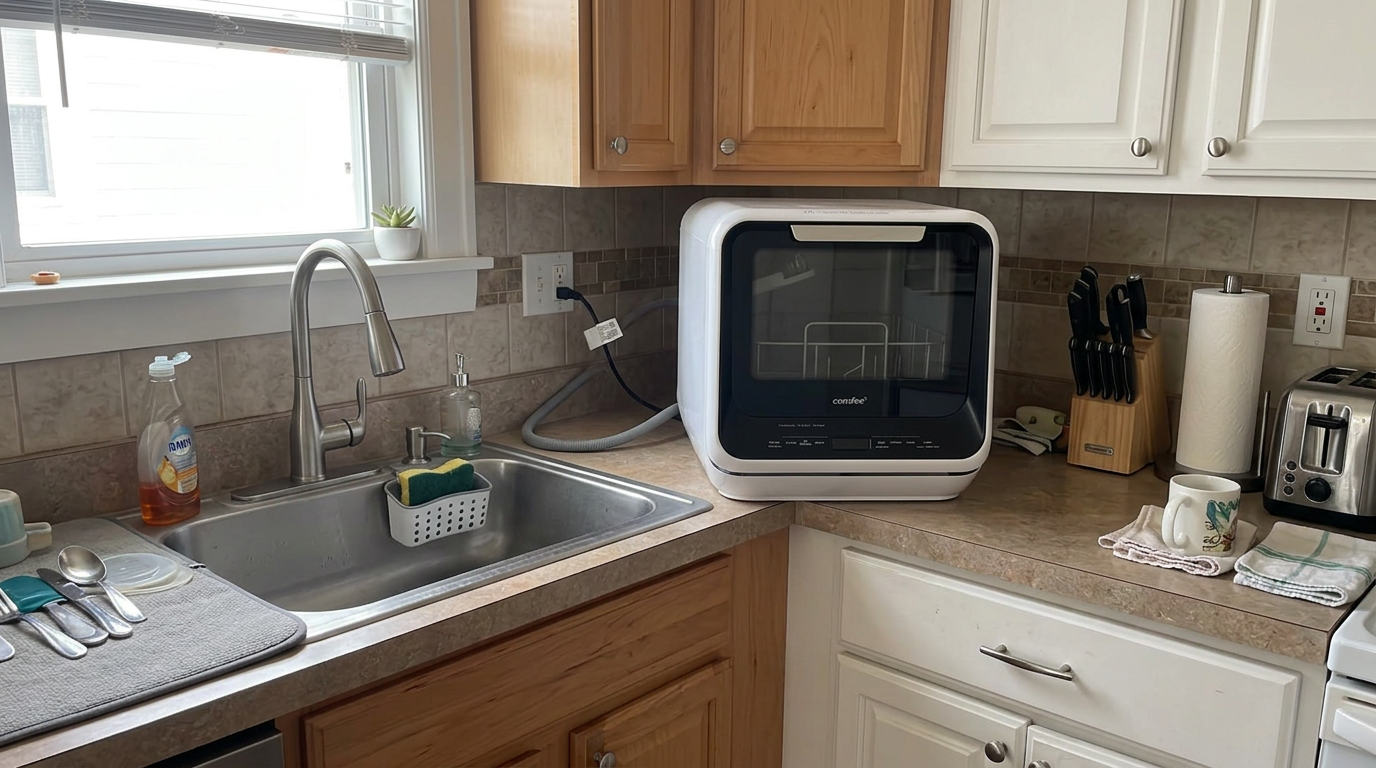
The compact tub with its rack and spray arms.
Our tip: Keep the box and foam for the first few weeks, because if you need to return or move the dishwasher, it's much safer to ship in its original packaging.
How compact is it?
This is one of the smallest countertop dishwashers I've tested.
It measures roughly 16.5 inches wide, 17.1 inches deep and 17.2 inches tall.
That's a little shorter than a typical microwave.
COMFEE still recommends more than 19.6 inches between the counter and the wall cabinets, so you can reach the filling cap on top.
It fit on my narrow counter with room for a dish rack beside it.
| Measurement | Size | What it means |
|---|---|---|
| Width | About 16.5 in | Narrow counters |
| Depth | About 17.1 in | Standard counter depth |
| Height | About 17.2 in | Shorter than most |
| Weight | About 37 lb | One-person lift |
| Clearance above | More than 19.6 in | Room to fill the tank |
Our tip: Measure your counter depth and the gap under your cabinets before ordering, because the door needs to swing open fully and you need space above to unscrew the filling cap.
Setting it up
Setup took about ten minutes.
I placed it on a level spot near the sink and an outlet.
Then I removed the small plug on the back drain outlet and attached the drain hose firmly.
The other end went into the sink, with no kinks or twists.
That drain hose is the only hose you need if you fill the tank by hand.
The inlet hose is optional for anyone who'd rather fill from the faucet.
| Step | What I did | Time |
|---|---|---|
| Place it | Level counter by sink and outlet | 2 min |
| Attach drain hose | Remove plug, push hose on | 2 min |
| Route hose | Into the sink, no kinks | 1 min |
| Fill the tank | Three pitchers through the top | 3 min |
| Add detergent | Into the cup on the door | 1 min |
Our tip: Push the drain hose fully onto its outlet and give it a gentle tug to check, because a loose hose can pop off mid-drain and empty dirty water across your counter.
Filling the 1.32-gallon tank
The tank opening sits on top under a screw cap.
You unscrew it, place the plastic filling guide over the hole and pour from the pitcher.
The first fill took about three full pitchers.
A water shortage light✕Water shortage lightAn indicator on the control panel that stays lit until the tank holds enough water for a cycle. It switches off and the machine beeps when the tank is full. stays on until there's enough water, then switches off with a beep.
No guessing, which I liked.
Pouring too fast splashed water over the top, so I learned to pour slowly and steadily.
| Fill method | Effort | Best for |
|---|---|---|
| Pitcher through the top | Pour about 1.32 gallons | Renters, RVs, dorms |
| Faucet hose | Hands-free | Daily use with a compatible faucet |
Using the faucet hose instead
The included quick-connect inlet hose attaches to a compatible faucet with the adapter.
With it connected, the tank fills itself, so you skip the pitcher.
It worked well on my standard faucet once I'd swapped the aerator for the adapter.
I still used the pitcher most of the time, because it meant I didn't tie up the faucet.
If you run it daily, the hose saves a little effort.
Our tip: Keep the faucet aerator you remove in a labeled bag, because you'll want it back if you move out or decide the hose isn't worth leaving on.
Detergent and what to avoid
A small sample of detergent comes in the box, which got me started.
After that, I used regular automatic dishwasher detergent, measured into the cup.
Pods worked, but they were large for such a small machine, so I preferred measured powder.
Never use hand dish soap, because it produces so many suds it can leak from the door.
| Detergent | My result |
|---|---|
| Measured powder | Best: clean, no film |
| Gel | Very good |
| Standard pod | Fine, slightly heavy for the size |
| Hand dish soap | Never use |
Our tip: Measure powder to the line in the detergent cup rather than overfilling, because a small tub uses little water and too much detergent leaves a film on cups and glasses.
Loading a small machine well
With a small tub, loading matters more than anything.
The rack held four 9-inch plates, two cereal bowls, two mugs and a cutlery basket of forks, knives and spoons.
My 10.5-inch dinner plates didn't fit, so I used my smaller lunch plates.
Glasses fit on the sides, angled toward the spray.
I had to plan each load, but after a few days it became second nature.
| Item | Fit | Notes |
|---|---|---|
| 9-inch plates | Good | Up to about 9.5 in |
| 10.5-inch dinner plates | No | Too tall |
| Cereal bowls | Good | Angled |
| Mugs | Good | Upside down |
| Cutlery | Excellent | Tableware basket |
| Small saucepan | Tight | Only the smallest |
| Frying pan | No | Too big |
Our tip: Check your plate size before buying, because if your everyday plates are larger than about 9.5 inches you'll need smaller ones or you'll be hand-washing them.
How it washes: 360° dual spray
It uses a dual spray✕Dual sprayTwo spray points that rotate and send water at the dishes from different angles, so more surfaces get hit in a small tub. system that rotates 360 degrees.
Through the door, I could hear water sweeping around the tub.
Plates facing the center came out spotless, and bowls angled inward were clean inside.
If I blocked a spray arm with a mug handle, the dishes behind it stayed dirty.
I gave the arms a quick spin by hand before each start.
Cleaning coverage by position in my loads.
Our tip: Turn the spray arms by hand after loading, because in a tub this small one stray spoon or plate edge can stop them and leave half the load dirty.
The six programs
There are five wash programs and one drying mode.
Normal is for everyday loads, Rapid for quick washes, Hygiene for heavily soiled dishes, Glass for glassware and Fruit for produce.
Air Refresh is the extra mode that circulates air to dry and freshen.
I used Rapid most evenings, Normal for dried-on food and Hygiene for greasy pans.
| Program | Best for | My notes |
|---|---|---|
| Normal | Everyday dishes | Reliable all-rounder |
| Rapid | Small daily loads | About 40 minutes |
| Hygiene | Greasy, baked-on food | Heats to 162°F |
| Glass | Glassware | Gentler wash |
| Fruit | Produce | Uses the fruit basket |
| Air Refresh | Drying and freshness | Can be turned off |
Our tip: Pick Rapid for dishes from the same day and Normal or Hygiene for anything left overnight, because the short cycle doesn't have time to soften dried-on food.
The 40-minute Rapid cycle
Rapid became my everyday choice.
After loading and adding detergent, I selected Rapid and the display showed about 40 minutes.
The machine checks the water level first; if the shortage light is on, it waits for more water.
Pressing Start lights up the indicator and the wash begins.
Halfway through, the display showed around 27 minutes left, which helped me plan.
When it finished, the display read END.
The stages of a Rapid cycle.
Our tip: Run Rapid straight after dinner while food is still soft, because 40 minutes is plenty for fresh mess but not enough for sauce that has dried on overnight.
The 162°F Hygiene cycle
Hygiene heats water up to 162°F.
I used it for a greasy skillet lid, a casserole bowl and plastic containers that held curry.
They all came out clean, without the film Normal sometimes left.
COMFEE also says it's suitable for children's dinnerware.
It takes longer than Rapid, so I saved it for loads that needed it.
| Item | Rapid | Hygiene |
|---|---|---|
| Greasy lid | Slight film | Clean |
| Casserole bowl | Some residue | Clean |
| Curry containers | Orange tint | Much cleaner |
| Kids’ plastic plates | Clean | Clean |
Our tip: Check that plastics are rated for high heat before choosing Hygiene, because water at 162°F can warp thin containers that are only top-rack safe.
Cleaning results over three weeks
For an appropriately sized load, cleaning was very good.
Everyday plates, bowls, mugs and cutlery came out clean on Rapid.
Dried-on oatmeal and egg needed Normal.
Greasy and tomato-stained plastics needed Hygiene.
About 9 in 10 items were spotless on the first wash, and most misses were loading mistakes.
Share of items clean on the first wash in my testing.
Our tip: Scrape plates into the trash but don't rinse them, because the detergent needs some food and grease to work against and pre-rinsing wastes the water you're trying to save.
Air Refresh drying
After the wash, Air Refresh circulates air through the tub.
It helps dry dishes and removes moisture and odors.
In my kitchen, plates and cutlery were dry when I unloaded, and mugs held a few drops in the base.
When I left a clean load overnight, the tub didn't smell musty.
You can switch Air Refresh off if you'd rather open the door and air-dry.
| Item | Dry when unloaded? |
|---|---|
| Ceramic plates | Yes |
| Cutlery | Yes |
| Glasses | Mostly |
| Mugs | A few drops |
| Plastics | Some drops |
Washing fruit and vegetables
The Fruit program uses the separate fruit basket.
I placed grapes, cherry tomatoes and apples in the basket and ran the cycle with no detergent.
They came out rinsed and cool, with the dusty film gone from the apples.
Delicate berries held up fine, but I wouldn't put soft fruit like raspberries in.
For muddy potatoes, I still used a brush at the sink.
| Produce | Result |
|---|---|
| Grapes | Excellent |
| Cherry tomatoes | Excellent |
| Apples | Very good |
| Strawberries | Good, gentle |
| Raspberries | Too delicate |
| Potatoes | Scrub by hand |
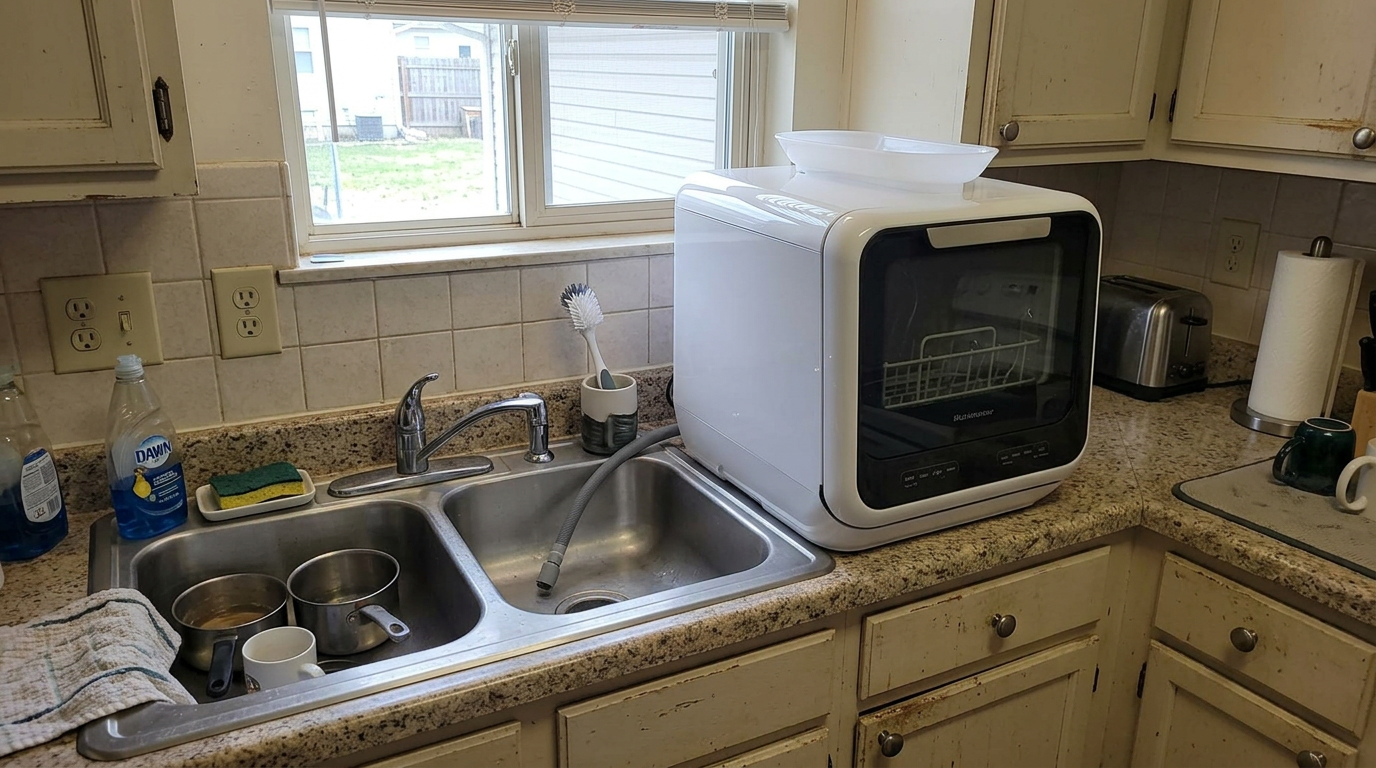
The fruit basket keeps produce separate from the rack.
Our tip: Never add detergent to the Fruit program, and run it only after a normal wash has cleaned the tub, because you want produce touching clean surfaces and clean water only.
The Glass program
Glass is a gentler cycle for glassware.
Tumblers and a couple of stemless wine glasses came out clear.
Taller stemmed glasses didn't fit standing up, given the short tub.
A little rinse aid helped prevent spots in my hard water.
Our tip: Angle glasses so they don't touch each other, because the spray makes them rattle slightly in a small tub and contact can chip thin rims.
Draining into the sink or a bucket
Wastewater pumps out through the drain hose during and at the end of the cycle.
I mostly drained into the sink.
At a friend's cabin, I drained into a two-gallon bucket, which was plenty for one cycle.
The hose has to stay free of sharp bends, or water drains slowly.
If you use a bucket, check it before the next cycle so it doesn't overflow.
Our tip: Clip or weigh down the end of the drain hose in the sink, because the pump pushes water out with enough force to make a loose hose wriggle out onto the counter.
Water use
A cycle uses the tank's 1.32 gallons, about 5 liters.
That's much less than I used hand-washing the same dishes with the tap running.
Before testing, I timed my hand-washing for a week, and the faucet ran for several minutes each day.
COMFEE claims it uses about a third of the water of hand-washing, which seemed fair.
Water for a small daily load.
Our tip: Run it once a day with a full load rather than twice with half loads, because every cycle uses the same tank of water no matter how many dishes are inside.
Energy use
Listings put annual energy use at about 130 kWh with regular use.
My plug-in meter showed Rapid used the least, Normal a bit more and Hygiene the most, because of the extra heating.
Air Refresh added a little.
To estimate your running cost, multiply the kWh figure by your local electricity rate.
| Use | Energy (approx.) |
|---|---|
| Rapid | Lowest |
| Normal | Moderate |
| Hygiene | Highest |
| Air Refresh | A little extra |
| Yearly, regular use | About 130 kWh |
Our tip: Turn Air Refresh off on warm, dry days and just open the door when the cycle ends, because the dishes will air-dry quickly and you'll save a little energy each time.
Controls and the countdown display
The control panel is simple.
Program buttons are clearly labeled, and the display counts down the remaining time.
The water shortage symbol tells you if the tank needs more water.
When a cycle ends, the display shows END.
I learned the controls in one evening.
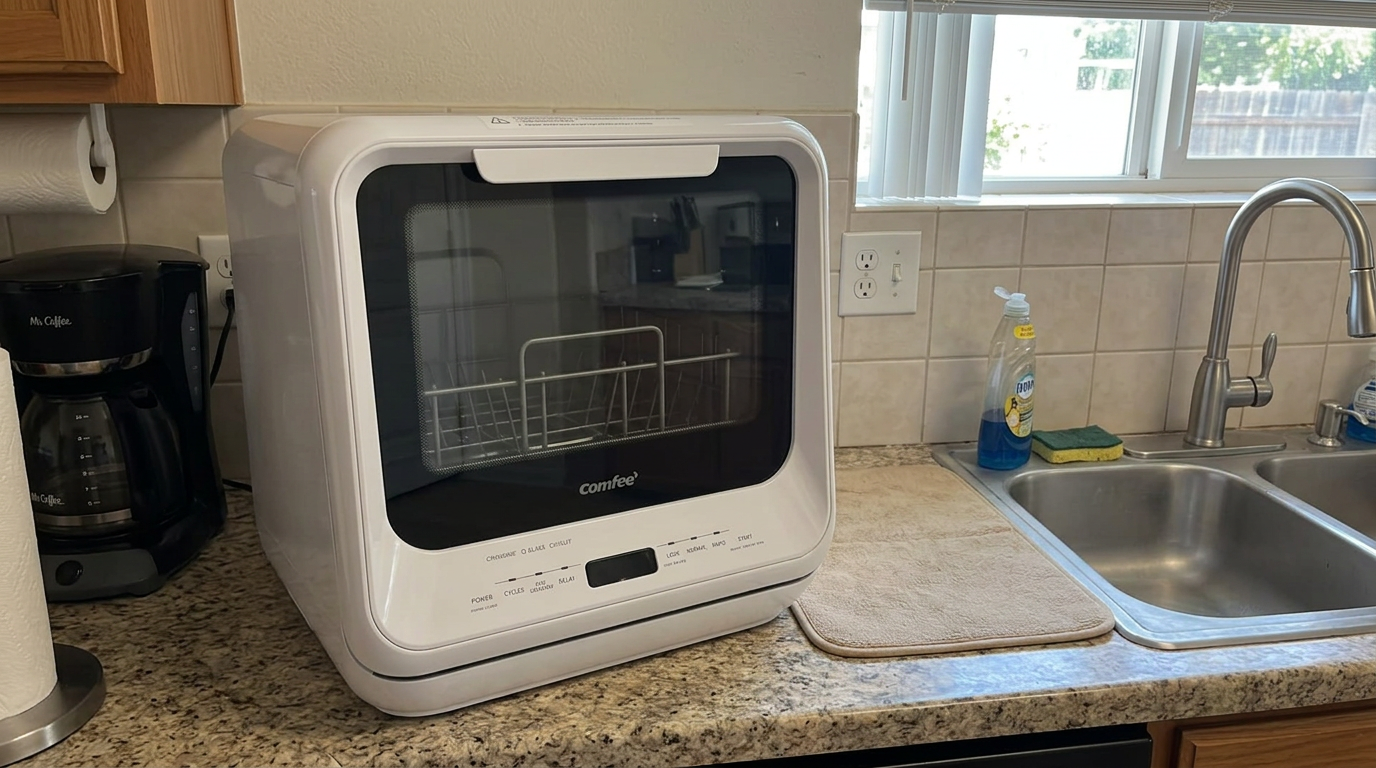
The control panel with program buttons and countdown display.
Our tip: Glance at the countdown when you start a cycle and set a phone timer for the same time, because you'll get the best drying if you crack the door open soon after END appears.
Noise
It's audible but not loud.
The wash sounds like steady rain inside a box, with a hum from the pump.
In my small kitchen, I could talk normally while it ran.
The drain pump and beeps were the loudest bits, and they're short.
Running it after dinner, I barely noticed it from the living room.
How loud each stage felt.
Our tip: Start the dishwasher as you sit down for the evening, because the wash fades into background noise from another room and the noisy drain lasts only a minute.
The filter and keeping it clean
A filter in the bottom of the tub catches food scraps.
It twists out for rinsing.
After a week, mine held rice and pasta bits.
I rinsed it every few days and gave it a soft brush once a week.
I also wiped the door seal weekly so crumbs didn't stop it sealing.
| Task | How often | Time |
|---|---|---|
| Rinse the filter | Every 2–3 days | 1 minute |
| Brush the filter | Weekly | 2 minutes |
| Wipe the door seal | Weekly | 1 minute |
| Wipe the filling cap | Weekly | 30 seconds |
| Empty Hygiene cycle | Monthly | One cycle |
Our tip: Wipe the threads of the filling cap now and then, because splashed water and dust can build up there and make the cap hard to screw on tightly.
Leak and overflow protection
COMFEE lists leakage protection, which matters for a machine sitting on a counter.
In three weeks, I never saw water leak from the door or base.
The only water on the counter came from my own splashes when filling the tank too fast.
The door seal stayed tight throughout.
Our tip: Place a thin tray or mat under the dishwasher if your counter is wood, because occasional filling splashes can mark the surface even when the machine itself never leaks.
How much time it saved me
Before the test, I timed my hand-washing and drying of the same daily dishes.
It averaged about 15 minutes.
With the COMFEE, filling, loading and unloading took about seven minutes.
That gave me roughly an hour back each week.
The sink was also clear, which made cooking less cluttered.
Daily hands-on time for my dishes.
Our tip: Fill the tank before you sit down to eat, because it's one less step when you're tired after dinner and the machine will be ready the moment the plates are loaded.
How it fit my day
I ran one Rapid cycle after dinner most nights.
Breakfast and lunch dishes waited in the rack with the door closed.
For one person, a day's dishes fit in one load.
For two people, I used smaller plates and loaded carefully.
Pots and the frying pan still got washed by hand.
| Household | Cycles per day | Pots by hand? |
|---|---|---|
| One person | 1 | A few |
| Two people | 1, loaded carefully | Yes |
| Three people | 2 | Most |
| Four or more | 2+ | All |
Our tip: Keep a set of 9-inch plates for everyday use if your dinner plates are bigger, because the dishwasher can then handle all your daily dishes without anything left over.
Using it in an RV, dorm or office
With its own tank and only a drain hose required, it works almost anywhere with an outlet.
I took it to a friend's cabin, filled it from a water jug and drained into a bucket.
It washed the weekend's dishes without fuss.
At about 37 pounds, it's easier to move than larger countertop models.
In a dorm or office, it's ideal for mugs, lunch tubs and a few plates.
| Place | What you need | Works well? |
|---|---|---|
| RV | Outlet, water jug | Yes |
| Cabin | Outlet, drain bucket | Yes |
| Dorm | Outlet near a sink | Yes |
| Office | Outlet near the sink | Yes |
Our tip: Drain the base fully and tape the door closed before moving it in a vehicle, because a little water stays in the sump and the door can swing open on bumps.
Who gets the most from it
Singles and couples with small kitchens get the most out of it.
Renters benefit because there's nothing to install.
Dorm residents and RV owners will appreciate the compact size and tank.
If you host often or have a family, a larger countertop model makes more sense.
Hard water, spots and rinse aid
My tap water is fairly hard, which usually leaves white marks on glasses.
In the first week, two tumblers came out with faint spots.
Adding a rinse aid✕Rinse aidA liquid used in the final rinse that helps water slide off dishes instead of forming droplets, reducing spots and speeding drying. cleared that up.
It also helped plastics dry faster with Air Refresh.
If your water is very hard, a detergent with built-in softening helps too.
| Setup | Glasses result |
|---|---|
| No rinse aid | Faint spots |
| Rinse aid added | Clear |
| Rinse aid and softening detergent | Clearest |
Our tip: Wipe a spotty glass with white vinegar to test whether the marks are hard-water deposits, because if they vanish, rinse aid is the fix rather than a different program.
Plastic containers and lids
Lightweight plastic is tricky in any dishwasher, and more so in a small one.
Small tubs flipped over in the spray unless I wedged them between mugs.
Lids were the worst, so I tucked them at the sides of the rack.
Normal cleaned most containers, but tomato and curry stains needed Hygiene.
Very thin takeout tubs I washed by hand to avoid warping.
| Item | Best spot | Result |
|---|---|---|
| Small tubs | Between mugs | Clean |
| Stained tubs | Rack, Hygiene | Much cleaner |
| Lids | Rack sides | Mostly clean |
| Thin takeout tubs | Hand-wash | May warp |
Our tip: Weigh down light lids by tucking them between heavier dishes, because the spray can flip them and fill them with dirty water.
Kids’ cups, bowls and bottles
A friend lent me her toddler's sippy cups, plastic bowls and a couple of baby bottles.
I took the valves and lids apart and put the small parts in the tableware basket.
Hygiene at 162°F cleaned everything thoroughly.
Tall bottles only fit lying at an angle, so two at a time was the limit.
For a family with a baby, it's handy as a second machine for these small items.
Our tip: Take sippy-cup valves and bottle nipples apart before washing, because milk hides in the small parts and only the spray can reach it once they're separated.
Build quality
For a compact, budget-friendly machine, it feels well put together.
The door closes firmly and the seal stayed tight.
The rack and tableware basket are plastic but sturdy.
The filling cap's threads are the one part that felt a little delicate, so I screwed it on gently.
After three weeks of daily use, nothing had loosened or cracked.
| Part | After three weeks |
|---|---|
| Door and hinge | Solid |
| Door seal | Tight, no leaks |
| Rack and basket | Sturdy |
| Filling cap | Fine, handle gently |
| Control buttons | Responsive |
Our tip: Screw the filling cap on until it's snug, not tight, because overtightening plastic threads is the quickest way to strip them.
Unloading and putting away
Unloading took two or three minutes.
I lifted the tableware basket straight out and carried it to the drawer.
Then the mugs, then the plates and bowls.
If I unloaded straight after END, I worked from the bottom up so drips from mugs didn't land on dry plates.
The sump✕SumpThe small well at the bottom of the tub where water collects before it is pumped out through the drain hose. always looked empty after draining, which told me the pump was working properly.
Our tip: Unload the bottom of the rack first if you open the door right after a cycle, because water pooled on upturned mugs drips onto everything beneath them.
Three weeks with the COMFEE CDC17P0ABB
Week one: I learned to fill slowly, load around the spray arms and switch to 9-inch plates.
Rapid became my default after dinner.
Week two: I started using Hygiene for greasy dishes and Fruit for produce.
Hand-washing dropped to just pots and pans.
Week three: I took it to a cabin for a weekend and it worked perfectly from a jug and bucket.
How satisfied I felt each week.
Our tip: Give it a full week before judging the cleaning, because most early misses came from how I loaded it rather than the machine itself.
Safety and good habits
It runs on a standard 120V outlet.
Keep the cord and hoses away from the stove and sink edge.
Hygiene water is hot, so don't open the door mid-cycle.
Let cutlery and glasses cool for a few minutes before unloading after a hot cycle.
Our tip: Plug it directly into a wall outlet rather than an extension cord, because the heater draws a lot of current and a light-duty cord can overheat.
Troubleshooting what I ran into
A few small issues came up during testing.
| Problem | Cause | Fix |
|---|---|---|
| Won’t start | Water shortage light on | Add water until it beeps |
| Water on counter | Poured too fast | Pour slowly into the guide |
| Slow drain | Kinked hose | Straighten and lower hose |
| Dirty bowl insides | Blocked spray arm | Spin arms before starting |
| Film on plastics | Rapid or Normal | Use Hygiene if heat-safe |
Our tip: If the dishwasher won't start, check the water shortage symbol first, because the most common reason is a tank that's just a little short of full.
Mistakes to avoid
Don't pour water in too fast.
Don't load plates over about 9.5 inches.
Don't use hand dish soap.
Don't let the drain hose kink behind the machine.
And don't forget to screw the filling cap back on tightly.
Our tip: Screw the filling cap back on as soon as the tank beeps full, because an open cap lets steam out of the top during the wash and can drip onto the control panel.
Who it suits in real life
It's ideal for singles and couples in apartments, dorms and RVs.
It suits renters who can't add plumbing.
Families will find it too small as their only dishwasher.
If you use large dinner plates, check sizes carefully before buying.
| Household | Fit | Why |
|---|---|---|
| Single renter | Excellent | Tiny footprint, no plumbing |
| Couple | Very good | One careful load a day |
| Dorm or RV | Excellent | Compact, runs from tank |
| Family of four | Poor | Too small |
| Office kitchenette | Very good | Mugs and lunch tubs |
Our tip: Count the dishes you actually use in a day before buying, because if they won't fit in one load you'll be running it twice and the convenience starts to slip.
Is the COMFEE CDC17P0ABB worth the money?
For one or two people with a small kitchen, yes.
It's simple to set up, needs no plumbing and cleans everyday dishes well.
The Rapid cycle is quick, Hygiene handles grease, and Air Refresh keeps it fresh.
Capacity and plate size are the real limits.
Three questions to ask:
Do you wash for one or two people?
Are your everyday plates 9.5 inches or smaller?
And do you have about 20 inches of clearance under your cabinets?
How it compares with other ways to wash dishes
| Feature | COMFEE CDC17P0ABB | Hand-washing | Full-size dishwasher | Larger countertop model |
|---|---|---|---|---|
| Plumbing needed | No | No | Yes | Often optional |
| Water per load | About 1.32 gal | Much more | More | Similar |
| Footprint | Very small | — | Built-in | Larger |
| Plate size | Up to about 9.5 in | Any | Large | Up to about 10.5 in |
| Drying | Air Refresh | Towel | Heated | Varies |
| Effort | Low | High | Low | Low |
| Your priority | Is it a fit? | Why |
|---|---|---|
| Tiny counter | Excellent | Very compact |
| No plumbing | Excellent | 1.32-gal built-in tank |
| Quick cycles | Very good | 40-minute Rapid |
| Big dinner plates | Poor | Up to about 9.5 in |
| Large households | Poor | Small load |
Which one is right for you: is the COMFEE CDC17P0ABB your match?
4 quick questionsCOMFEE CDC17P0ABB specifications
From manufacturer data, retailer listings and my own testing.
How I tested and scored the COMFEE CDC17P0ABB
For three weeks, the COMFEE CDC17P0ABB was my only dishwasher on a small apartment counter, plus one weekend at a cabin.
I ran every program, tracked how clean each item came out, tested pods, powder and gel, and filled the tank by pitcher and by faucet hose.
I timed cycles, drained into a bucket to check water use and measured energy with a plug-in meter.
- Ease of setup (9.0): only a drain hose needed; clear indicators.
- Compact size (8.8): fits the smallest counters.
- Cleaning (8.2): very good daily; Hygiene handles grease.
- Capacity (6.0): one or two people; 9.5-inch plate limit.
The overall score of 8.0 is an editorial rating that reflects those four areas.
COMFEE CDC17P0ABB FAQ
Does the COMFEE CDC17P0ABB need plumbing?
No. It has a 1.32-gallon built-in tank you fill through a cap on top. Only the drain hose is needed; the faucet inlet hose is optional.
How do I know when the tank is full?
A water shortage light stays on until there's enough water, then turns off and the machine beeps.
How long is the Rapid cycle?
About 40 minutes in my testing. The display counts down and shows END when it's done.
What programs does it have?
Normal, Rapid, Hygiene, Fruit and Glass, plus an Air Refresh mode for drying and freshness.
How hot does Hygiene get?
Up to 162°F, which handled greasy and baked-on dishes well.
What size plates fit?
Plates up to about 9.5 inches. My 10.5-inch dinner plates didn't fit.
How many dishes fit in one load?
About four 9-inch plates, two bowls, two mugs and a basket of cutlery, or 30+ smaller items.
Where does the water drain?
Through the drain hose into your sink or a bucket. A two-gallon bucket holds one cycle.
How much water does it use?
About 1.32 gallons, or 5 liters, per cycle.
Does it dry the dishes?
Air Refresh circulates air to dry and freshen. Plates and cutlery were dry; mugs and plastics held a few drops.
Can I use dishwasher pods?
Yes, but measured powder suited the small tub better. Never use hand dish soap.
How do I clean it?
Rinse the filter every few days, brush it weekly, wipe the door seal and run an empty Hygiene cycle monthly.
Senior home appliance tester
Emily has tested home appliances for a living since 2016, first as a test coordinator at a national consumer advocacy group and, since 2021, at HouseholdMe. She has a degree in industrial design from Ohio State, so she looks at how a product is built, not just how it performs. She used the COMFEE CDC17P0ABB as her only dishwasher for three weeks for this review.
- Three weeks of hands-on testing of the COMFEE CDC17P0ABB
- COMFEE product information and user manual