COMFEE Countertop Dishwasher CDC17P2AWW review
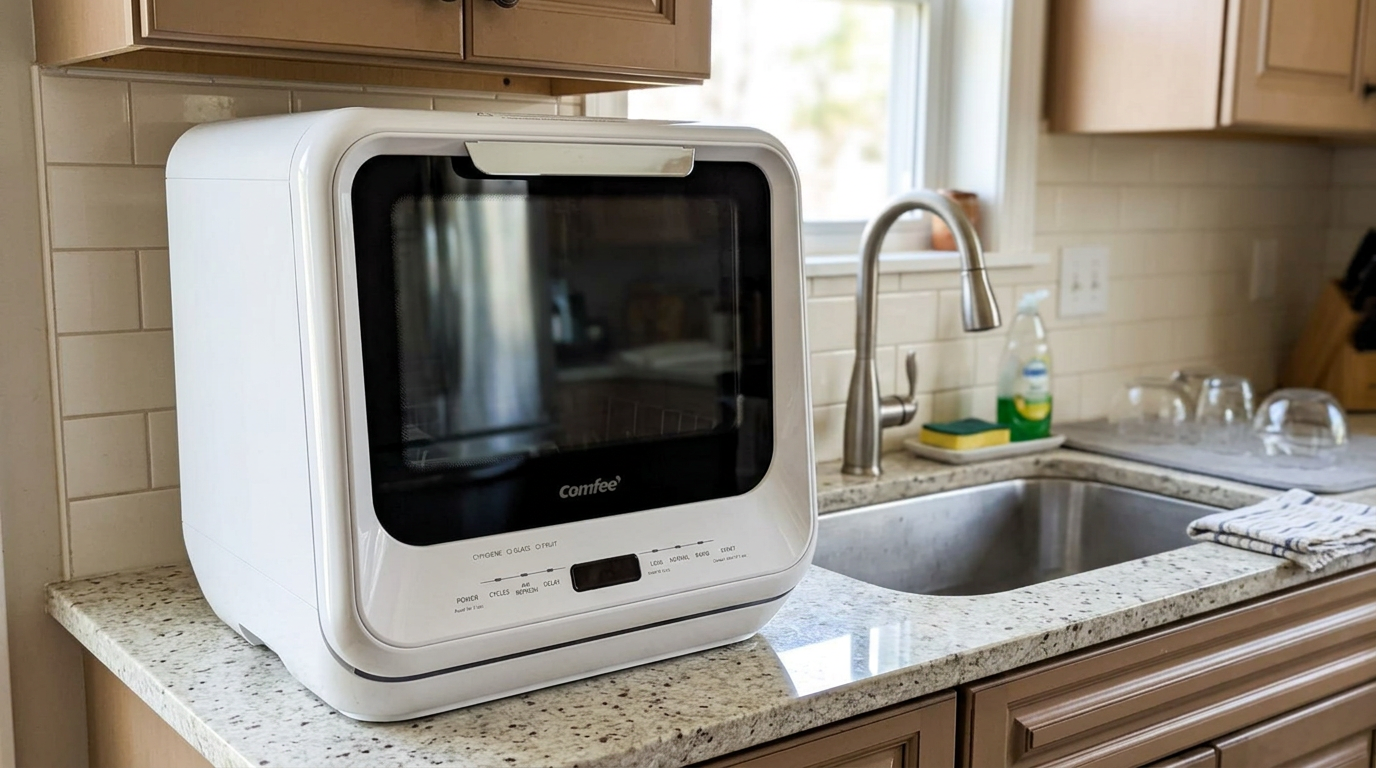
The COMFEE Countertop Dishwasher CDC17P2AWW is a compact countertop dishwasher with a 6-liter built-in water tank, a high-temperature Hygiene cycle, UV drying and a door that opens itself at the end of the cycle to let steam out. I used it daily for three weeks in a rental kitchen with no dishwasher hookup. It fit 10.5-inch dinner plates, cleaned greasy pans and baked-on bowls better than I expected for its size, and the auto-open door meant dishes came out dry instead of dripping. It's still a small machine, and the 62 dB wash is noticeable in an open-plan room, but for one to three people it's one of the most complete countertop options I've tested.

Emily Carter
Hands-on review
Hands-on testing, research, specs
3 weeks
26 minutes
Jargon helpNew to countertop dishwashers? Tap any dotted term to see what it means.
In this review
Yes, for small households without a dishwasher. The COMFEE CDC17P2AWW runs from a 6-liter tank you fill with the included pitcher, or from your faucet with the quick-connect hose. It fits 10.5-inch plates, the Hygiene cycle heats up to 192°F for greasy and baked-on messes, and UV drying plus an auto-opening door left my dishes dry and the tub fresh. Capacity is still limited to a small household's daily load, big pots don't fit, and it's audible during the wash.
COMFEE CDC17P2AWW at a glance
COMFEE CDC17P2AWW pros and cons
- Runs from its 6-liter tank, no plumbing needed
- Auto-open door and UV drying leave dishes dry
- Hot Hygiene cycle handles greasy, baked-on food
- Small capacity for larger families
- Large pots and sheet pans don't fit
- Noticeable noise during the wash
Who should buy the COMFEE CDC17P2AWW?
- Renters with no dishwasher hookup
- One to three people
- RVs, dorms and small kitchens
- Families who cook big meals every day
- Open-plan homes that need a silent machine
- Kitchens with low wall cabinets over the counter
First impressions of the COMFEE CDC17P2AWW
It arrived well packed, and at just over 41 pounds it was a two-handed lift onto the counter.
The finish is clean and white, with a touch control panel across the top of the door.
Inside is a single main rack with a fold-down section for cups, a removable tableware basket for cutlery and a removable filter in the base.
In the box were the quick-connect inlet hose with an adapter, a drain hose, a fruit basket, a water pitcher and the manual.
The door felt solid and closed with a firm click.
It looks more like a small appliance than a gadget, which I liked.
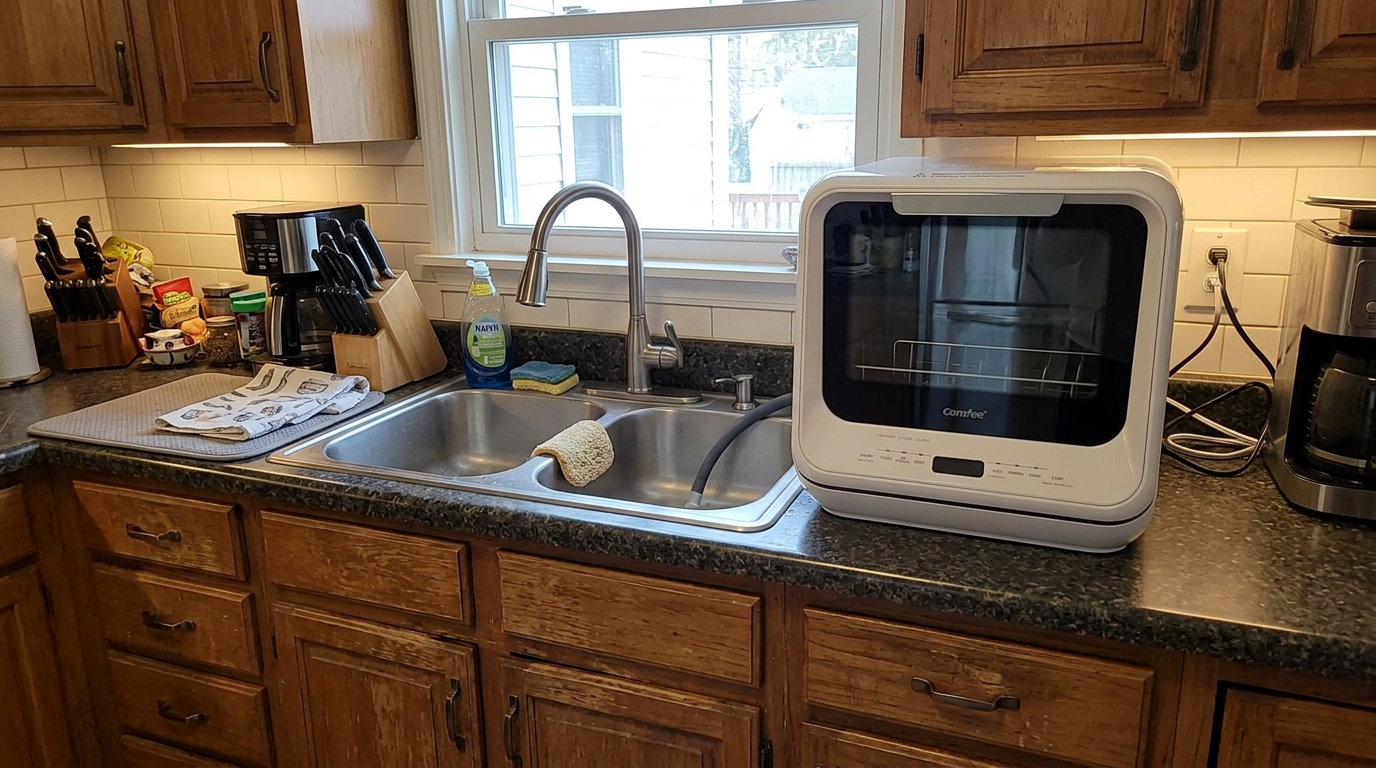
A single rack with a cup shelf and a cutlery basket.
Our tip: Run a first empty Normal cycle with a little detergent before loading real dishes, because it flushes the tank and lines and lets you hear every stage of the cycle while nothing is at stake.
Size and where to put it
It measures about 16.5 inches wide, 17.25 inches deep and 18.35 inches tall.
On my counter, it took about the space of a large microwave.
COMFEE recommends leaving more than 19.6 inches between the counter and the wall cabinets above, so you can open the tank lid and pour.
My cabinets cleared that by just over an inch.
Put it near an outlet and close enough to the sink for the drain hose to reach.
| Measurement | Size | What it means |
|---|---|---|
| Width | 16.5 in | About a large microwave |
| Depth | 17.25 in | Check deep enough counter |
| Height | 18.35 in | Needs 19.6 in under cabinets |
| Weight | About 41 lb | Two-handed lift |
| Tank | 6 liters | One full cycle |
Our tip: Measure from the counter to the underside of your wall cabinets before you buy, because if you have less than about 20 inches you won't be able to lift the tank lid and pour water in.
Tank or faucet: two ways to fill it
The built-in tank holds 6 liters, which is enough for one cycle.
You lift the lid on top and pour water in with the pitcher.
The tank indicator tells you when it's full, so there's no guessing.
If you'd rather not pour, the quick-connect inlet hose attaches to most kitchen faucets with the adapter in the box.
I used the tank most of the time, because it meant leaving my rental's faucet untouched.
On busy days, I clipped the hose on, which made filling hands-free.
| Fill method | Effort | Best for |
|---|---|---|
| Built-in tank | Pour about 6 liters | Renters, RVs, any counter |
| Faucet hose | Hands-free | Daily heavy use |
Draining the water
The drain hose clips to the back and runs into the sink.
Dirty water pumps out at the end of the wash.
The hose needs to sit lower than the machine and stay free of kinks.
I drained one cycle into a bucket to check, and it came to roughly the tank's 6 liters.
That matches the water you put in, so nothing is left sitting in the base.
Our tip: Clip the end of the drain hose over the edge of the sink, because if it slips onto the counter mid-drain you'll have a puddle and a soggy dish towel.
Loading: what fits and what doesn’t
The interior is roomier than older mini dishwashers, and it takes plates up to 10.5 inches.
I fitted four dinner plates, two side plates, two cereal bowls and two mugs on the rack, with cutlery in the basket.
Glasses and small cups went on the fold-down cup section.
A small saucepan fit with the handle angled, but my frying pan and sheet pan didn't.
For one or two people, a day's dishes fit in one load.
| Item | Where it went | Fit |
|---|---|---|
| 10.5-in dinner plates | Main rack, ends first | Good |
| Bowls | Main rack | Good |
| Mugs | Rack or cup shelf | Good |
| Cutlery | Tableware basket | Excellent |
| Small saucepan | Rack, handle angled | Tight |
| Frying pan | — | Too big |
| Sheet pan | — | Too big |
Our tip: Load plates from the two ends of the rack toward the middle, as the manual suggests, because the space in the center is where bowls and cups fit best around the spray arm.
How it washes
Water is pushed through a rotating spray arm✕Spray armA spinning arm under the rack that shoots water at the dishes. Water pressure turns it so the jets sweep across the load. under the rack.
The manual warns not to place dishes upright and to face dirty sides toward the spray arm, and that made a visible difference.
When I loaded plates flat against the sides, the centers came out spotless.
When I let a bowl lean into the arm's path, the bowl behind it stayed dirty.
Giving the arm a quick spin by hand after loading became a habit.
Cleaning coverage in my loads.
Our tip: Spin the spray arm by hand once the rack is loaded, because a single spoon handle or plate edge in its path stops it turning and half the load won't get clean.
Detergent and rinse aid
There's a small detergent cup on the inside of the door.
Pods worked well in this machine, which wasn't true of every compact model I've tested.
I also tried measured powder, and it was equally good.
A little rinse aid helped glasses dry without spots.
Only use dishwasher detergent, never dish soap, which foams and can leak.
| Detergent | My result |
|---|---|
| Standard pod | Clean, no residue |
| Measured powder | Clean, no residue |
| Gel | Very good |
| Dish soap | Never use |
Our tip: Never use hand dish soap, even a drop, because it foams up instantly in a dishwasher and can push suds out around the door seal.
The wash programs
COMFEE calls it a 5+2 setup: five washing programs and two extra features.
The programs are Normal, Rapid, Hygiene, Fruit and Glass.
The extras are UV drying and auto door open.
Normal is for everyday loads, Rapid for lightly dirty dishes, and Hygiene runs hot for grease and baked-on food.
Glass is gentler, and Fruit is a quick cold rinse for produce.
| Program | Best for | My notes |
|---|---|---|
| Normal | Everyday dishes | My default |
| Rapid | Lightly dirty dishes | Fastest option |
| Hygiene | Greasy, baked-on food | Heats up to 192°F |
| Glass | Glassware | Gentler wash |
| Fruit | Fruit and vegetables | Cold rinse, no detergent |
Our tip: Use Rapid only for dishes that were rinsed or lightly used, because it trades heat and time for speed and won't shift dried-on food the way Normal or Hygiene does.
The 192°F Hygiene cycle
This is the program that sets it apart from simpler countertop models.
The Hygiene cycle heats water up to 192°F.
I used it for a lasagna dish, a greasy frying-pan lid and a bowl with dried-on oatmeal.
All three came out clean, with no greasy film.
It takes longer and uses more energy, so I kept it for loads that needed it.
It's also a good choice for cutting boards and containers that held raw meat, if they're rated for high heat.
| Messy item | Normal | Hygiene |
|---|---|---|
| Baked-on lasagna dish | Some residue | Clean |
| Greasy lid | Slight film | Clean |
| Dried oatmeal | Clean after soak | Clean |
| Plastic cutting board | Clean | Clean, check heat rating |
Our tip: Check that plastics are rated for high heat before using Hygiene, because water that hot can warp thin containers and lids that are only top-rack safe.
Cleaning results over three weeks
Day to day, the cleaning was very good.
Coffee mugs, cereal bowls, pasta plates and cutlery came out clean on Normal.
Egg on forks and tomato sauce on plates were no trouble.
Greasy plastic containers were the toughest, and Hygiene solved that.
Over three weeks, about 9 in 10 items were spotless on the first wash.
The few misses were almost always loading mistakes on my part.
Share of items clean on the first wash.
Our tip: Scrape food into the trash but don't pre-rinse, because modern dishwasher detergent works best with some grease to cut and the hot rinse takes care of the rest.
UV drying and the auto-open door
Drying is where many compact dishwashers struggle.
The COMFEE uses two tricks.
At the end of the cycle, the door pops open slightly by itself so steam can escape.
There's also a UV drying✕UV dryingA drying stage that uses ultraviolet light inside the tub to help keep it dry and limit mold and mildew while dishes sit inside. function that helps keep the tub dry and fresh.
When I came back to a finished load, plates, cutlery and glasses were dry.
Plastic tubs held a few drops, which is normal for plastic.
| Item | Dry when I unloaded? |
|---|---|
| Ceramic plates | Yes |
| Cutlery | Yes |
| Glasses | Yes, with rinse aid |
| Mugs | Mostly; a few drops in the base |
| Plastic tubs | A few drops |
Keeping the tub fresh
A closed, damp box is a recipe for musty smells.
Between the auto-open door and the UV drying, the tub stayed dry and neutral-smelling all three weeks.
I left a clean load inside over a weekend and came back to dry dishes and no odor.
The door seal stayed clean, and I saw no mildew in the corners.
Our tip: Leave the door slightly ajar between loads, because airflow is the cheapest way to keep any dishwasher smelling fresh, and this one already tells you that by opening itself.
The fruit and vegetable program
The Fruit program uses the separate fruit basket and a short, cool rinse.
No detergent goes in.
Grapes, berries and cherry tomatoes came out rinsed and cold.
Apples from a farmers' market lost the dusty film they had on them.
It's handy, but for muddy root vegetables I still used a brush at the sink.
| Produce | Result |
|---|---|
| Grapes | Excellent |
| Berries | Very good, gentle |
| Apples | Very good |
| Cherry tomatoes | Excellent |
| Potatoes | Scrub by hand instead |
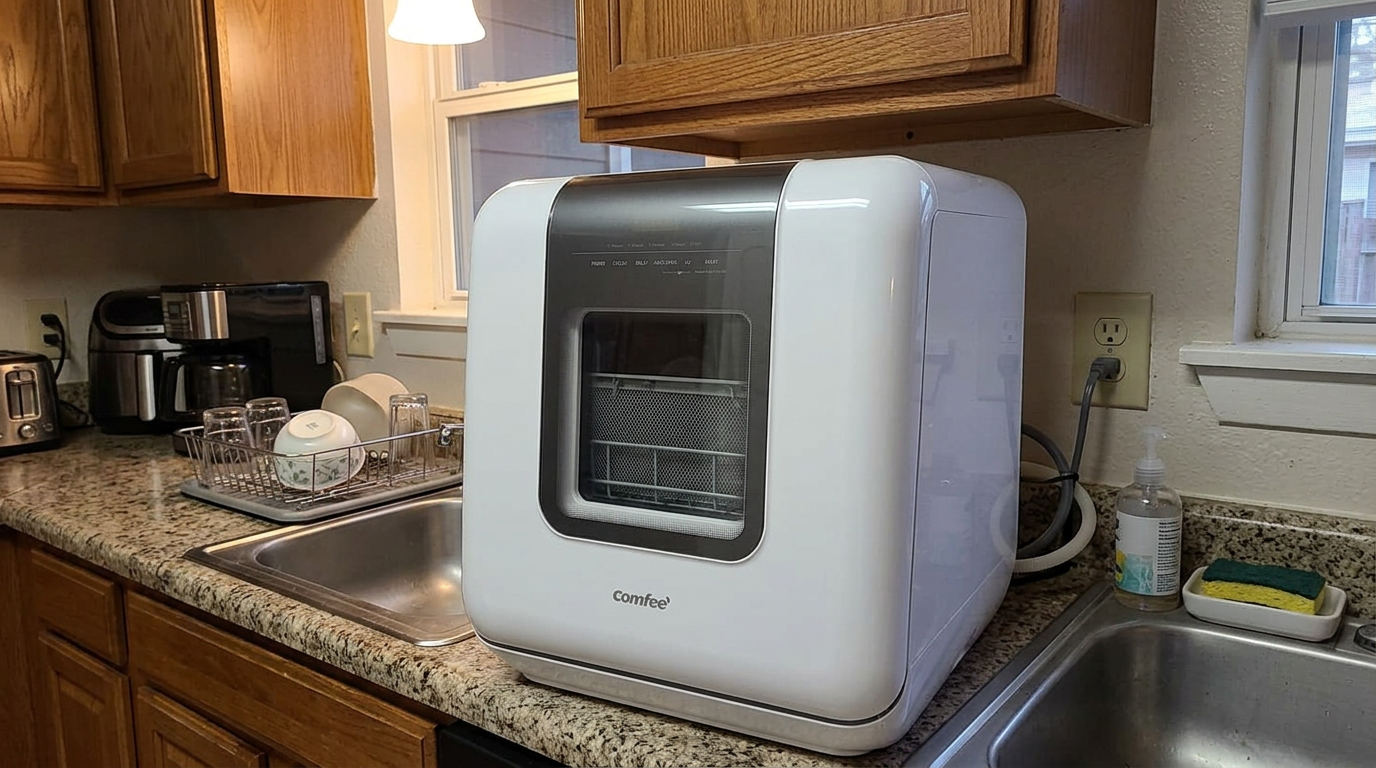
The fruit basket keeps produce apart from the dish rack.
Our tip: Wash the fruit basket and rack before running Fruit, because the program uses no detergent and you want the produce touching only clean surfaces.
The Glass program
The Glass program is gentler for glassware.
Wine glasses and thin tumblers came out clean and clear.
With a little rinse aid, there were no water spots.
Tall stemware had to lie at an angle, so only two wine glasses fit at once.
Our tip: Keep glasses from touching each other or the door, because the wash makes them vibrate slightly and contact points can chip thin rims over time.
The Rapid program
Rapid is the quick option for lightly used dishes.
I used it for breakfast mugs and plates when a friend stayed over and we needed them again by lunch.
It handled coffee rings and toast crumbs fine.
It didn't shift dried egg or sauce left overnight, so pick Normal for those.
Our tip: Run Rapid soon after a meal rather than hours later, because it's short on time and heat and works best before food dries onto the dishes.
Water use
A cycle uses the 6 liters in the tank, about 1.6 gallons.
That's far less than I used washing the same small load by hand with the tap running.
I timed my hand-washing for a week before testing, and the faucet ran for several minutes a day.
If saving water matters to you, this is a real improvement.
Water for a small daily load in my kitchen.
Our tip: Run it only when the rack is reasonably full, because a cycle uses the same tank of water whether you wash three items or a full day's dishes.
Energy use
The listing puts it at about 0.35 kWh per cycle and around 150 kWh a year with regular use.
My plug-in meter showed similar numbers on Normal.
Hygiene used noticeably more, because heating water to 192°F takes energy.
To estimate your cost, multiply the kWh figure by your local electricity rate.
| Use | Energy (approx.) |
|---|---|
| One Normal cycle | About 0.35 kWh |
| Hygiene cycle | Noticeably more |
| Yearly, regular use | About 150 kWh |
| Pumps alone | Very low |
Our tip: Save Hygiene for loads that really need it, because heating water that hot is where most of the extra energy goes and Normal cleans everyday dishes just as well.
Noise
It's rated at 62 dB, and that matched my experience.
The wash sounds like steady rain with a pump hum.
In my small kitchen, I had to raise my voice slightly to talk over it.
In a separate room with the door closed, I barely noticed it.
The drain stage and the beeps are the loudest moments, but they're short.
How loud each stage felt in my kitchen.
Our tip: Start a cycle as you leave the kitchen for the evening, because the wash is noticeable in a small open room but fades into the background from the next room.
Controls and display
The touch panel is simple and clearly labeled.
You choose a program, check the tank indicator and press start.
The LED display shows the time remaining, which helped me plan when to unload.
After a day or two, I could set a cycle without looking at the manual.
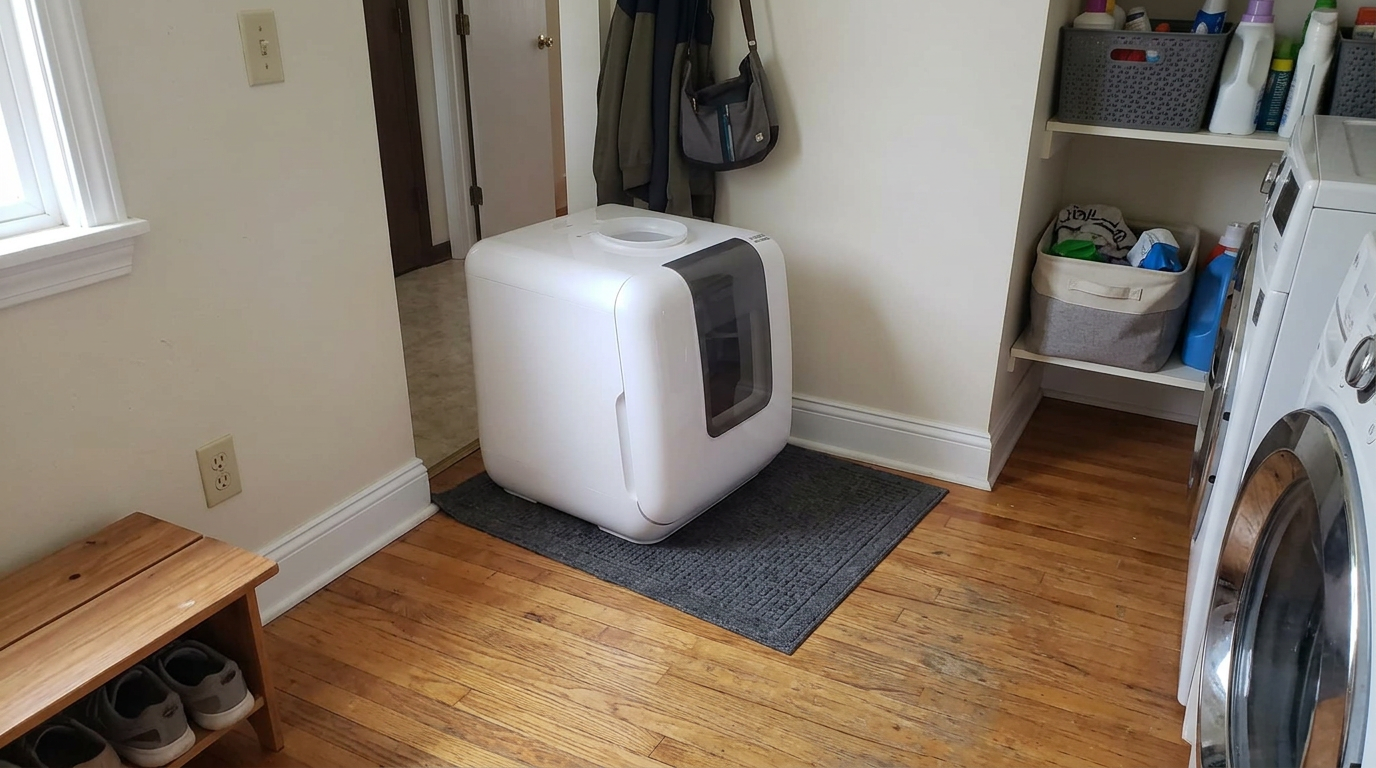
The touch panel with program buttons and time display.
Our tip: Press the power button before you start pouring water, as the manual notes, because the tank indicator only responds once the machine is switched on.
The filter and upkeep
A removable filter in the base catches food scraps.
It twists out and back in.
After a week, mine had rice, pasta bits and coffee grounds.
I rinsed it every few days and brushed it weekly.
A clogged filter makes draining slower and leaves dishes dirtier.
| Task | How often | Time |
|---|---|---|
| Rinse the filter | Every 2–3 days | 1 minute |
| Brush the filter | Weekly | 2 minutes |
| Wipe the door seal | Weekly | 1 minute |
| Check spray arm holes | Monthly | 2 minutes |
| Empty Hygiene cycle | Monthly | One cycle |
Our tip: Run an empty Hygiene cycle once a month with a dishwasher cleaner, because the high heat flushes grease out of the pump and lines and keeps the machine smelling clean.
Build quality and leak protection
The build feels solid for a countertop machine.
The rack glides smoothly and the cutlery basket clicks in securely.
The door seal stayed tight, and I never saw a drip on the counter.
Listings mention leakage protection, which is reassuring for a machine that sits on a counter.
The only part that felt lighter was the tank lid.
| Part | After three weeks |
|---|---|
| Door and hinges | Solid |
| Door seal | Tight, no leaks |
| Rack | Smooth, no rust |
| Tank lid | Fine, a little light |
| Touch panel | Responsive |
Our tip: Wipe the door seal with a damp cloth weekly, because crumbs trapped there can stop the door closing fully and lead to small leaks over time.
How much time it saved me
Before testing, I timed myself hand-washing and drying the same daily dishes.
It averaged about 15 minutes a day.
With the COMFEE, loading, filling and unloading took about seven minutes.
That freed up more than an hour a week.
The sink was clear for cooking, which made a bigger difference than I expected.
Daily hands-on time for my dishes.
Our tip: Load as you go after each meal rather than all at once at night, because the evening job then becomes just filling the tank and pressing start.
How it fit my daily routine
I ran one Normal cycle every evening.
Breakfast and lunch dishes went in during the day.
For one or two people, that was enough.
When a friend stayed for four days, a quick Rapid cycle at lunch kept up.
Big pots and the frying pan still got washed by hand.
| Household | Cycles per day | Pots by hand? |
|---|---|---|
| One person | 1 | A few |
| Two people | 1 | Yes |
| Three people | 1–2 | Yes |
| Four or more | 2+ | Most |
Our tip: Wash big pots by hand while the dishwasher runs, because they won't fit anyway and you'll finish the whole kitchen in the same evening session.
Using it in an RV, dorm or office
Because it runs from its own tank, it works where there's no water hookup.
I tested it at a friend's lake cabin with a water jug and a bucket for draining.
It washed a weekend's dishes with only an outlet needed.
At 41 pounds it's heavier than some models, so it's best on a counter where it can stay put.
In an office kitchenette, it's a neat way to handle mugs and lunch containers.
| Place | What you need | Works well? |
|---|---|---|
| RV | Outlet and water jug | Yes |
| Cabin | Outlet and drain bucket | Yes |
| Dorm | Outlet near a sink | Yes |
| Office | Outlet near the sink | Yes |
Our tip: Drain the base completely before moving it, because a little water stays in the sump after each cycle and can spill when you tilt a 40-pound machine.
Who gets the most from it
Renters get the most, because there's nothing to install and it moves with you.
Singles, couples and small families get the most from the capacity.
People who cook greasy food will appreciate the Hygiene cycle.
And anyone who hates towel-drying will love the auto-open door.
Using the faucet hookup
The quick-connect✕Quick-connect hoseAn inlet hose that snaps onto an adapter screwed to your faucet, so you can attach and remove it in seconds without tools. inlet hose comes with a faucet adapter.
I unscrewed my faucet's aerator, screwed the adapter on and the hose clicked into place.
With the hose on, the tank filled itself when I started a cycle.
Removing it took a second, and the faucet worked normally with the adapter left on.
My pull-down sprayer faucet wasn't compatible, so check your faucet type before relying on it.
| Faucet type | Hookup worked? |
|---|---|
| Standard faucet with aerator | Yes |
| Older threaded faucet | Yes, with adapter |
| Pull-down sprayer | No |
| Touchless faucet | Check first |
Our tip: Keep the original faucet aerator in a labeled bag in a kitchen drawer, because you'll want it back if you move out of a rental or stop using the hose.
Hard water, spots and rinse aid
My area has fairly hard water, which usually leaves white spots on glasses.
In the first week, without rinse aid, two glasses had faint spots.
After adding a rinse aid✕Rinse aidA liquid added during the final rinse that helps water sheet off dishes instead of forming droplets, reducing spots and speeding up drying., they came out clear.
Rinse aid also helped the plastics dry faster.
If your water is very hard, a detergent with built-in softening helps too.
| Setup | Glasses result |
|---|---|
| No rinse aid, hard water | Faint spots |
| Rinse aid added | Clear |
| Rinse aid and softening detergent | Clearest |
Our tip: Wipe a spotty glass with white vinegar to test whether marks are hard-water deposits, because if they vanish, rinse aid will fix the problem rather than a different program.
The cup shelf and cutlery basket
The fold-down cup section is small but useful.
It held four espresso cups or two small glasses, which freed the main rack for plates.
The cutlery basket lifts out, so I could unload it straight into the drawer.
I put forks and spoons handles-down and knives handles-up for safety.
Long serving spoons had to lie flat on the cup shelf.
Our tip: Mix spoons with forks in the cutlery basket instead of grouping them, because spoons stacked together nest and the spray can't reach between them.
Plastics and food containers
Plastic containers are hard for any dishwasher, and tiny ones flip over.
I put them on the cup shelf, wedged between mugs, so they stayed upright.
Normal cleaned them, but greasy tomato sauce left a slight film.
Hygiene removed that film on heat-safe tubs.
Lids were the most likely to flip, so I tucked them at the sides.
| Item | Best spot | Result |
|---|---|---|
| Small tubs | Cup shelf | Clean |
| Greasy tubs | Rack, Hygiene | Clean |
| Lids | Rack sides | Mostly clean |
| Thin takeout tubs | Hand-wash | May warp |
Our tip: Weigh down light plastic lids by tucking them between heavier dishes, because the spray can flip them over and fill them with dirty water.
Greasy pans and everyday cooking
I cook a lot of stir-fries and roast vegetables, so greasy dishes were a real test.
A small skillet lid, a roasting tray insert and oily serving bowls all came out clean on Hygiene.
On Normal, oily bowls sometimes kept a slight film.
For real oil-heavy cooking, Hygiene is the program to pick.
My full-size wok and roasting pan still didn't fit, of course.
Results on greasy items.
Our tip: Wipe heavy oil out of a bowl or tray with a paper towel before loading, because less grease in the water means the detergent has more power left for the rest of the load.
Unloading and putting away
Unloading took about three minutes a day.
I emptied the cutlery basket first by lifting it straight out and carrying it to the drawer.
Then the cups from the shelf, then plates and bowls from the rack.
Because the auto-open door had already let the steam out, there were no drips falling from the cup shelf onto the plates below.
On the rare occasion I unloaded straight after a cycle, I worked bottom to top so drips from mugs didn't land on dry plates.
It's a small routine, but it made the whole process feel tidy.
Our tip: Unload the bottom of the rack first if you open the door right after a cycle, because water pooled on upturned mugs drips onto anything below when you lift them out.
Three weeks with the COMFEE CDC17P2AWW
Week one: I learned to load from the ends, face dirty sides inward and spin the arm.
The auto-open door impressed me straight away.
Week two: I started using Hygiene for greasy dishes and Fruit for produce.
I stopped hand-washing anything except big cookware.
Week three: A friend stayed over and capacity became the limit, but a lunchtime Rapid cycle handled it.
How satisfied I felt each week.
Our tip: Give yourself a few days to learn the loading pattern, because the biggest jump in cleaning results came from how I placed dishes, not which program I picked.
Safety and good habits
It runs on a standard 120V outlet on a 10-amp circuit, according to the manual.
Keep the cord and hoses away from the stove.
Hygiene water is very hot, so don't open the door mid-cycle.
Let metal and glass cool for a few minutes before unloading after Hygiene.
Our tip: Plug it straight into a wall outlet rather than an extension cord, because the heater draws a lot of power and a thin cord can overheat.
Troubleshooting what I ran into
A few small issues came up during testing.
| Problem | Cause | Fix |
|---|---|---|
| Dirty bowl insides | Leaning into spray arm | Load flat, spin arm |
| Slow draining | Kinked hose | Straighten and lower hose |
| Film on plastics | Normal cycle | Use Hygiene if heat-safe |
| Wouldn’t fill | Power off | Switch on before pouring |
| Spots on glasses | No rinse aid | Add rinse aid |
Our tip: Check the filter and spray arm first whenever results drop, because nearly every cleaning problem in a compact dishwasher comes down to blocked water flow.
Mistakes to avoid
Don't stand plates upright in the middle.
Don't overload so the spray arm can't turn.
Don't use dish soap.
Don't skip the filter for weeks.
And don't put non-heat-safe plastics through Hygiene.
Our tip: Read the dishwasher-safe symbol on every plastic item before loading, because a compact tub puts plastics close to the heater and the hot cycles can warp them.
Who it suits in real life
It's ideal for renters and small households in compact kitchens.
It also works for RVs, cabins, dorms and office kitchenettes.
Families who cook every night will find it small as their only dishwasher.
Check your cabinet clearance first, because it needs nearly 20 inches.
| Household | Fit | Why |
|---|---|---|
| Single renter | Excellent | No hookup, plenty of room |
| Couple | Excellent | One load a day |
| Family of three | Good | Some pots by hand |
| Family of five | Fair | Too small alone |
| RV or cabin | Very good | Runs from the tank |
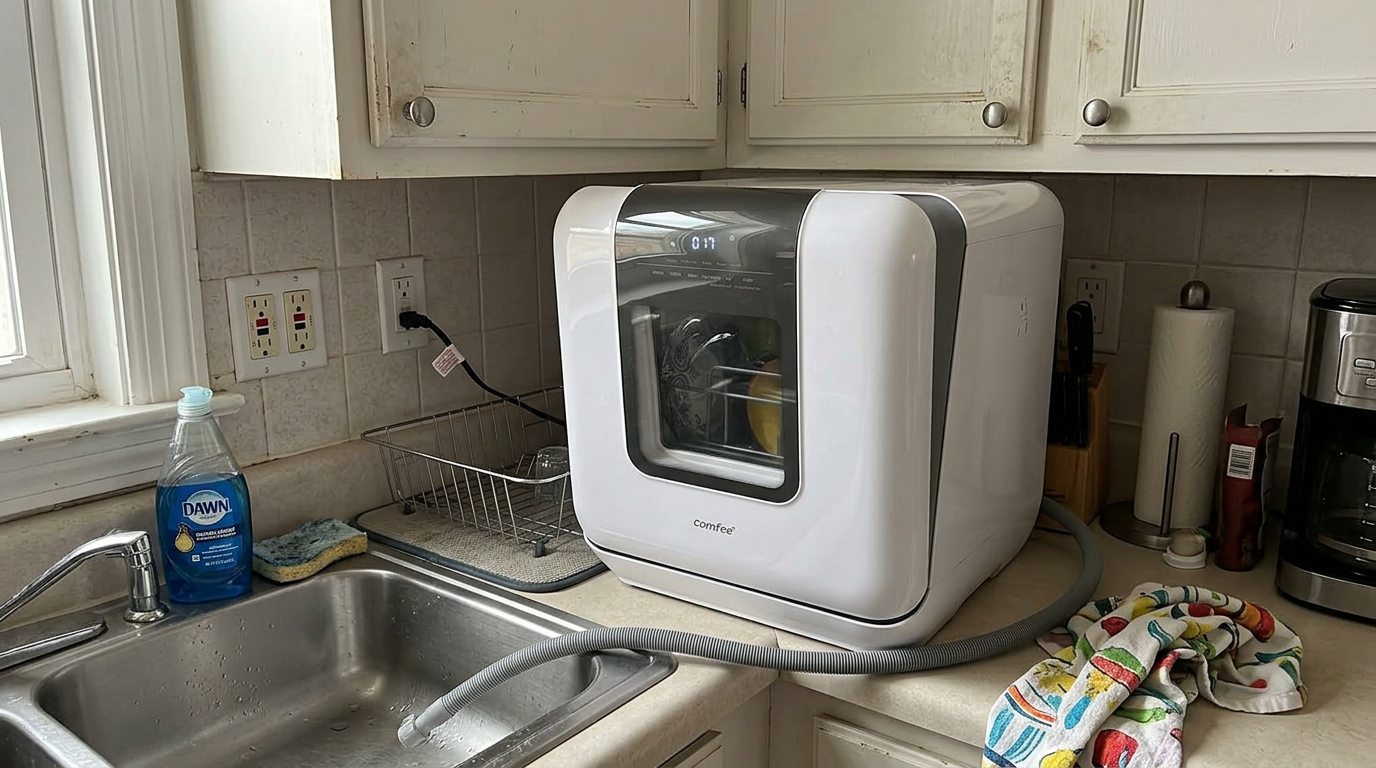
Sized for one to three people.
Our tip: Count the dishes you use in a normal day before you buy, because if it's more than one load you'll be running two cycles daily.
Is the COMFEE CDC17P2AWW worth the money?
For small households without a dishwasher, yes.
It's easy to set up, cleans well, dries properly and keeps itself fresh.
The Hygiene cycle and auto-open door put it a step above simpler countertop models.
Capacity and noise are the main compromises.
Three questions to ask:
Do you have no built-in dishwasher?
Do you cook for three or fewer?
And do you have nearly 20 inches of clearance under your cabinets?
How it compares with other ways to wash dishes
| Feature | COMFEE CDC17P2AWW | Hand-washing | Full-size dishwasher | Basic countertop model |
|---|---|---|---|---|
| Plumbing needed | No | No | Yes | Often |
| Water per load | About 6 liters | Much more | More | Similar |
| Capacity | Small | Any | Large | Small |
| Drying | UV and auto-open door | Towel | Heated | Often weak |
| High-heat cycle | Up to 192°F | No | Often | Sometimes |
| Effort | Low | High | Low | Low |
| Your priority | Is it a fit? | Why |
|---|---|---|
| No installation | Excellent | 6-liter built-in tank |
| Dry dishes | Excellent | Auto-open door and UV drying |
| Greasy cookware | Very good | 192°F Hygiene cycle |
| Big pots | Poor | Too small |
| Quiet operation | Fair | 62 dB wash |
Which one is right for you: is the COMFEE CDC17P2AWW your match?
4 quick questionsCOMFEE CDC17P2AWW specifications
From manufacturer data, retailer listings, the user manual and my own testing.
How I tested and scored the COMFEE CDC17P2AWW
For three weeks, the COMFEE CDC17P2AWW was my only dishwasher in a rental kitchen.
I ran every program, tracked how clean each item came out, tried pods, powder and gel, and checked drying with and without the auto-open door.
I measured water by draining into a bucket and energy with a plug-in meter.
- Drying (9.0): auto-open door and UV drying left dishes dry.
- Ease of setup (8.8): tank or faucet, simple controls; needs cabinet clearance.
- Cleaning (8.6): very good daily; Hygiene handled grease.
- Capacity (6.6): good for one to three; no big cookware.
The overall score of 8.3 is an editorial rating that reflects those four areas.
COMFEE CDC17P2AWW FAQ
Does the COMFEE CDC17P2AWW need plumbing?
No. It has a 6-liter built-in tank you fill with the pitcher. You can also connect it to a faucet with the included quick-connect hose and adapter.
What programs does it have?
Five washing programs, Normal, Rapid, Hygiene, Fruit and Glass, plus UV drying and auto door open.
How hot does the Hygiene cycle get?
Up to 192°F, which handled greasy and baked-on dishes well in my testing.
Do the dishes come out dry?
Yes. The door opens itself at the end of the cycle to vent steam, and UV drying helps keep the tub dry. Plastics held a few drops.
What size plates fit?
Plates up to 10.5 inches. I fit four dinner plates, two side plates, two bowls and two mugs with cutlery.
How much water does it use?
One tank, about 6 liters or roughly 1.6 gallons, per cycle.
How much energy does it use?
About 0.35 kWh per Normal cycle, or around 150 kWh a year with regular use. Hygiene uses more.
How loud is it?
It's rated at 62 dB. It's noticeable in a small open kitchen but fades from the next room.
How much space do I need under the cabinets?
COMFEE recommends more than 19.6 inches between the counter and the wall cabinets so you can open the tank lid.
Can I wash pots and pans in it?
Small saucepans fit with the handle angled. Frying pans and sheet pans didn't fit in my testing.
Can I use dishwasher pods?
Yes. Pods and measured powder both worked well. Never use hand dish soap.
How do I clean the filter?
Twist it out from the base, rinse it every few days, brush it weekly and twist it back in until it locks.
Senior home appliance tester
Emily has tested home appliances for a living since 2016, first as a test coordinator at a national consumer advocacy group and, since 2021, at HouseholdMe. She has a degree in industrial design from Ohio State, so she looks at how a product is built, not just how it performs. She used the COMFEE CDC17P2AWW as her only dishwasher for three weeks for this review.
- Three weeks of hands-on testing of the COMFEE CDC17P2AWW
- COMFEE product information and user manual