Braun MultiQuick 5 MQ515 Hand Blender review
The Braun MultiQuick 5 MQ515 Hand Blender is a light, simple stick blender with a 400-watt motor, a 21-step speed wheel and a turbo button. I used it for three weeks for mayonnaise, whipped cream, frozen berry smoothies, applesauce and leek and potato soup. Mayonnaise turned thick in one beaker, cream whipped in about 30 seconds and soup went smooth right in the pot. Frozen fruit needed some patience and berry seeds stayed in the smoothie, but for everyday blending, it is comfortable, quick and easy to live with.

Emily Carter
Hands-on review
Hands-on testing, research, specs
3 weeks
26 minutes
Jargon helpNew to hand blenders? Tap any dotted term to see what it means.
In this review
Yes, if you want a no-fuss stick blender for soups, sauces, mayonnaise and single smoothies. The Braun MultiQuick 5 MQ515 is light at about 1.8 pounds, the soft grip is comfortable and the buttons need almost no pressure, so holding it for a few minutes never felt like work. The 21-step speed wheel gives real control and turbo handles the tough jobs. The base kit only includes the shaft and a 20-ounce beaker, frozen fruit needs repositioning and whipping cream with the blade takes attention. For everyday cooking in a small kitchen, it is a sensible, comfortable choice.
Braun MultiQuick 5 MQ515 at a glance
Braun MultiQuick 5 MQ515 pros and cons
- Light, soft-grip body with feather-light buttons
- 21 speeds plus turbo for fine control
- Thick mayonnaise and smooth soup with little splashing
- Base kit has no chopper, whisk or masher
- Frozen fruit needs stopping and repositioning
- 20-ounce beaker is only for small batches
Who should buy the Braun MultiQuick 5 MQ515?
- Home cooks who make soup in the pot
- Mayonnaise, dressing and sauce makers
- Small kitchens with little storage
- Daily frozen-smoothie drinkers
- Bakers who whip cream and egg whites often
- Anyone who needs a chopper from day one
First impressions of the MultiQuick 5
Out of the box, the MultiQuick 5 looks plain in a good way.
It is a black motor body with a soft-grip handle and a long stainless steel blending shaft that clicks onto the bottom.
Nothing about it shouts for attention, which suits a tool that lives in a drawer.
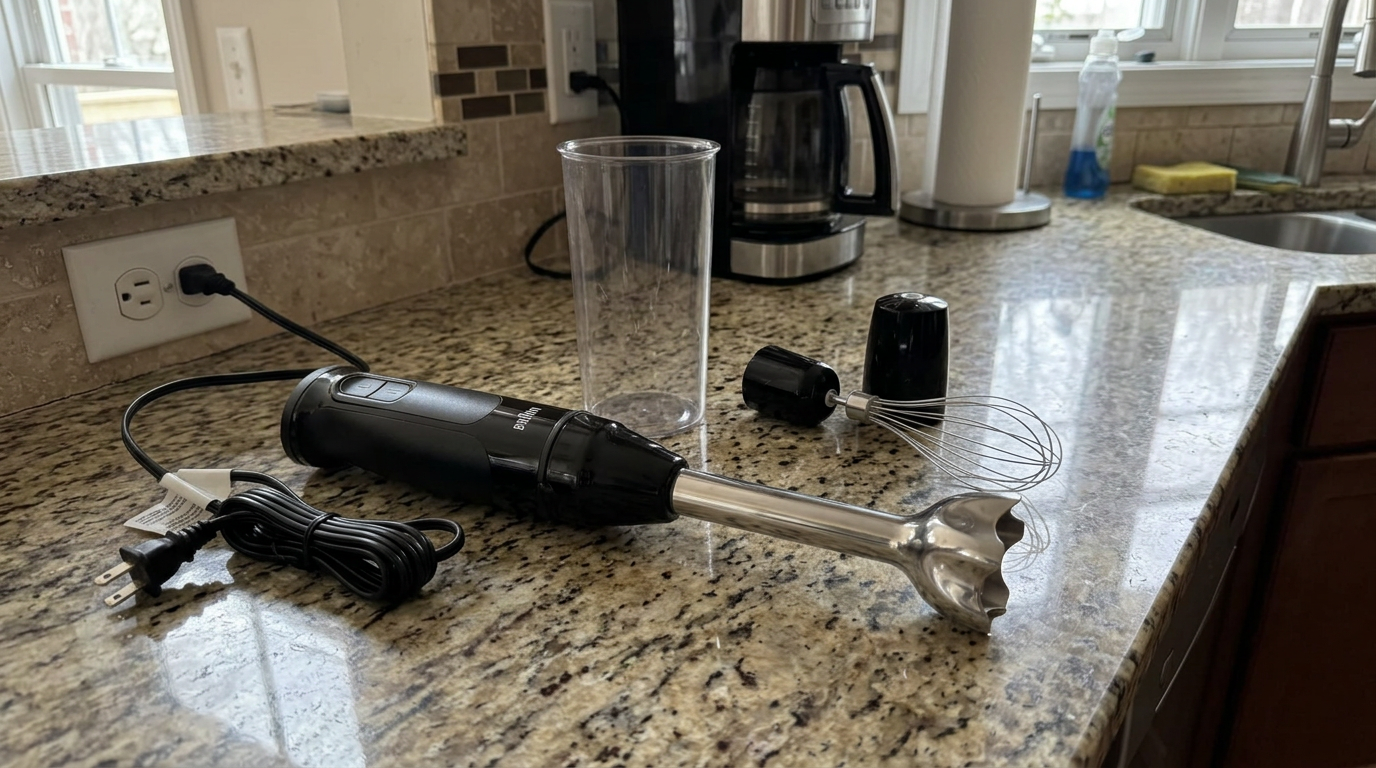
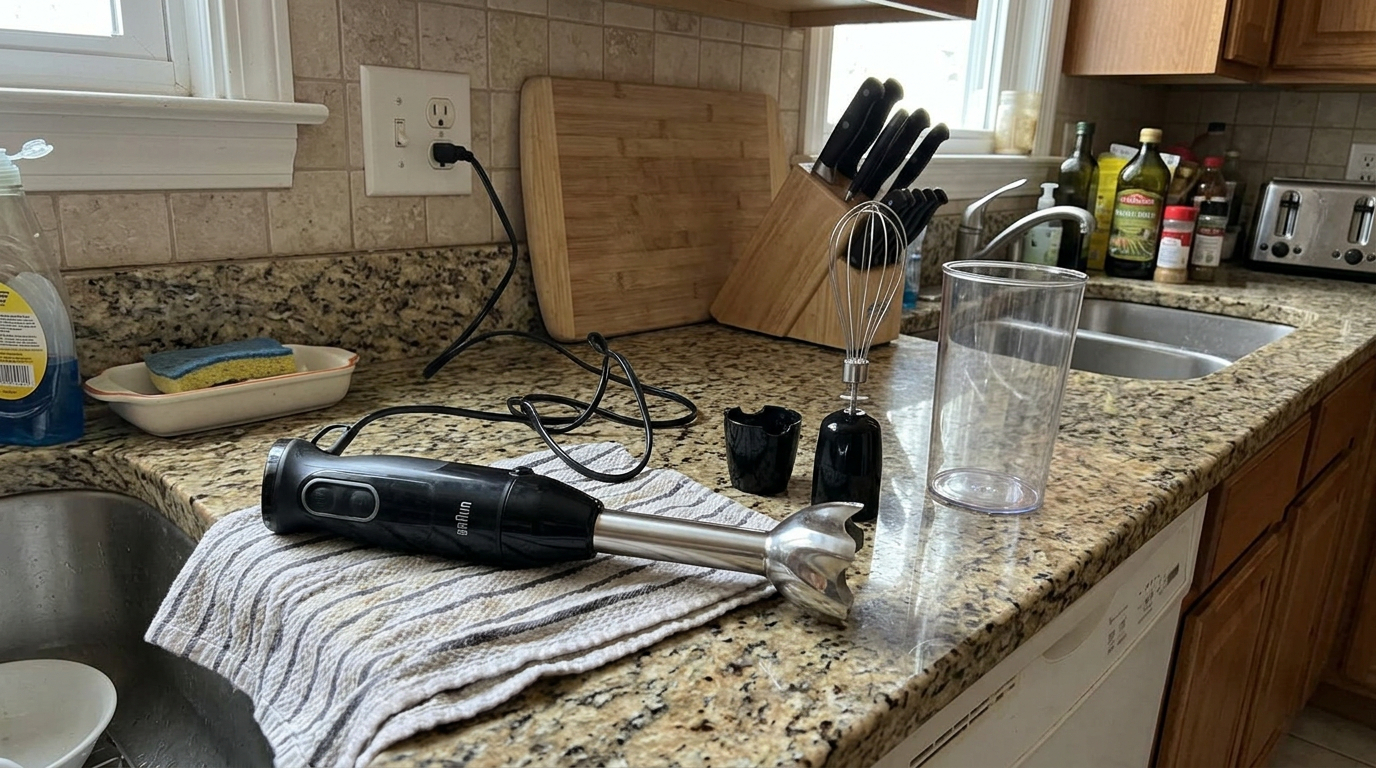
The motor body, stainless steel blending shaft and the 20-ounce beaker.
The first thing I noticed was the weight.
At about 1.8 pounds, it feels lighter than I expected for a 400-watt blender, but it does not feel cheap.
The shaft clicks on firmly and there was no wobble between the two parts.
The controls sit near the top of the handle, right where my thumb landed.
There is a speed wheel, a regular power button and a turbo button.
That is the whole interface, and I liked it that way.
Our tip: Wash the blending shaft and beaker before first use, because new parts can carry factory residue, and a quick wash with warm, soapy water means your first mayonnaise tastes only of egg, oil and vinegar.
Design and build quality
The design is practical and understated.
The black body fits most kitchens and the brushed stainless steel shaft looks like it will last.
The lower part of the shaft holds the blade inside a shaped guard.
The build felt solid throughout my three weeks.
No creaks, no rattles and no play in the shaft connection, even after daily use and several dishwasher cycles.
The plastic beaker is light but stiff enough that it did not flex while I blended mayonnaise in it.
The power cord is long enough for normal counter work.
On my counter, I could reach the stove and the sink area from one outlet without an extension cord.
How far you can go depends on where your outlets are, of course.
| Detail | What I found |
|---|---|
| Weight | About 1.8 lb, light enough for minutes of blending |
| Grip | Soft-touch surface, secure even with damp hands |
| Shaft connection | Firm click, no wobble |
| Beaker | Light, stiff, ounce markings |
| Cord | Long enough for a typical counter |
Our tip: Store the cord loosely coiled rather than wrapped tight around the handle, because tight wraps put stress on the point where the cord enters the motor body and that is where cords usually fail first.
Controls, speed wheel and turbo
The MultiQuick 5 has a variable speed wheel✕Variable speed wheelA thumb-operated dial that sets the motor speed in small steps, so you can pick a gentle or fast speed before pressing the power button. with 21 steps.
You set the speed with your thumb, then press the regular power button to run at that speed.
The turbo button✕Turbo buttonA separate button that runs the motor at maximum power regardless of the speed wheel setting, useful for emulsions, frozen fruit and quick whipping. skips straight to full power.
The speed differences are easy to feel.
Low settings turned cooked apples smoothly without throwing them around, while high settings made short work of soup.
Turbo was my go-to for mayonnaise, whipped cream and frozen fruit.
Both buttons are soft and need very little finger pressure.
That sounds minor, but it matters when you hold a button down for a minute or two.
My thumb never got tired, even during the longest smoothie test.
The speeds I settled on for each task in my tests.
Our tip: Set the speed wheel before you press the power button, because changing speed with your thumb while you hold the button is possible but easy to overdo, and a sudden jump to high speed is what causes most splashes.
Grip, weight and handling comfort
Comfort is where this blender really earns its place.
The soft-grip handle gives a secure hold, and the 1.8-pound weight never felt heavy, even when I worked through a large pot of soup.
I could hold it in one hand and steady the pot with the other.
Vibration was low at every speed.
At turbo, I could feel the motor working, but it did not buzz through my hand the way some cheaper blenders do.
After a two-minute smoothie session, my hand felt fine.
Our tip: Rest your index finger lightly along the side of the handle while your thumb runs the buttons, because this gives you more control over the angle of the shaft and helps you keep the blade submerged.
Homemade mayonnaise test
Mayonnaise is where an immersion blender beats a food processor.
With a processor, you drizzle oil slowly through the lid while the machine runs.
With the MultiQuick 5, everything goes into one beaker at once.
I poured the oil into the 20-ounce beaker, then added one whole egg, one extra yolk, vinegar and salt.
I lowered the blending head to the very bottom of the beaker, pressed turbo and held it still.
Within seconds, a pale, thick emulsion✕EmulsionA smooth mixture of two liquids that normally do not combine, like oil and egg, held together by fast blending. Mayonnaise is the classic example. started forming around the blade.
Once the bottom had thickened, I slowly raised the shaft toward the surface while it kept running, then moved it gently back down.
That pulled the remaining oil into the mix.
The whole thing took well under a minute.
The result was thick, smooth mayonnaise that held its shape on a spoon.
It was perfect for sandwiches, potato salad and a quick garlic dip.
I made it four times during testing and it worked every time.
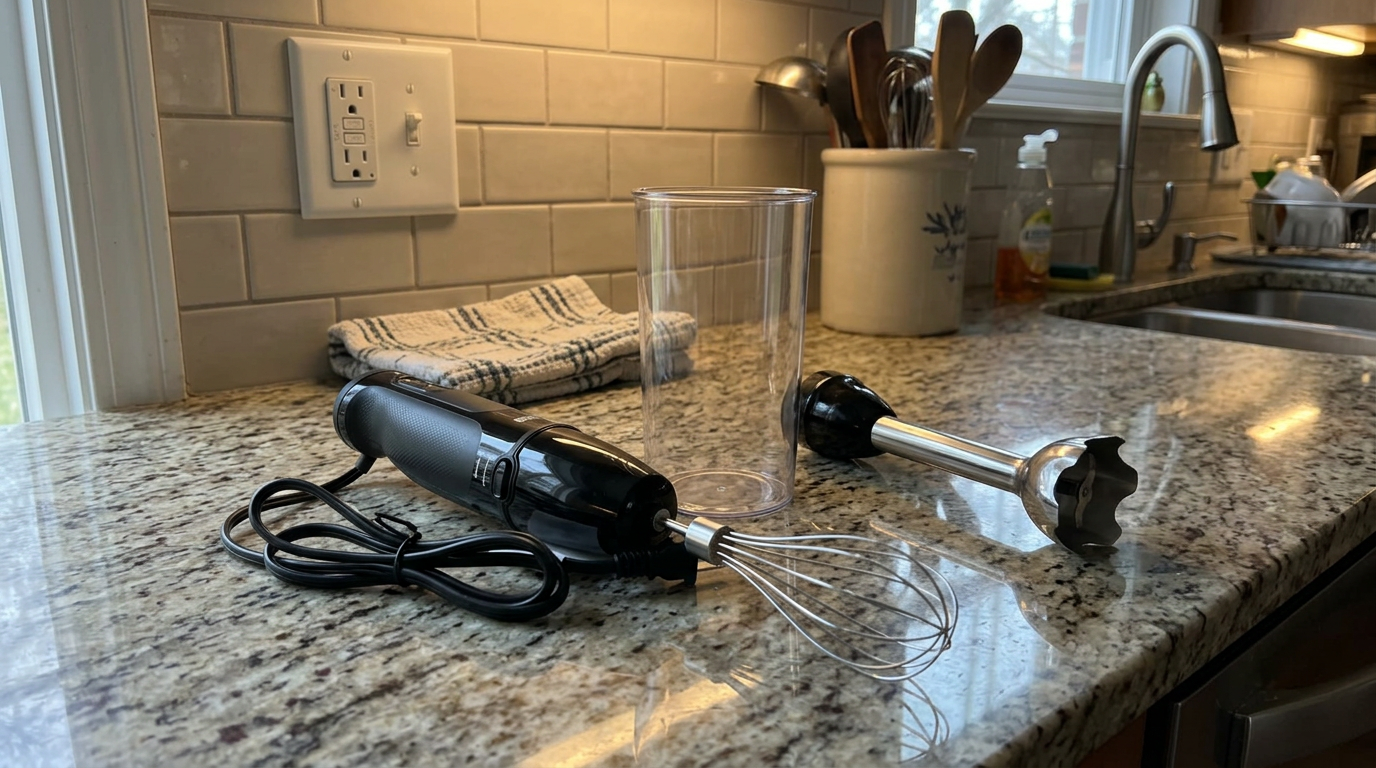
The beaker is the right size for one batch of mayonnaise or dressing.
Our tip: Keep the blade pressed to the bottom of the beaker until you see the mixture turn white and thick, because lifting too early lets oil get pulled in before the emulsion has formed and that is when mayonnaise stays runny.
Whipping cream with the blade
I poured one cup of cold heavy whipping cream into a tall container, lowered the shaft and pressed turbo.
The cream thickened and turned fluffy in about 30 seconds.
That is fast, almost too fast.
You have to watch it the whole time.
A few seconds too long and the cream goes from soft peaks✕Soft peaksThe stage when whipped cream or egg whites hold a peak that gently folds over at the tip. Beyond stiff peaks, cream turns grainy and then separates into butter. to grainy, and then toward butter.
On my second attempt, I stopped at 25 seconds and the texture was ideal.
The cream came out slightly uneven, firmer near the blade and softer at the top.
A few strokes with a spoon fixed that.
It works well for the occasional dessert, but if you whip cream often, the separate whisk attachment is the better tool.
Our tip: Chill the container and the cream before whipping, because cold cream traps air more easily, gives you a little more time before it overwhips and produces a lighter, more stable result.
Frozen berry smoothie test
For the smoothie test, I used a mix of frozen strawberries, blueberries, blackberries and raspberries with milk.
I put the fruit in a tall container, added the milk, submerged the shaft and pressed turbo.
This was the toughest test of the three weeks.
Frozen fruit takes longer than fresh, and the MultiQuick 5 needed help.
Larger strawberries got stuck near the bottom and I had to stop, move the blender and start again a few times.
Altogether, it took about a minute and a half to get a smooth drink.
The finished smoothie was smooth, with no fruit chunks.
Small seeds from the blackberries and raspberries were still noticeable when I drank it.
That is normal for a stick blender, and straining or using seedless fruit solves it.
| Smoothie step | What happened |
|---|---|
| First 20 seconds | Smaller berries blended, large strawberries stuck |
| Stop and reposition | Moved the shaft over the stuck pieces |
| Next 40 seconds | Mixture loosened and circulated |
| Final 30 seconds | Smooth texture, small seeds remained |
Letting the frozen fruit sit in the milk for five minutes before blending helped a lot on my second try.
The edges softened just enough for the blade to grab them, and I stopped far less often.
Our tip: Cut large frozen strawberries in half before freezing them, because smaller, even pieces circulate around the blade more easily and reduce the number of times you need to stop and reposition the blender.
Homemade applesauce
Applesauce was the easiest test.
I peeled a couple of apples, cut them into pieces and cooked them in a saucepan until soft.
Then I turned off the heat and waited for the bubbling to stop.
I started at a medium speed and moved the blender around the pan.
In about 30 seconds, the apples were completely smooth.
No sugar, no extra ingredients, just fresh, warm applesauce.
With a small amount in a wide pan, I had to move the blender around to reach every piece.
For bigger batches, a deeper pot works better because the shaft stays submerged and you can move it gently up and down.
Our tip: Tilt the saucepan slightly toward you when blending a small amount, because this pools the food around the blade so it stays covered and you avoid splatter from the blade catching air.
Leek and potato soup in the pot
Creamy soup is the main reason most people buy an immersion blender.
I made a leek and potato soup and blended it straight in the cooking pot.
No ladling hot liquid into a jar, no extra dishes.
After turning off the heat and letting the boiling stop, I lowered the shaft into the pot and started at medium speed.
I moved it slowly up and down and around the pot.
Within a couple of minutes, the soup was silky and naturally creamy, without any cream added.
The blending head✕Blending headThe bell-shaped guard at the bottom of the shaft that surrounds the blade. Its shape guides food into the blade and reduces splashing and suction. did its job.
As long as the blade stayed under the surface, my stovetop stayed clean.
The long shaft also kept my hand well above the hot soup.
Approximate blending times from my tests.
Our tip: Use a pot that is deeper than it is wide when blending soup, because the extra depth keeps the blade submerged as you move it and contains any splashes, which is safer with hot liquid.
Splash control and noise
The blending head is shaped to improve circulation and reduce splashing.
In practice, it worked well as long as I followed one rule: blade in first, then power on.
The one time I started it half out of the soup, I got a few drops on the wall.
The MultiQuick 5 is quieter than a countertop blender or food processor.
At turbo, it has a clear motor whine, but I could still hear the radio in the kitchen.
At low and medium speeds, it was pleasantly quiet.
| Situation | Splashing |
|---|---|
| Blade fully submerged, medium speed | None |
| Blade submerged, turbo | Very little |
| Blade lifted near the surface | Some |
| Started outside the food | Yes, avoid this |
Our tip: Release the power button and wait for the blade to stop before you lift the shaft out, because a spinning blade near the surface flicks food out of the container and can spray hot liquid.
Attachments and accessories
The base MultiQuick 5 package includes the blender and the beaker.
Braun also makes a whisk, a masher and a chopper that fit the same motor body, depending on the bundle.
The attachment system is simple.
To swap an attachment, you press the two release buttons on the sides of the connection and pull the shaft off.
Then you line up the new attachment and push it on until it clicks.
It took me two seconds once I knew where the buttons were.
| Attachment | Included in base kit? | What it does |
|---|---|---|
| Blending shaft | Yes | Soups, sauces, smoothies, purees |
| Beaker | Yes | Mayonnaise, dressings, small smoothies |
| Whisk | Some bundles | Whipped cream, egg whites, light batters |
| Masher | Some bundles | Mashed potatoes and root vegetables |
| Chopper | Some bundles | Onions, herbs, nuts, breadcrumbs |
I like that you can start with the basic kit and add what you need later.
If you already own a hand mixer or food processor, you may never need the extras.
Our tip: Buy the whisk attachment only if you whip cream or egg whites at least a few times a month, because the standard blade already handles occasional whipping and an unused attachment just takes up drawer space.
Cleaning and care
Cleaning is straightforward.
The stainless steel blending shaft and the beaker are dishwasher-safe, and both came out clean after every cycle.
The motor body should never go in water, so I wiped it with a damp cloth.
Mayonnaise is the messiest job.
Some of it hides under the blade and around the blending head.
I found that rinsing the shaft right away, before anything dried, made all the difference.
The blade is very sharp, so I never put my fingers near it.
A bottle brush or a sponge on a stick reaches inside the guard safely.
Our tip: Detach the shaft from the motor before you rinse it, because water running down the shaft can reach the connection and the motor body, which must stay dry to stay safe.
Safety tips from my testing
A stick blender is simple, but it has a very sharp blade and often goes into hot food.
These are the habits that kept me safe during testing.
- Unplug before changing or cleaning attachments.
- Turn off the heat and wait for boiling to stop before blending.
- Keep the blade submerged before switching on.
- Never touch the blade with your fingers.
- Keep the motor body away from water.
Our tip: Unplug the blender before you reach under the blade to clear a stuck strawberry or piece of apple, because the buttons are so light that a slight bump can start the motor while your fingers are near the blade.
Getting started
Setup takes less than a minute.
Wash the shaft and beaker, push the shaft onto the motor until it clicks and plug it in.
That is it.
I recommend a quick practice run with water in the beaker.
Try a few speeds, try turbo and get a feel for how much the blender wants to move.
It takes the surprise out of your first real recipe.
| Step | What to do |
|---|---|
| 1 | Wash the shaft and beaker |
| 2 | Click the shaft onto the motor body |
| 3 | Set the speed wheel to a low number |
| 4 | Submerge the blade, then press power |
| 5 | Move slowly up and down, then release |
Our tip: Practice with a beaker of water before your first real recipe, because it shows you how each speed and the turbo button feel and how the blender pulls food in, without any risk of wasting ingredients.
Salad dressings and quick sauces
The beaker is ideal for salad dressings.
I made a mustard vinaigrette, a lemon and herb dressing and a creamy yogurt dressing, each in under 20 seconds.
The emulsions held for hours in the fridge instead of separating right away.
Pan sauces were just as easy.
After roasting vegetables, I blended the pan juices with a little stock into a smooth gravy right in the saucepan.
For a quick tomato sauce, I blended a pot of simmered tomatoes and garlic until velvety.
| Recipe | Speed | Time | Result |
|---|---|---|---|
| Mustard vinaigrette | Medium | About 15 seconds | Creamy, stable |
| Lemon herb dressing | High | About 20 seconds | Herbs finely blended |
| Yogurt dressing | Medium | About 10 seconds | Smooth, pourable |
| Tomato sauce | High | About 60 seconds | Velvety, no chunks |
Our tip: Add the mustard or a spoon of yogurt to vinaigrettes before blending, because these act as natural stabilizers and keep the oil and vinegar together far longer than blending alone.
Vegetable purees and baby food
Purees are a natural fit for this blender.
I cooked carrots, sweet potato and peas separately and blended each in a small pot with a little cooking water.
Each one went smooth in under a minute.
The low speeds were useful here.
I could start gently so the soft vegetables did not fly around, then increase the speed until the texture was right.
For a chunkier texture, I simply stopped earlier.
Peas were the only vegetable that kept a few skins in the puree.
A quick push through a sieve fixed that.
Our tip: Add cooking liquid a tablespoon at a time when pureeing vegetables, because it is easy to add more but impossible to take it back out, and too much liquid turns a puree into soup.
Can it mash potatoes?
Without the masher attachment, I would not use the blending shaft for mashed potatoes.
The fast blade breaks down the starch and makes potatoes gluey.
I tried a small test batch to confirm it, and the texture was sticky, as expected.
If mashed potatoes are a weekly dish in your home, look for a bundle with the masher.
Otherwise, a simple hand masher does the job perfectly well.
Our tip: Use the blending shaft for potato soup but not for mashed potatoes, because liquid protects the starch in soup while thick mash turns gluey when a fast blade overworks it.
A good fit for small kitchens
My test kitchen is small, and the MultiQuick 5 never took up counter space.
The motor body and shaft fit in a drawer next to my spatulas, and the beaker nests inside a cupboard with my measuring cups.
For many tasks, it replaced bigger appliances.
I did not take out a countertop blender for single smoothies, and I did not need a food processor for mayonnaise.
That saved space and cleaning time.
| Appliance | Storage space | Setup and cleanup |
|---|---|---|
| MultiQuick 5 | Drawer-sized | Quick: one shaft, one beaker |
| Countertop blender | Counter or large cupboard | Jar, lid and base |
| Food processor | Large cupboard | Bowl, lid, blade and pusher |
Our tip: Hang the blending shaft on a hook or store it upright in a utensil crock, because laying it loose in a drawer exposes the blade guard to knocks and makes it easy to cut yourself reaching past it.
Which package should you choose?
The basic MultiQuick 5 package covers most everyday blending.
If you mainly make soups, mayonnaise, dressings, purees and the occasional smoothie, you do not need anything else.
If you whip cream, meringue or egg whites often, a bundle with the whisk is worth it.
Some bundles add a whisk, masher and two-cup chopper, which turns the blender into a small kitchen system.
Think about how often you would really use each piece before choosing.
| You mostly make | Best choice |
|---|---|
| Soups, sauces, mayonnaise | Base kit |
| Plus regular whipped cream or egg whites | Bundle with whisk |
| Plus mashed potatoes | Bundle with masher |
| Plus chopped onions, herbs and nuts | Bundle with chopper |
Our tip: Check which attachments your chosen bundle includes before ordering, because the MultiQuick 5 name covers several packages and the extras make a real difference to what you can do on day one.
A typical weeknight with the MultiQuick 5
By the second week, I reached for the MultiQuick 5 almost every evening.
A typical night started with a dressing for a side salad, blended in the beaker while the pasta water came to a boil.
Then it went straight into the sink for a quick rinse.
Later, I used it again for the sauce.
A pan of roasted peppers, garlic and stock turned into a smooth, bright sauce in under a minute, right in the pan.
Two jobs, one tool and almost no extra washing up.
| Task | Where I blended | Time |
|---|---|---|
| Lemon herb dressing | Beaker | About 20 seconds |
| Roasted pepper sauce | Saucepan | About 50 seconds |
| Rinse between jobs | Sink | About 15 seconds |
| Final clean | Dishwasher | No effort |
This is where a light stick blender shines.
It is not about one impressive result but about removing small hassles from cooking every day.
I made more fresh dressings and sauces in these three weeks than I usually do in two months.
Our tip: Blend dressings first and sauces second when you use the blender twice in one meal, because a cold, oily dressing rinses off easily while a warm, starchy sauce is easier to clean once the shaft is already wet.
What long-term ownership looks like
Three weeks is not a lifetime, but it tells you a lot about build quality.
After daily use and repeated dishwasher cycles, the shaft looked the same as on day one, with no cloudy marks or rust spots.
The beaker markings had not faded either.
The click connection felt just as firm at the end as at the start.
The speed wheel still turned smoothly with clear steps, and the buttons did not get sticky.
The motor sounded the same and never smelled hot, even after a long soup session.
The part most likely to wear is the cord, as on any corded appliance.
Treating it gently and storing it loosely should help it last for years.
Our tip: Give the motor a short rest after about a minute of continuous turbo use on thick mixtures, because short breaks keep the motor cool and are the easiest way to extend the life of any stick blender.
My three weeks with the MultiQuick 5
In week one, I ran the structured tests: mayonnaise, whipped cream, the frozen smoothie, applesauce and soup.
I timed each one and judged the texture by eye, by spoon and by taste.
In week two, the blender became part of my daily cooking.
I made dressings for lunch salads, a pan sauce most evenings and a weekend batch of tomato soup.
That is when I really came to appreciate how light it is.
In week three, I focused on the small details: cleaning, storage and how the controls felt over time.
Nothing loosened, the shaft still clicked on firmly and the motor sounded the same as on day one.
| Week | Focus | Main finding |
|---|---|---|
| 1 | Structured recipe tests | Excellent mayonnaise and soup, slower frozen fruit |
| 2 | Daily cooking | Light and comfortable for everyday tasks |
| 3 | Details and durability | Solid build, easy cleaning, no wear |
Our tip: Keep the blender plugged in and within reach for the first week, because a tool you can grab in two seconds is one you actually use, and that is the fastest way to learn what it does well.
Troubleshooting what I ran into
A few small problems came up, and each one had an easy fix.
| Problem | Cause | Fix |
|---|---|---|
| Splashes on the wall | Started with the blade out of the food | Submerge first, then press power |
| Strawberries stuck under the guard | Large, hard frozen pieces | Stop, reposition or let fruit soften |
| Runny mayonnaise | Lifted the shaft too early | Hold at the bottom until it turns white |
| Grainy whipped cream | Whipped a few seconds too long | Stop as soon as soft peaks form |
| Shaft will not come off | Release buttons not pressed fully | Press both buttons firmly, then pull |
Our tip: Stop the blender and look whenever the sound changes, because a sudden higher pitch usually means the blade is spinning in air or the food is stuck, and a quick reposition fixes both.
Who it suits in real life
The MultiQuick 5 suits people who cook from scratch a few times a week and want one simple tool for blending.
It is especially good for soup lovers, sauce makers and anyone who wants to make mayonnaise at home.
It is less ideal if you drink a frozen smoothie every morning.
It can do it, but a countertop blender does it faster and with less effort.
Serious bakers will also want the whisk attachment or a hand mixer.
Our tip: Think about the three things you would blend most often before buying any stick blender, because the right choice depends far more on your weekly cooking than on the motor wattage printed on the box.
Is the Braun MultiQuick 5 MQ515 worth the money?
Yes, for everyday blending.
It makes excellent mayonnaise, smooth soups, purees and dressings, and it is one of the most comfortable stick blenders I have held.
Cleanup takes a minute and it stores in a drawer.
The trade-offs are clear.
Frozen fruit needs patience, berry seeds stay in, the beaker is small and the base kit has no chopper or whisk.
If those things matter to you, choose a bundle with attachments.
My category scores after three weeks.
How it compares with other kitchen tools
| Feature | MultiQuick 5 | Countertop blender | Food processor | Hand mixer |
|---|---|---|---|---|
| Blend in the pot | Yes | No | No | No |
| Mayonnaise | Excellent | Good | Good, slow drizzle | Poor |
| Frozen fruit | Fair | Excellent | Poor | No |
| Whipped cream | Fast, needs care | No | Some models | Excellent |
| Storage space | Drawer-sized | Counter space | Large cupboard | Drawer or cupboard |
| Cleanup | Quick | Jar to wash | Several parts | Two beaters |
| Your priority | Fit | Why |
|---|---|---|
| Smooth soups | Excellent | Blends in the pot |
| Mayonnaise and dressings | Excellent | One-beaker method |
| Frozen smoothies | Fair | Needs repositioning |
| Regular whipping | Fair | Fast but needs care, whisk sold in bundles |
| Chopping | Not in base kit | Chopper in some bundles |
Which one is right for you: is the Braun MultiQuick 5 your match?
4 quick questionsBraun MultiQuick 5 MQ515 specifications
From manufacturer data, retailer listings and my own testing.
How I tested and scored the Braun MultiQuick 5 MQ515
For three weeks, the Braun MultiQuick 5 MQ515 was my only blending tool.
I ran five structured tests, mayonnaise, whipped cream, a frozen berry smoothie, applesauce and leek and potato soup, timing each one and judging texture by eye, spoon and taste.
I also used it about 25 times for everyday cooking, including dressings, sauces and purees, and cleaned it after every use.
- Comfort and control (9.0): light body, soft grip, easy buttons, 21 speeds.
- Cleaning (8.6): dishwasher-safe shaft and beaker, quick rinse.
- Blending performance (8.2): excellent mayonnaise and soup, slower frozen fruit.
- Versatility out of the box (7.6): base kit is shaft and beaker only.
My test scores were: mayonnaise 9.2, soup 9.0, applesauce 9.0, whipped cream 7.8 and frozen smoothie 7.2. The overall score of 8.3 is an editorial rating that reflects those results and three weeks of daily use.
Braun MultiQuick 5 MQ515 FAQ
Is the Braun MultiQuick 5 MQ515 worth it?
Yes, for soups, mayonnaise, dressings, purees and single smoothies. It is light, comfortable and easy to clean, though the base kit has no chopper or whisk.
How powerful is the MultiQuick 5 MQ515?
It has a 400-watt motor with a 21-step speed wheel and a turbo button for full power.
Can it make mayonnaise?
Yes, and very well. Put all the ingredients in the beaker, start at the bottom on turbo and slowly raise the shaft once it thickens.
Can it whip cream?
Yes. One cup of heavy cream whipped in about 30 seconds on turbo, but watch closely because it overwhips quickly.
Can it blend frozen fruit?
Yes, but it takes patience. My frozen berry smoothie took about 90 seconds with some repositioning, and small seeds remained.
Can I blend hot soup in the pot?
Yes. Turn off the heat, let the boiling stop and keep the blade submerged. Leek and potato soup went smooth in about two minutes.
What comes in the box?
The base package includes the motor body, the stainless steel blending shaft and a 20-ounce BPA-free beaker.
Are attachments available?
Yes. A whisk, a masher and a chopper fit the same motor body and come in some bundles or separately.
How heavy is it?
About 1.8 pounds, which makes it comfortable to hold for several minutes.
Which parts are dishwasher-safe?
The blending shaft and the beaker. Wipe the motor body with a damp cloth and never put it in water.
Is it loud?
It is quieter than a countertop blender or food processor. You hear the motor on turbo, but it is not harsh.
Can it make mashed potatoes?
Not with the blending shaft, which makes potatoes gluey. Use the masher attachment or a hand masher.
Senior home appliance tester
Emily has tested home appliances for a living since 2016, first as a test coordinator at a national consumer advocacy group and, since 2021, at HouseholdMe. She has a degree in industrial design from Ohio State, so she looks at how a product is built, not just how it performs. She used the Braun MultiQuick 5 as her only blending tool for three weeks for this review.
- Three weeks of hands-on testing of the Braun MultiQuick 5 MQ515
- Braun product information and user manual