Blueair Blue Signature SP1i review
The Blueair Blue Signature SP1i bedroom air purifier is one of the smallest smart purifiers I've tested, yet it cleaned my bedroom faster than many bigger machines. In three weeks, it was almost silent at night, reacted instantly to dust and cooking, and its app and motion-activated screen were a pleasure to use. Its filter is pricier to replace than some and it's designed for one room, but for a bedroom it's hard to beat.

Emily Carter
Hands-on review
Hands-on testing, research, specs
3 weeks
25 minutes
Jargon helpNew to air purifiers? Tap any dotted term to see what it means.
In this review
Yes, if you want a quiet, smart purifier for a bedroom, nursery or home office. The Blueair SP1i cleans a room of about 250 square feet fast, runs as quietly as 19 dB on its lowest setting and uses just 20 watts at most. Its sensors, app and motion-activated touchscreen make it easy to live with. Replacement filters cost more than some rivals', and it's not built for big open-plan rooms, but in its own space it's one of the best I've tested.
Blueair SP1i at a glance
Blueair SP1i pros and cons
- Very quiet, from 19 dB
- Fast cleaning for its size
- Smart sensors, app and touchscreen
- Replacement filters cost more than some
- Designed for one room
- Light on manual controls without the app
Who should buy the Blueair SP1i?
- Bedrooms and nurseries
- Light sleepers
- Small apartments and home offices
- Large open-plan living spaces
- Buyers chasing the lowest running costs
- People who want no app at all
First impressions of the Blueair SP1i
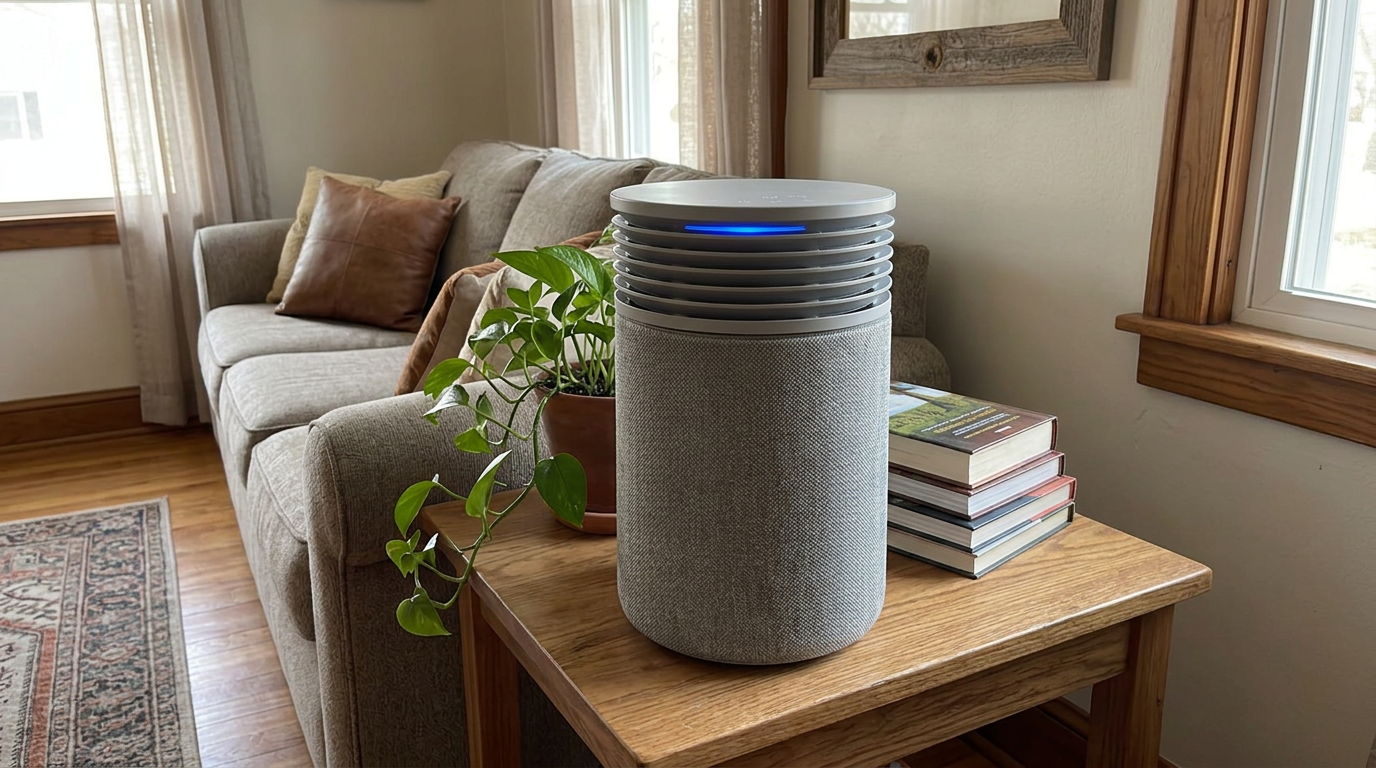
The first thing I noticed about the Blueair SP1i was how small it is.
It's under 14 inches tall, about 9.4 inches across and weighs less than 6 pounds, so it fits comfortably on a nightstand or dresser.
Blueair is a Swedish brand, and it shows: the design is soft, simple and modern, with a fabric pre-filter wrapped around the base and a clean top.
It looks more like a speaker or a lamp base than an appliance, which matters because purifiers work best out in the open rather than hidden away.
If a purifier is ugly, people tend to tuck it behind a chair or under a desk, where it can't draw air properly.
The SP1i is the kind of purifier you're happy to leave in plain view on a nightstand or bookshelf, and that alone makes it work better in real life.
The fabric pre-filter also comes in other colors, so you can match it to your room if the standard shade doesn't suit you.
Build quality felt solid, with no rattles or creaks when I picked it up or moved it between rooms.
On top is a touchscreen that wakes up when you move your hand near it, then fades away again.
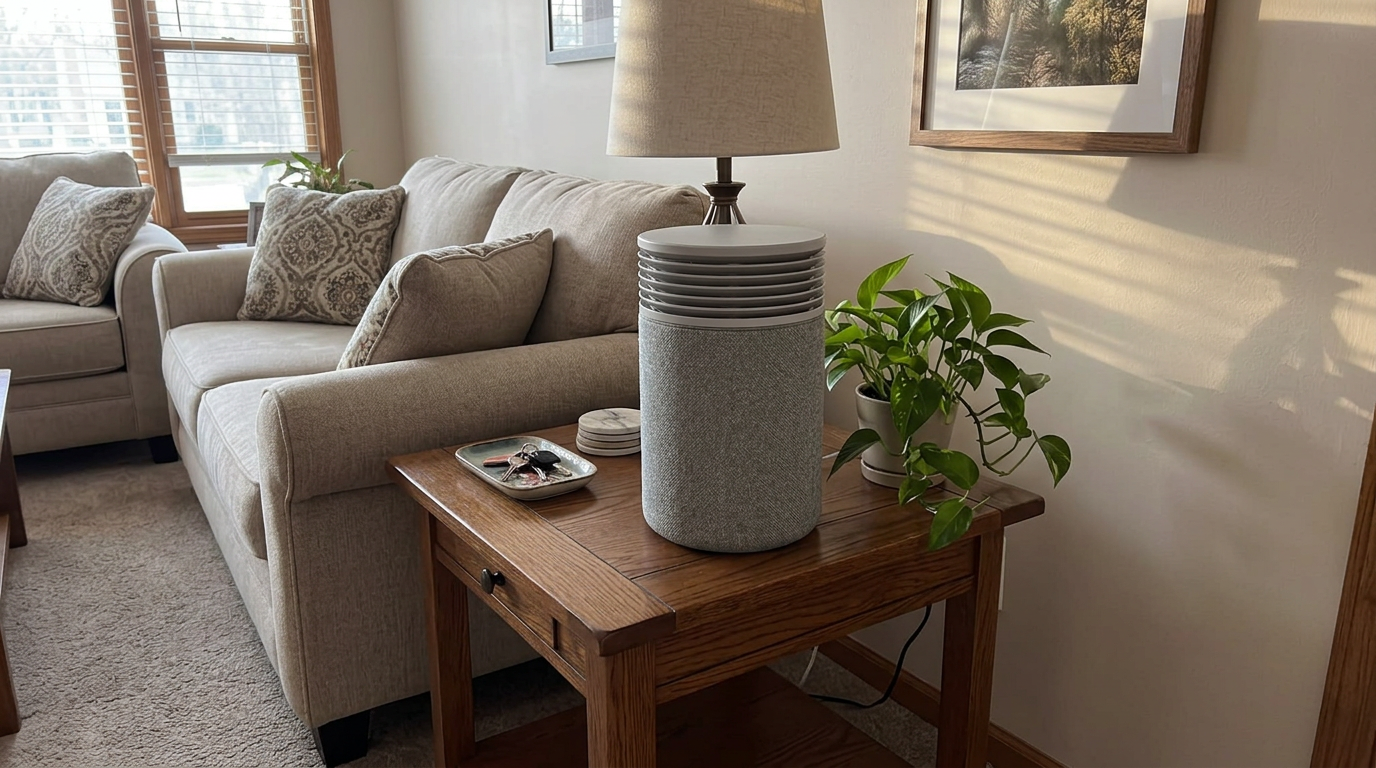
Small enough for a nightstand, and designed to be seen.
Setting it up
Setup took about ten minutes, including the app.
I removed the packaging, checked that the filter inside was unwrapped and placed the purifier on my dresser.
Then I plugged it in, downloaded the Blueair app and connected it to my Wi-Fi.
The app walked me through each step, and the purifier was running in auto mode within minutes.
| Step | What to do |
|---|---|
| 1 | Remove all packaging |
| 2 | Check the filter is unwrapped |
| 3 | Place it with space around the base |
| 4 | Plug in and switch on |
| 5 | Connect the Blueair app over Wi-Fi |
| 6 | Select auto mode |
Our tip: Connect the app during setup rather than later, because it's the easiest way to set schedules, track filter life and check air quality from bed.
What the Blueair SP1i actually is
Blueair recommends the SP1i for rooms up to 248 square feet.
At that size, it filters all the air in the room in about 12.5 minutes, which works out to 4.8 air changes per hour✕Air changes per hour (ACH)How many times a purifier can filter the full volume of air in a room each hour. Four to five is a common target for allergies and smoke..
That's the level usually recommended for allergies and smoke.
Its CADR✕CADRClean Air Delivery Rate: how many cubic feet of cleaned air a purifier delivers per minute. Higher means it cleans a room faster. is about 160 to 179 cubic feet per minute, depending on the pollutant, which is impressive for something this small.
For light background cleaning, it can cover up to about 1,190 square feet in an hour.
CADR by pollutant
Blueair's rated clean air delivery rates.
| Room size | Time to filter all the air | Good for |
|---|---|---|
| Up to 248 sq ft | About 12.5 minutes | Allergies, pets, smoke |
| Up to about 1,190 sq ft | About 1 hour | Light background cleaning |
Our tip: Use the 248 square foot figure when choosing a room, because that's the size where the SP1i delivers the fast, thorough cleaning allergy sufferers need.
How the filtration works
The SP1i uses Blueair's HEPASilent✕HEPASilentBlueair's filtration technology, which combines a light electrical charge on particles with mechanical filter media. It allows a less dense filter, so the fan can move more air more quietly. technology, which combines electrostatic and mechanical filtration.
In plain terms, it gives particles a slight charge so a less dense filter can catch them.
A less dense filter lets air through more easily, which is why the purifier can be small and quiet yet still move a lot of air.
Blueair rates it to capture at least 99.97% of particles down to 0.1 microns.
The layers
The outer fabric pre-filter catches larger dust, lint and hair.
Inside is a particle filter combined with activated carbon✕Activated carbonCarbon treated to have a huge surface area full of tiny pores. It traps odors and gases such as cooking smells and VOCs that particle filters can't catch. for odors and gases.
Blueair also adds what it calls OdorFence technology for odor gases.
| Layer | Catches | Maintenance |
|---|---|---|
| Fabric pre-filter | Lint, hair, large dust | Vacuum or replace |
| HEPASilent particle filter | Fine dust, pollen, dander, smoke | Up to 1 year |
| Carbon and OdorFence | Odors, gases, VOCs | Part of the main filter |
Our tip: Vacuum the fabric pre-filter with an upholstery brush every couple of weeks, because a clean outer layer keeps airflow high and the purifier quiet.
How well it cleans
I tested the Blueair SP1i in my 200 square foot bedroom and my 220 square foot home office.
In both, it brought the air back to a good reading very quickly after dusty jobs.
After I fluffed the duvet and shook out the pillows, the air quality dipped and then recovered within minutes in auto mode.
Cooking smells drifting upstairs triggered it too, and it cleared them faster than I expected from such a small purifier.
I also tried it for a day in my large living room, where it made a noticeable difference near the sofa but couldn't keep the whole space as clean.
My impressions from three weeks of air quality readings.
Sensors and auto mode
The SP1i has particle sensors and a VOC✕VOCsVolatile organic compounds: gases released by things like cleaning sprays, paint, new furniture and cooking. Some can irritate the eyes and lungs. sensor that track the air in real time.
In auto mode, the fan speed adjusts itself based on what the sensors detect.
The colored indicator shows blue for good air, yellow for moderate and red for poor.
During testing, it reacted to fluffing the duvet, frying onions downstairs, a cleaning spray and even an uncovered sneeze.
There's also an eco mode, which saves energy once the air is clean.
| What I did | Indicator | Auto mode response |
|---|---|---|
| Fluffed the duvet | Red | Ramped up, cleared in minutes |
| Cooking downstairs | Yellow | Medium for a while |
| Used a cleaning spray | Yellow | VOC sensor boost |
| Sneezed | Brief yellow | Short boost |
| Quiet evening | Blue | Lowest speed or eco |
Our tip: Leave it in auto and let eco mode take over when the air is clean, because the sensors respond faster than you would and it saves power the rest of the time.
The touchscreen and app
Motion-activated touchscreen
The touchscreen on top wakes up when it detects your hand nearby, then fades when you walk away.
From there, you can choose auto, night, eco or one of four fan speeds.
I loved that the screen isn't permanently lit, which makes a big difference in a bedroom.
The Blueair app
The app shows real-time air quality, lets you change modes and fan speeds, and set schedules.
It also tracks filter life and can remind you when it's time to replace the filter.
I used it most for switching to night mode from bed and checking how the air had been during the day.
Our tip: Set a nightly schedule in the app to switch to night mode at bedtime, so you never have to reach over and tap the screen in the dark.
Noise levels
This is where the SP1i really stands out.
On its lowest setting, Blueair rates it at just 19 dB, which is below what most people can hear in a quiet room.
In night mode, I genuinely couldn't tell it was on unless I put my ear right next to it.
On the highest speed, it reaches about 50 dB, roughly the level of a normal conversation.
That's audible, but it's still quieter than many purifiers on their top setting.
Blueair's rated noise range and how each level felt in my bedroom.
Our tip: Use night mode rather than the lowest manual speed at bedtime, because it keeps the purifier quiet and the display dark at the same time.
Power use
The SP1i uses a maximum of 20 watts, which is very low.
Even if you ran it at full power all day, every day, it would use about 15 kilowatt-hours a month.
In auto and eco mode, it used far less in my testing, because the fan spent most of the time on its lowest speeds.
Estimated monthly energy use based on the rated wattage and my usage.
Electricity costs are tiny; the main running cost is the replacement filter.
Our tip: Keep eco mode on during the day when nobody is in the room, because it trims power use further without letting the air quality slip.
Maintenance and filter life
Blueair says the filter can last up to a year, depending on how you use it.
Its RealTrack system estimates filter life based on fan speed, how long the purifier runs and how polluted the air is.
When the filter needs replacing, an LED turns red and the app sends a reminder.
Between replacements, the only job is vacuuming the fabric pre-filter.
| Task | How often | Time needed |
|---|---|---|
| Vacuum the fabric pre-filter | Every 2–4 weeks | 2 minutes |
| Wipe the top and screen | Monthly | 1 minute |
| Replace the main filter | Up to once a year | 5 minutes |
| Replace the pre-filter | When worn or for a new color | 2 minutes |
The downside is that replacement filters cost more than those for some other compact purifiers.
Over several years, that adds up, so it's worth factoring in.
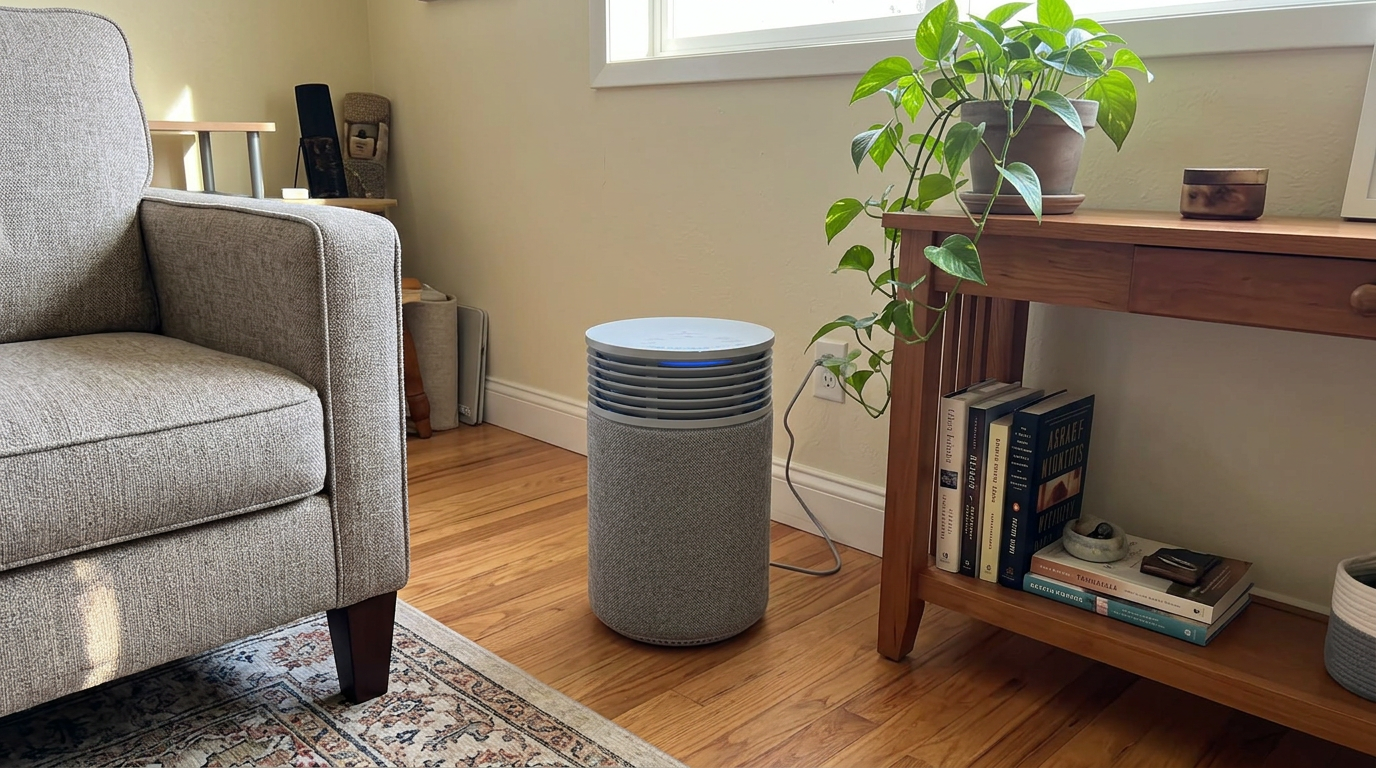
The fabric pre-filter is the only part that needs regular attention.
Where to put it
The SP1i draws air in through 360 degrees around the base and pushes clean air out of the top.
That means it can sit near a corner, as long as it isn't pressed right against a wall or furniture.
Its small size makes it ideal for a nightstand, dresser or desk.
Our tip: Raise it onto a nightstand or dresser rather than leaving it on the floor, because it's closer to where you breathe and the touchscreen is easier to reach.
Living with it in the bedroom
The bedroom is where the Blueair SP1i felt completely at home.
It sat on my dresser for most of the test, running in auto during the day and night mode overnight.
The screen stayed dark unless I reached over it, and the fan was silent enough that I forgot it was there.
Every morning, the app showed clean air through the night, with small spikes when the dog jumped onto the bed.
I noticed less of the morning stuffiness I sometimes get, though everyone's allergies are different.
| Bedroom factor | How it did |
|---|---|
| Size | Fits on a dresser or nightstand |
| Display at night | Dark unless you reach for it |
| Night noise | Essentially silent |
| Morning air | Consistently clean |
Living with it in the home office
I moved it to my office for several workdays, carrying it by hand because it's so light.
Even on its higher speeds, it never got loud enough to bother me on video calls.
The VOC sensor picked up a desk cleaning spray and a scented candle, and the purifier ramped up straight away.
It also kept my bookshelves noticeably less dusty over the test.
Share of a typical workday, from my testing notes.
Odors, pets and small utility rooms
Small Blueair purifiers have a reputation for handling odors well in small spaces, so I tested that too.
I put the SP1i in my laundry room for two days, where a musty smell builds up in damp weather.
By the second day, the smell had faded noticeably.
In the bedroom, it also helped with that general dog smell after a wet walk.
It's not designed for a large kitchen, but in a small room the carbon and OdorFence layer made a real difference.
| Problem | How the SP1i handles it | My rating |
|---|---|---|
| Dust | HEPASilent filter | 9.0 |
| Pollen and pet dander | HEPASilent filter, fast airflow | 9.0 |
| Musty laundry room smell | Carbon and OdorFence | 8.5 |
| Cooking smells | Carbon, small room only | 7.8 |
Our tip: Try it in a laundry room or small bathroom with no window, because a compact purifier with carbon is great at stopping musty smells in a small, closed space.
Allergy season
For allergy sufferers, a bedroom purifier needs three things: enough airflow, a fine filter and quiet nights.
The SP1i ticks all three.
Its 4.8 air changes per hour in a 248 square foot room meet the usual allergy recommendation.
Its HEPASilent filter targets pollen, dust mite debris and pet dander, including fine PM2.5✕PM2.5Fine particles 2.5 micrometers or smaller, such as smoke and some pollution. They can travel deep into the lungs..
And it's quiet enough to run all night.
| Allergy habit | Why it helps |
|---|---|
| Close the bedroom door | Keeps the room within its coverage |
| Run it all night in night mode | Clean air while you sleep |
| Wash bedding weekly | Removes allergens it can't reach |
| Close windows on high-pollen days | Stops pollen coming in |
Our tip: Change out of outdoor clothes before going into the bedroom during pollen season, because the less pollen you carry in, the easier it is for the purifier to keep the room clean.
Smoke, candles and cooking
Smoke particles are among the hardest for a purifier to deal with, because they're so fine.
The SP1i's smoke CADR of 160 cubic feet per minute is strong for its size, and that showed in my testing.
When I blew out a candle in the bedroom, the indicator went red and returned to blue within a few minutes in auto.
A burnt piece of toast downstairs took longer to clear upstairs, because the smoke kept drifting in until I closed the bedroom door.
Once the door was shut, the room recovered quickly.
For homes affected by wildfire smoke, I'd use the SP1i to keep the bedroom clean and run a larger purifier in the main living area.
| Smoke source | Door | How quickly it cleared |
|---|---|---|
| Candle in the bedroom | Closed | A few minutes |
| Burnt toast downstairs | Open | Slow, kept drifting in |
| Burnt toast downstairs | Closed | Quickly once sealed |
Our tip: On smoky days, keep the bedroom door and windows closed and set the SP1i to a high speed for an hour, because a sealed room is what lets a compact purifier get ahead of fine smoke.
What a year of ownership looks like
Based on my three weeks and Blueair's guidance, a year with the SP1i should be simple.
You'll vacuum the fabric pre-filter roughly once or twice a month.
You'll probably replace the main filter once, when the app and LED say it's time.
You might replace the fabric pre-filter if it gets worn, or simply because you want a different color.
Electricity use stays very low thanks to the 20 watt maximum and eco mode.
My estimate for a typical bedroom.
The yearly filter is the main cost to plan for.
In return, you get a purifier that's essentially maintenance-free the rest of the time.
One small purifier per room or one big one?
A question I'm often asked is whether it's better to buy one large purifier or a small one for each room.
After testing the SP1i, I lean toward small purifiers for bedrooms.
Bedroom doors are usually closed at night, so a big purifier in the hallway or living room can't reach them.
A compact unit like this one sits right where you sleep, cleans fast and stays quiet.
For a large open-plan living space, though, a bigger purifier will do a better job than several small ones.
| Space | Better choice | Why |
|---|---|---|
| Bedrooms | A small purifier each | Doors closed at night |
| Home office | A small purifier | Quiet during calls |
| Open-plan living area | One larger purifier | More airflow for the space |
| Laundry room | A small purifier | Musty smells in a closed space |
Design details I liked and didn't
What I liked
It's small, light and genuinely attractive.
The motion-activated screen is the best bedroom display I've used on a purifier.
The fabric pre-filter softens the look and is easy to clean.
And 360-degree intake means it works in a corner.
What I didn't
Replacement filters and pre-filters aren't cheap.
Without the app, schedules and filter tracking are harder to use.
And it's built for a single room, so a large home needs more than one.
- Small and light
- Motion-activated screen
- Fabric pre-filter
- Filter costs
- Best features need the app
- One room only
What surprised me
How fast such a small purifier cleans
I expected a purifier this size to be slow, but it cleared my bedroom faster than some much larger machines.
How quiet night mode is
At 19 dB, I genuinely had to check the app to be sure it was running.
How much I liked the hidden screen
A display that only wakes when you need it sounds minor, but in a bedroom it's a big deal.
From my testing notes.
How to get the best results
Use it in a room of up to about 250 square feet.
Leave it in auto during the day and night mode overnight.
Connect the app for schedules and filter tracking.
Vacuum the fabric pre-filter every few weeks.
And keep a little space around the base so it can draw air from every side.
All my test results in one place
| Test | Result | My rating |
|---|---|---|
| Bedroom cleaning | Fast recovery after dusty jobs | 9.4 |
| Office cleaning | Fast and quiet | 9.2 |
| Large living room | Helped locally | 6.0 |
| Sensor response | Seconds, including VOCs | 9.0 |
| Night noise | 19 dB rated, essentially silent | 9.8 |
| Odors in a small room | Musty smell faded in 2 days | 8.5 |
| Power | 20 W maximum | 9.6 |
What daily use is really like
For most of the three weeks, the Blueair SP1i lived on my bedroom dresser.
I moved it to the office for a few workdays and to the laundry room for two.
It ran in auto with eco during the day, switching to night mode on a schedule at 10 p.m.
Mornings began with a glance at the app, which almost always showed clean air overnight.
Making the bed triggered a brief boost, and the indicator was back to blue by the time I'd finished getting dressed.
During the day, the purifier ticked over so quietly that I rarely thought about it.
In the evening, cooking smells sometimes drifted up the stairs, and the sensors caught them before I did.
I vacuumed the fabric pre-filter once, after two weeks, and that was the only maintenance.
The days in the laundry room were a nice test of its versatility.
I carried it down in the morning, left it in auto with the door closed, and by the evening the room smelled noticeably fresher.
Being able to move it easily is a real advantage, because the room that needs cleaning most can change from day to day.
Share of running time from my testing notes.
Three weeks with the SP1i, week by week
Week 1: bedroom testing
The speed and silence impressed me straight away, and the app setup was painless.
Week 2: office and laundry room
It proved just as useful during the workday and surprisingly good at musty smells.
Week 3: settled routine
Schedules, auto mode and one pre-filter clean: it simply worked.
From my testing notes.
Common mistakes to avoid
| Mistake | What happens | Better habit |
|---|---|---|
| Using it for a big open-plan room | Can't keep up | One per room |
| Pushing it against a wall | Weaker airflow | A few inches of space |
| Skipping the app | No schedules or filter tracking | Connect it during setup |
| Ignoring the pre-filter | Louder, slower cleaning | Vacuum every few weeks |
| Replacing the filter by date | Wasted filter life | Follow the app's estimate |
| Leaving it on the floor | Further from where you breathe | Nightstand or dresser |
What I would change
Cheaper replacement filters would make it easier to recommend for the long term.
A few more on-unit options, such as schedules, would help people who don't want to use an app.
And a slightly larger version with the same quiet design would suit bigger bedrooms.
I'd also like the indicator light to dim further in night mode, although the motion-activated screen already does most of the work.
On a couple of nights, reaching for my phone on the nightstand woke the screen briefly, which was a small distraction in a dark room.
Moving the purifier to the dresser, a few feet from the bed, solved that completely.
Finally, I'd welcome a clearer view of the filter's remaining life on the purifier itself, rather than only in the app.
None of these are serious problems, and they don't change my view that this is one of the best bedroom purifiers I've tested.
They're the kind of small refinements I'd hope to see in the next version.
Three households, three verdicts
The light sleeper
Needs clean air and silence in the bedroom.
An excellent fit.
The small apartment
A studio or one-bedroom with a small living space.
Very good for the bedroom; you might want a second unit for the living area.
The open-plan family home
One purifier for a large living, dining and kitchen space.
Not the right choice on its own.
| Household | Fit | Main reason |
|---|---|---|
| Light sleepers | Excellent | 19 dB night mode |
| Allergy sufferers | Excellent | 4.8 ACH in 248 sq ft |
| Smart-home users | Very good | App and schedules |
| Large open-plan home | Poor alone | Single-room coverage |
Is the Blueair SP1i worth the money?
For a bedroom, yes.
You're getting fast cleaning, near-silent nights, smart sensors and a well-designed app in a purifier small enough for a nightstand.
Electricity costs are tiny thanks to the 20 watt maximum.
The main ongoing cost is the filter, which is pricier than some, though it can last up to a year.
Three questions to ask:
Is the room around 250 square feet or smaller?
Is quiet operation a priority?
And are you comfortable with yearly filter costs?
How it compares with other types of purifier
| Feature | Blueair SP1i | Typical compact purifier | Large-room purifier |
|---|---|---|---|
| Room at about 5 ACH | Up to 248 sq ft | About 150–200 sq ft | 400 sq ft or more |
| Lowest noise | 19 dB | Often 25–35 dB | Often 30–40 dB |
| Max power | 20 W | Often 20–40 W | Often 40–70 W |
| App | Yes | Sometimes | Often |
| Filter life | Up to 1 year | Often 6–12 months | Often 6–12 months |
| Size | Nightstand-sized | Small | Large |
| Your priority | Is the SP1i a fit? | Why |
|---|---|---|
| Quiet nights | Excellent | 19 dB night mode |
| Fast bedroom cleaning | Excellent | 4.8 ACH in 248 sq ft |
| Smart features | Very good | App, sensors, touchscreen |
| Lowest running costs | Fair | Pricier filters |
| Large open-plan spaces | Poor | Single-room design |
Which one is right for you: is the Blueair SP1i your match?
4 quick questionsBlueair SP1i specifications
From manufacturer data, retailer listings and my own testing.
How I tested and scored the Blueair SP1i
For three weeks, the Blueair SP1i ran in my 200 square foot bedroom, my 220 square foot office, my laundry room and, for one day, my large living room.
I tracked air quality with a separate monitor after making the bed, vacuuming, cooking and using cleaning sprays.
I judged noise at every setting in a quiet room at night, estimated energy use from the rated wattage and my usage, and used the app daily.
I also vacuumed the pre-filter and checked the app's filter-life estimate.
Finally, I checked my notes against Blueair's specifications.
- Quietness (9.6): 19 dB night mode and a soft top speed.
- Air cleaning (9.0): fast in rooms up to about 250 square feet.
- Smart features (8.8): sensors, app and touchscreen.
- Running costs (7.6): very low power, but pricier filters.
The overall score of 8.7 is an editorial rating that reflects those four areas.
Blueair SP1i FAQ
Is the Blueair SP1i worth it?
Yes, for bedrooms, nurseries and home offices. It's fast, very quiet and smart, though replacement filters cost more than some.
How big a room does it cover?
Blueair recommends it for rooms up to 248 square feet, which it cleans in about 12.5 minutes. It can cover about 1,190 square feet in an hour for light cleaning.
How quiet is it?
From 19 dB on its lowest setting to about 50 dB on high.
Does it have an app?
Yes. The Blueair app shows air quality, controls modes and speeds, sets schedules and tracks filter life.
How long does the filter last?
Up to a year, estimated by Blueair's RealTrack system based on how the purifier is used.
What is HEPASilent?
Blueair's filtration technology, combining electrostatic and mechanical filtration for high airflow with low noise.
Does it remove odors?
Yes. It has carbon and OdorFence technology, which worked well on musty smells in a small room.
How much power does it use?
A maximum of 20 watts.
Does the display stay on at night?
No. The touchscreen is motion-activated and stays dark unless you reach toward it.
Can I put it in a corner?
Yes. It draws air in from all sides, but leave a few inches of space.
Is it good for allergies?
Yes. It delivers 4.8 air changes per hour in a 248 square foot room, the usual allergy target.
What modes does it have?
Four fan speeds plus Auto, Night and Eco modes.
Senior home appliance tester
Emily has tested home appliances for a living since 2016, first as a test coordinator at a national consumer advocacy group and, since 2021, at HouseholdMe. She has a degree in industrial design from Ohio State, so she looks at how a product is built, not just how it performs. She tested the Blueair SP1i in her bedroom, office and laundry room for three weeks for this review.
- Three weeks of hands-on testing of the Blueair SP1i
- Blueair Blue Signature product information and specifications