The Best Budget Jura Automatic Coffee Machines in 2026
I lived with 13 Jura automatic coffee machines for four weeks each, then asked one question: which ones give you the real Jura experience without paying for touchscreens, profiles and party tricks you won't use? Five stood out. For most people, I recommend the Jura E6: a full-size 16-gram brew unit, a proper two-step americano, three hot water temperatures for tea and one-touch cappuccinos.

Michael Reynolds
Buying Guide
13 Jura models · 5 picks
4 weeks per machine
I choose products independently, based on hands-on testing. We may earn a commission through links on this page; your price stays the same. Affiliate policy
Jargon helpNew to espresso machines? Tap any dotted term to see what it means.
In this guide
The short answer
- Best budget Jura overall: the Jura E6. Rich espresso, a true two-step americano, tea water at three temperatures and a cappuccino at one touch.
- Best budget espresso: the Jura C3. The same full-size 16-gram brew unit as much bigger machines, in a compact body that only does black coffee.
- Most affordable compact Jura: the Jura ENA 4. Sweet, crema-rich espresso from one of the smallest and quietest bean-to-cup machines I've used.
- Best for americanos and tea: the Jura E4. Button-simple black coffee plus a separate hot water spout, with the easiest cleaning I measured.
- Best budget milk foam: the Jura C9. Some of the finest one-touch foam I've tested and 17 drinks in a body just over 10 inches wide.
Our picks at a glance
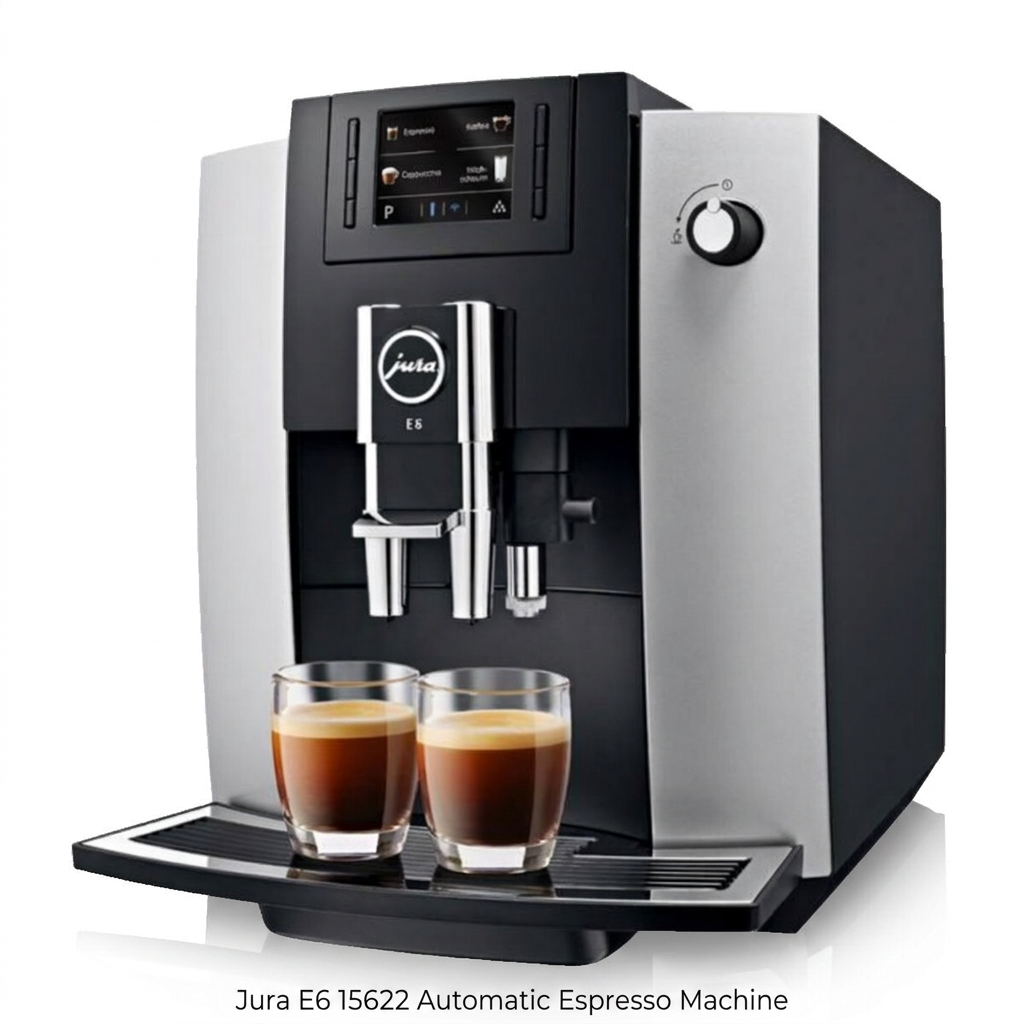
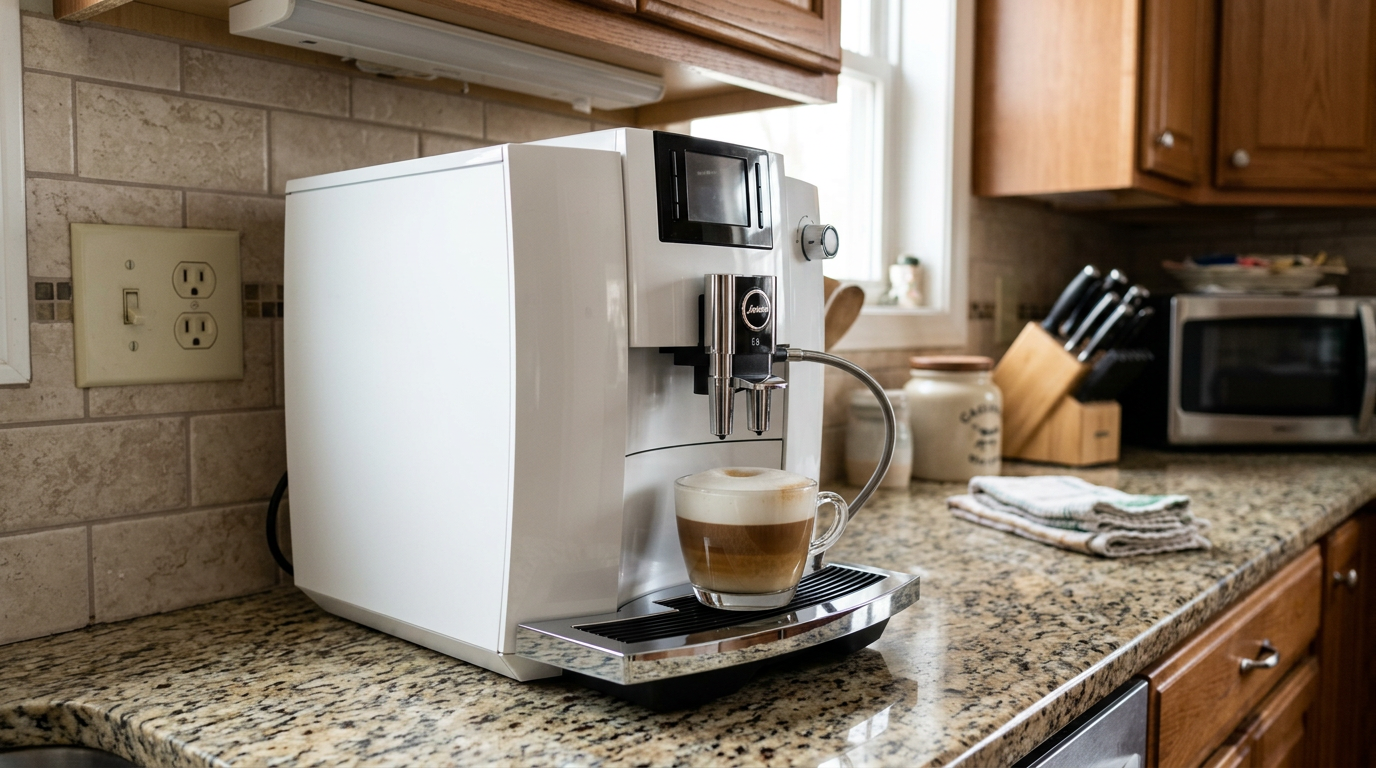
Jura E6 Automatic Espresso Machine
The sensible all-rounder: a 16-gram brew unit, two-step americano, three tea temperatures, one-touch cappuccino and a menu that learns your habits.
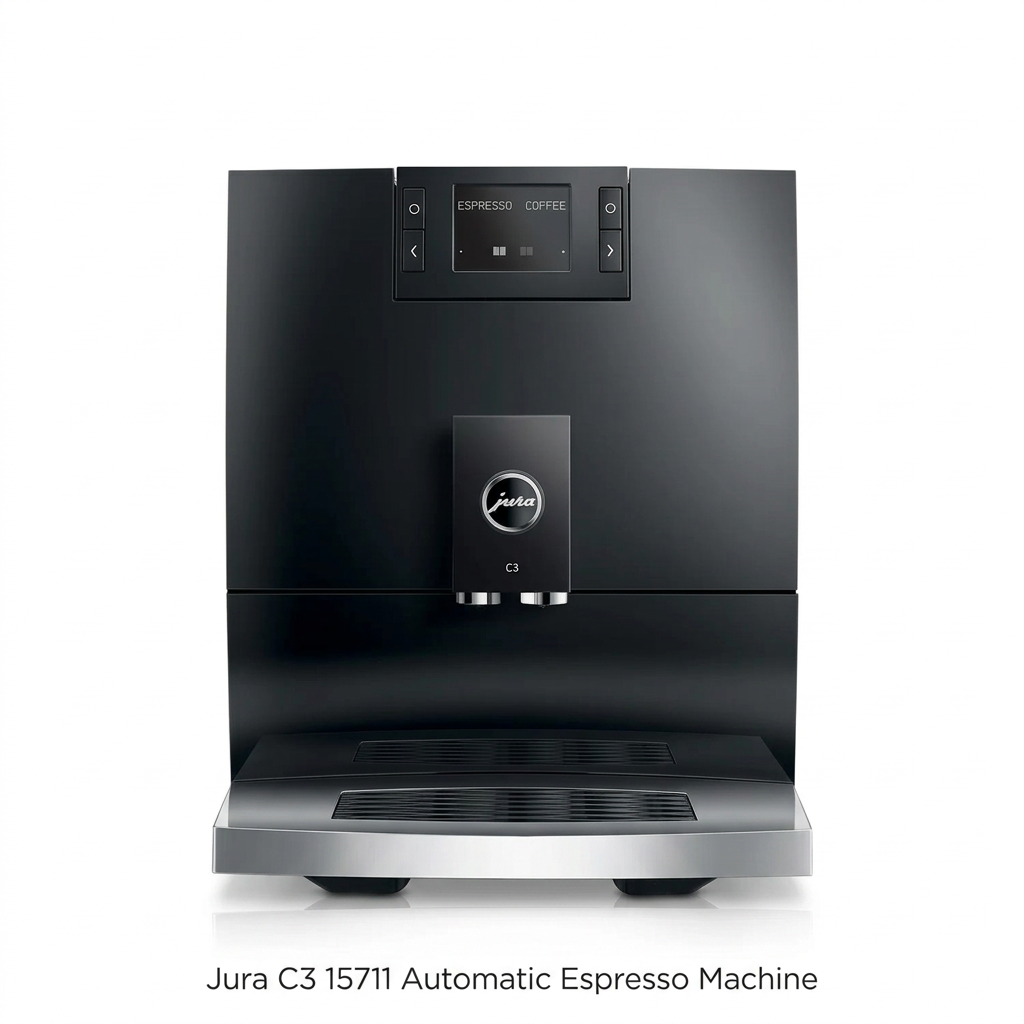
Jura C3 Automatic Espresso Machine
Espresso and long coffee only, with a thick, lasting crema, a full-size brew unit and about two minutes of daily cleaning.
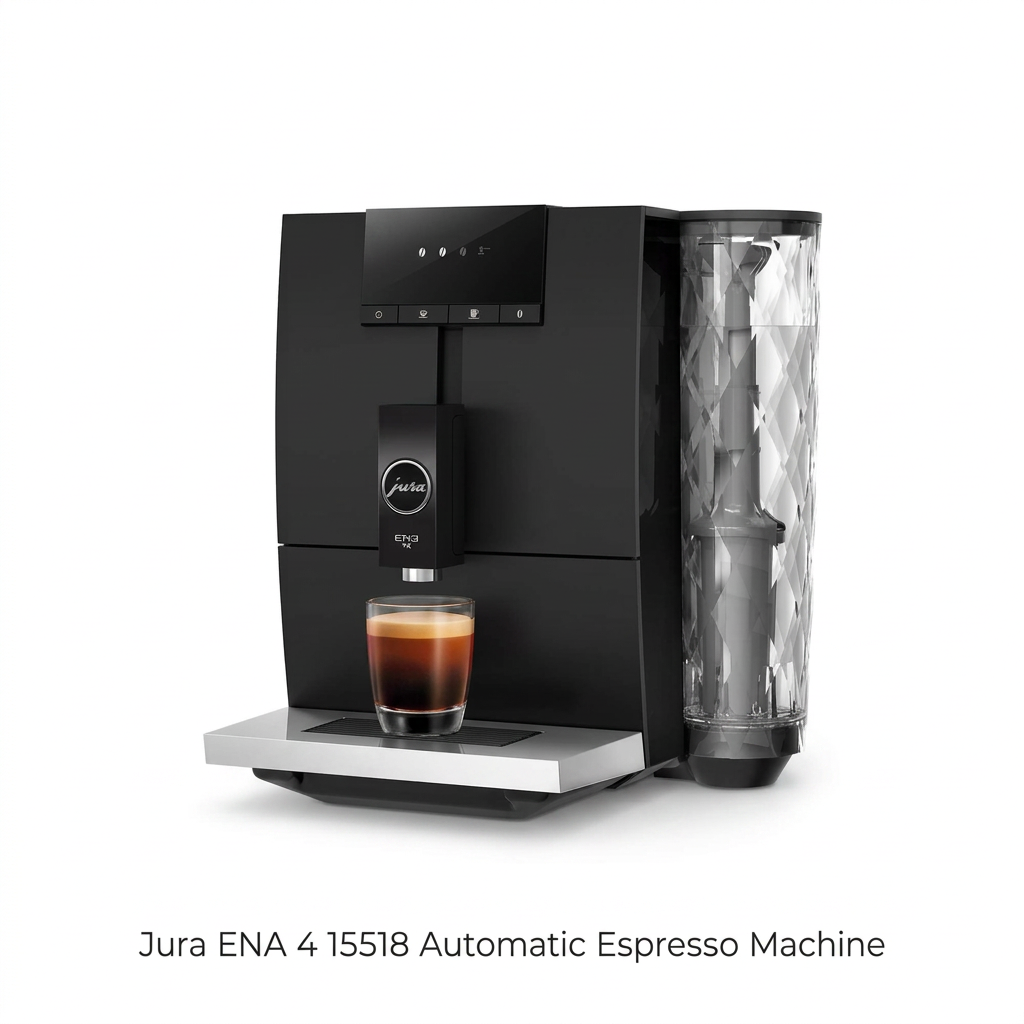
Jura ENA 4 Automatic Espresso Machine
Jura's smallest black coffee machine: quiet, consistent and sweet, with a double-press trick for bigger cups.
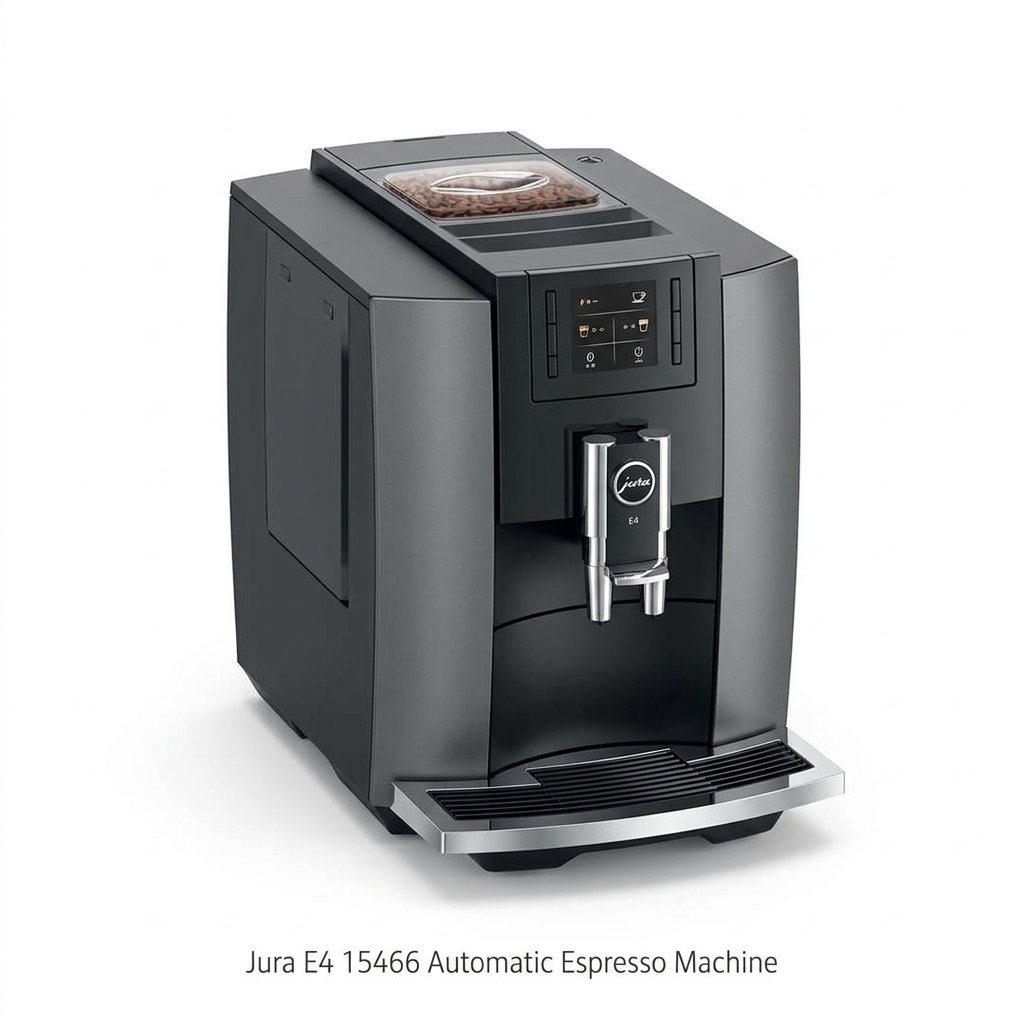
Jura E4 Automatic Espresso Machine
Simple buttons, a 16-gram brew unit and a real hot water spout, so americanos and tea come from the same machine.
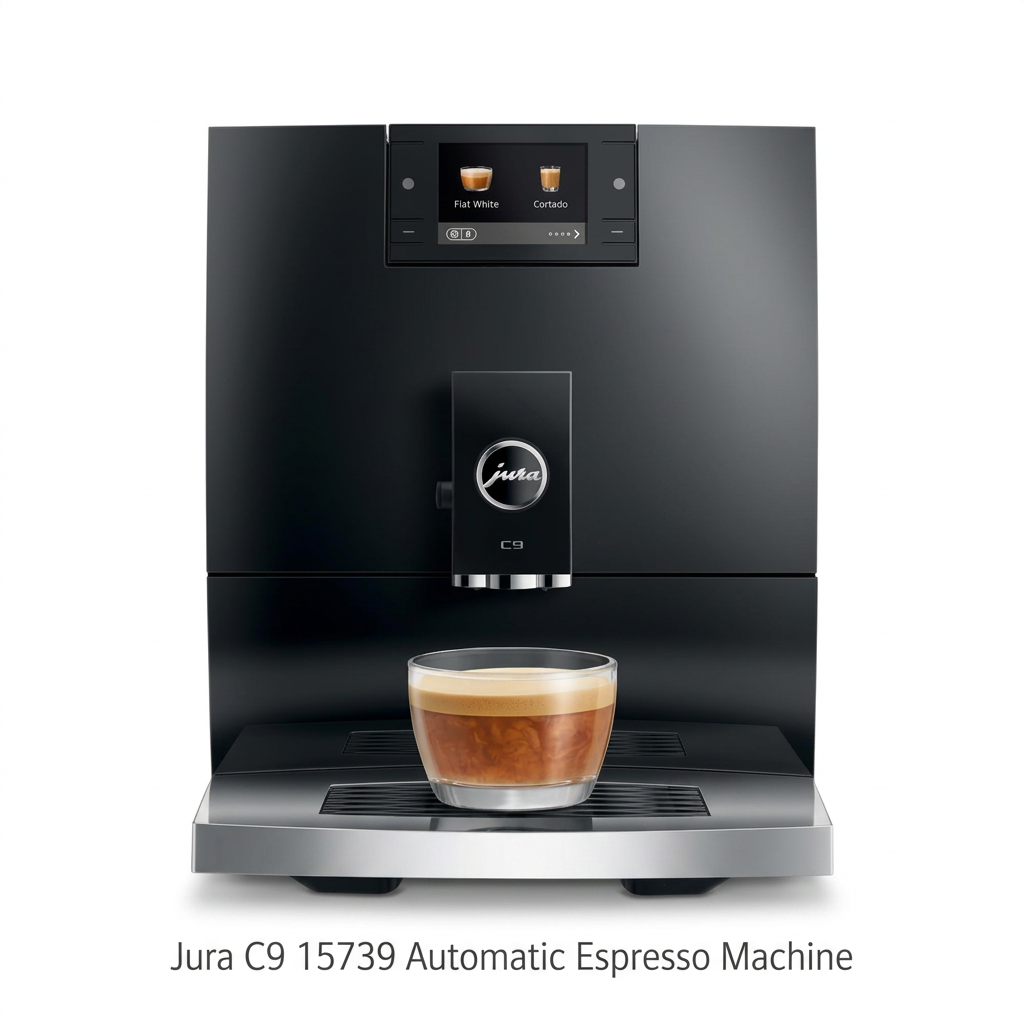
Jura C9 Automatic Espresso Machine
Glossy microfoam, a full-size brew unit and a gentle Light Brew mode, for milk drinks without paying for a touchscreen.
Prices change often. Click through to see the current price on Amazon.
Compare our budget picks side by side
Scores are from my four weeks with each machine. Specifications come from Jura's documentation and my own measurements. "Not listed" means I couldn't confirm the figure.
| 5 models compared | Best overall | Best espresso | Most compact | Americano and tea | Best milk foam |
|---|---|---|---|---|---|
| My test scores | |||||
| Overall score | 8.4 | 8.4 | 8.3 | 8.5 | 8.3 |
| Espresso | 8.8 | 9.0 | 8.6 | 8.8 | 8.9 |
| Milk or long coffee | Milk 8.0 | Long coffee 7.9 | Long coffee 7.8 | Coffee and americano 8.5 | Milk 8.4 |
| Ease of use | 8.6 | 8.9 | 8.8 | 8.9 | 7.6 |
| Cleaning | 8.1 | 8.8 | 8.6 | 9.0 | 8.2 |
| Drinks and features | |||||
| Milk system | Single-texture foam | ✕ | ✕ | ✕ | Fine-foam hose |
| Hot water spout | 3 temperatures | ✕ | ✕ | Separate spout | Not listed |
| Two-step americano | ✓ | ✕ | ✕ | With hot water spout | ✕ |
| Two cups at once | ✓ | ✓ | Double press, one cup | ✓ | ✓ |
| Milder coffee mode | ✕ | ✕ | ✕ | ✕ | Light Brew |
| Pre-ground chute | ✓ | ✓ | ✓ | ✓ | ✓ |
| Capacity | |||||
| Dose per brew | 5–16 g | 5–16 g | 6–10 g | 5–16 g | 5–16 g |
| Water tank | 1.9 L | 1.6 L | 1.1 L | 1.9 L | 1.6 L |
| Bean hopper | 280 g | 200 g | 125 g | 280 g | 200 g |
| Grounds container | About 16 | About 16 | About 10 | About 16 | Not listed |
| Controls and size | |||||
| Controls | Color screen, buttons | Small display, buttons | Icon display, buttons | Buttons, lit icons | 2.8-in color display |
| Width | 11 in | 10.2 in | 10.7 in | 11 in | 10.2 in |
| Height | 13.8 in | 12.8 in | 12.7 in | 13.8 in | 12.8 in |
| Depth | 17.3 in | 17.2 in | 17.5 in | 17.6 in | 17.2 in |
| Weight | 22 lb | 19.4 lb | 19 lb | 22 lb | 21 lb |
| Best for | Homes that drink black coffee daily and a cappuccino now and then. | Espresso purists who never touch milk. | Singles and couples with very little counter space. | Americano drinkers who share the kitchen with a tea drinker. | Milk drink fans who want great foam for less. |
My test scores at a glance
Every machine was scored on espresso, its second drink type, ease of use and cleaning. For the black coffee machines, that second score is long coffee, and for the others it's milk drinks.
The E4 scored highest overall, but it isn't my top budget pick for most homes. The E6 adds a cappuccino at one touch and three tea temperatures, which covers far more households for a modest step up.
Editorial scores from four weeks of daily use per machine.
| Best in each category | Winner | Score |
|---|---|---|
| Espresso | Jura C3 | 9.0 |
| Long coffee and americano | Jura E4 | 8.5 |
| Milk drinks | Jura C9 | 8.4 |
| Ease of use | Jura C3 and Jura E4 (tie) | 8.9 |
| Cleaning | Jura E4 | 9.0 |
Our tip: Spend on the drink you'll make every day, and skip every feature you'd only use at a party.
How I tested
I'm a former line cook with an SCA certificate in barista skills, and I've tested kitchen appliances for HouseholdMe since 2018. For this guide, I used 13 Jura machines as my everyday coffee maker for four weeks each, in a real kitchen shared with other people.
I worked through every grind and strength setting with several bean types, compared single and double cups, made americanos both ways and timed the daily cleaning. I counted how far each tank, hopper and grounds container went, then checked my notes against Jura's specifications and owner documentation. For this guide, I also weighed what each extra feature actually added to the cup.
What a budget Jura actually gives you
Jura doesn't really make cheap machines, so "budget" here means the entry end of the range. The good news is that the parts that decide how your coffee tastes are shared all the way up.
Most of the extra money on a premium Jura goes into touchscreens, user profiles, flavored foam and cold brew programs. Those are lovely, but they don't make a better espresso.
The same core technology
Every pick here grinds fresh beans with conical burrs and uses Jura's Pulse Extraction Process✕Pulse Extraction Process (P.E.P.)Jura’s method of pushing hot water through the coffee in short bursts instead of one steady stream. It lengthens contact time for short drinks, giving a fuller flavor. for short drinks. In my tests, that's why even the simplest machines pulled shots with a dense, lasting crema.
Water is heated by a thermoblock✕Thermoblocka compact heater that warms water as it flows through, instead of keeping a boiler full of hot water. It is ready within seconds and uses no standby power., so every pick is ready within seconds of switching on. None of them needs a warm-up you'd notice on a busy morning.
The brew unit is the real dividing line
If there's one spec to check on a budget Jura, it's the brew unit✕Brew unitthe part inside the machine where ground coffee is compressed and hot water is pushed through it. Its size sets how much coffee can go into one brew.. Jura says its compact C line was built around a full-size brew unit that holds 5 to 16 grams, the same range as its bigger models.
Four of my five picks have that full-size unit. The ENA 4 takes about 6 to 10 grams per cycle, which is perfect for espresso but needs a double press for a strong mug.
A classic double shot uses about 14 to 18 grams, so 16 grams is a full double in one brew.
Why a budget Jura makes sense now
More people are making their coffee at home. One recent consumer survey found that the share of coffee drinkers buying from a coffee shop at least weekly fell from about half in 2024 to about a third in 2026, while the share who prefer black coffee rose from 18% to 24%.
That's exactly who these machines are for. If your daily drink is an espresso, an americano or a simple cappuccino, a budget Jura covers it at the same quality as machines that cost far more.
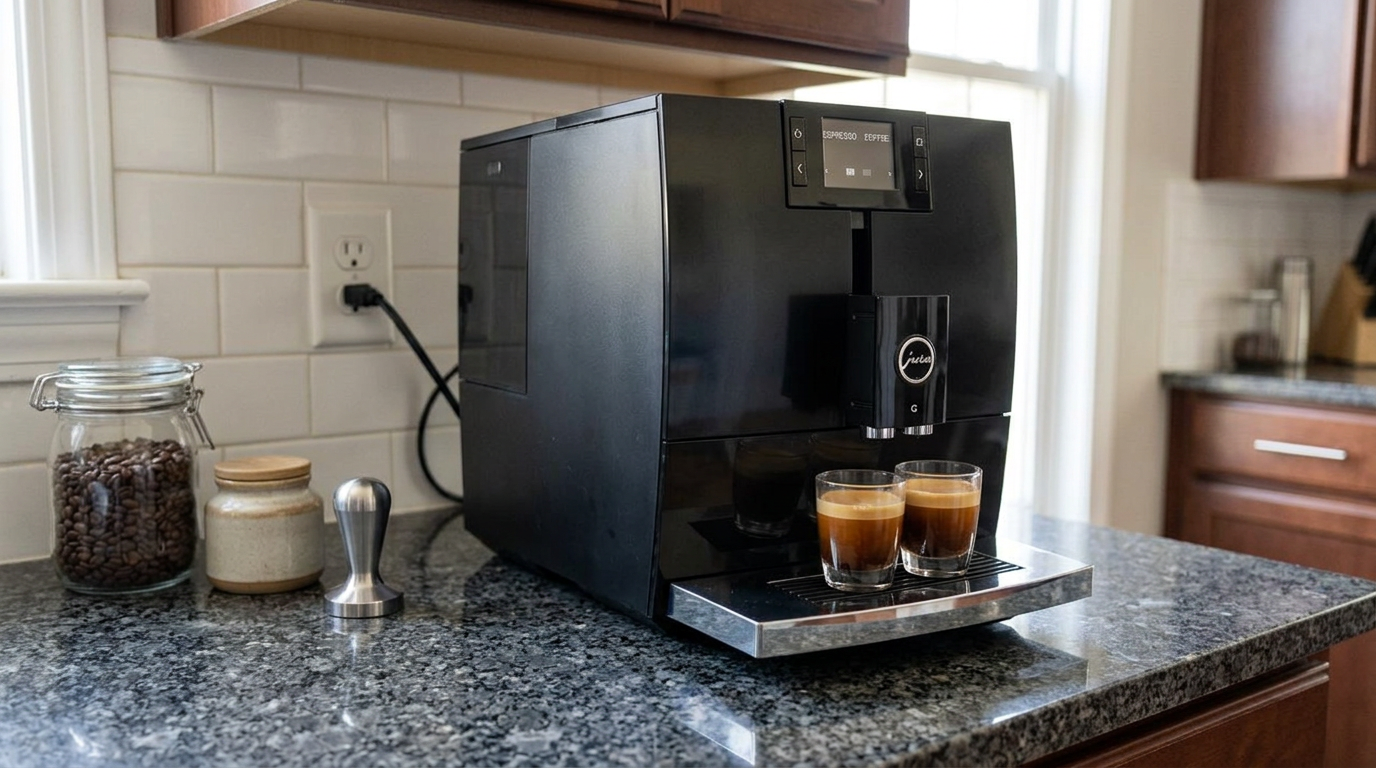
The C3 makes two espressos from two full grind-and-brew cycles, not one dose split in half.
Who should buy a budget Jura?
A budget Jura suits anyone who wants fresh-ground coffee at one touch and knows which few drinks they'll actually make. It's ideal if you drink black coffee, americanos or the occasional cappuccino.
It's not the right buy if lattes are your daily drink or several people want their own saved recipes. My guide to the best Jura for milk drinks covers the machines built for that.
Our picks in depth
1. Jura E6
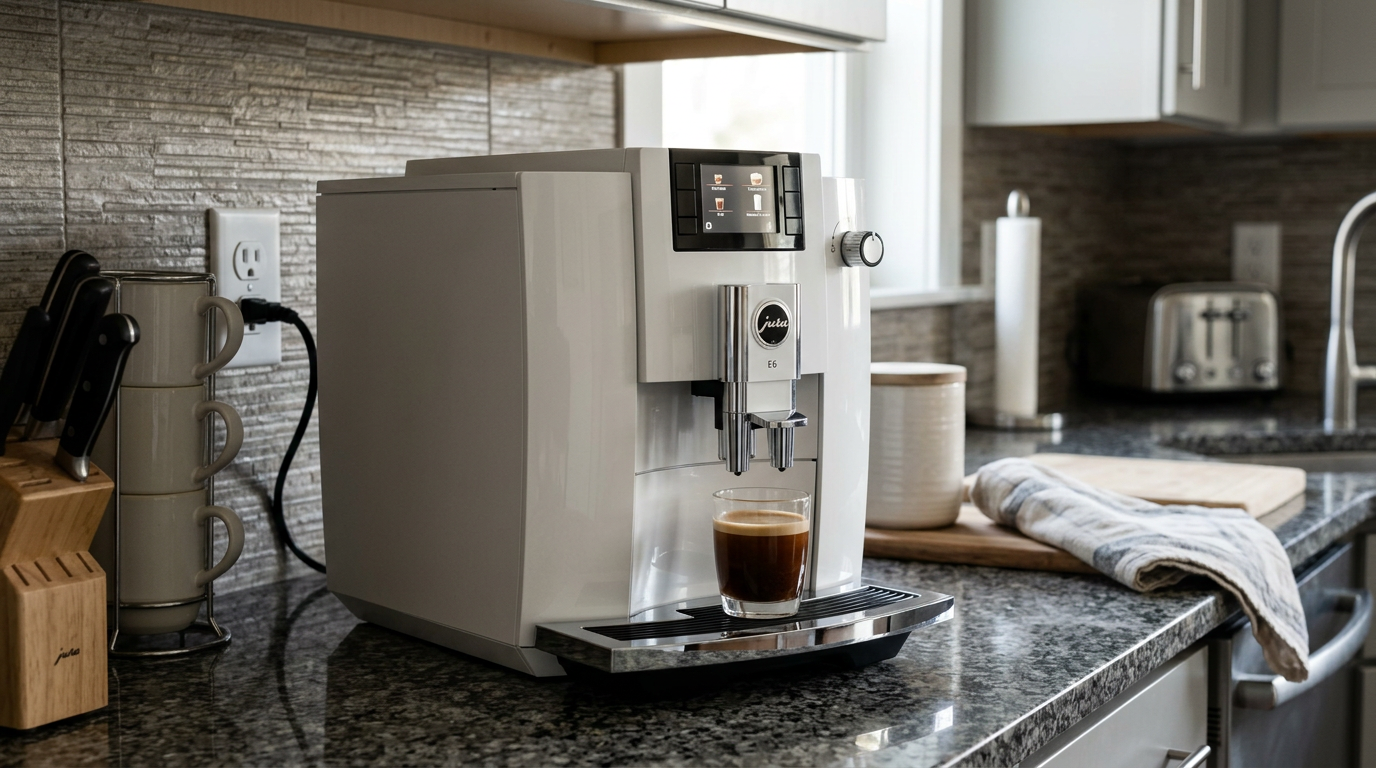
The Jura E6 is the budget Jura I'd recommend to most people, because it covers almost every everyday drink without paying for extras. It's a black coffee machine at heart, with a milk system for the cappuccino you want on a Sunday morning.
It uses the same 16-gram brew unit and grinder as far pricier machines. It also makes a real two-step americano and heats tea water to three different temperatures.
Espresso and the two-step americano
My espresso had a thick crema and a full, chocolatey body, and back-to-back shots tasted the same. Each shot starts with a short pre-infusion that soaks the coffee before full pressure arrives.
The americano is the E6's best drink. It brews an espresso first, then adds clean hot water separately, so the extra water never passes through the coffee and over-extracts it.
That's the difference between a real americano✕Americanoan espresso topped up with hot water. Adding the water separately keeps the cup clean and bright, instead of pushing a whole mug of water through the coffee. and a long coffee pushed through one puck. Mine tasted brighter and cleaner, with no woody finish.
Tea and hot water
The E6 has three hot water temperatures, which makes it genuinely useful for tea. Green tea on the low setting tasted sweet rather than bitter.
It comes with a separate hot water spout that you swap in for tea. That keeps any trace of milk out of the water, and it took about five seconds once I'd done it twice.
Our tip: Keep the spare spout in a drawer beside the machine, so switching between tea and cappuccinos takes seconds.
The one-touch cappuccino
Milk is drawn through a silicone hose from a carton or glass, and steam turns it into fine microfoam. The cappuccino came out with a generous layer of dense foam on a strong espresso.
There's only one foam texture, though, so a silky flat white isn't possible. For a latte, I pulled a double espresso into a tall glass and added two portions of milk foam.
Smart Mode
Smart Mode tracks which drinks you make most and moves them to the front of the menu. After a week, my americano and espresso were always the first two buttons I saw.
The screen is flanked by real, chunky buttons instead of glass. They worked with damp fingers, and a splash never started a drink.
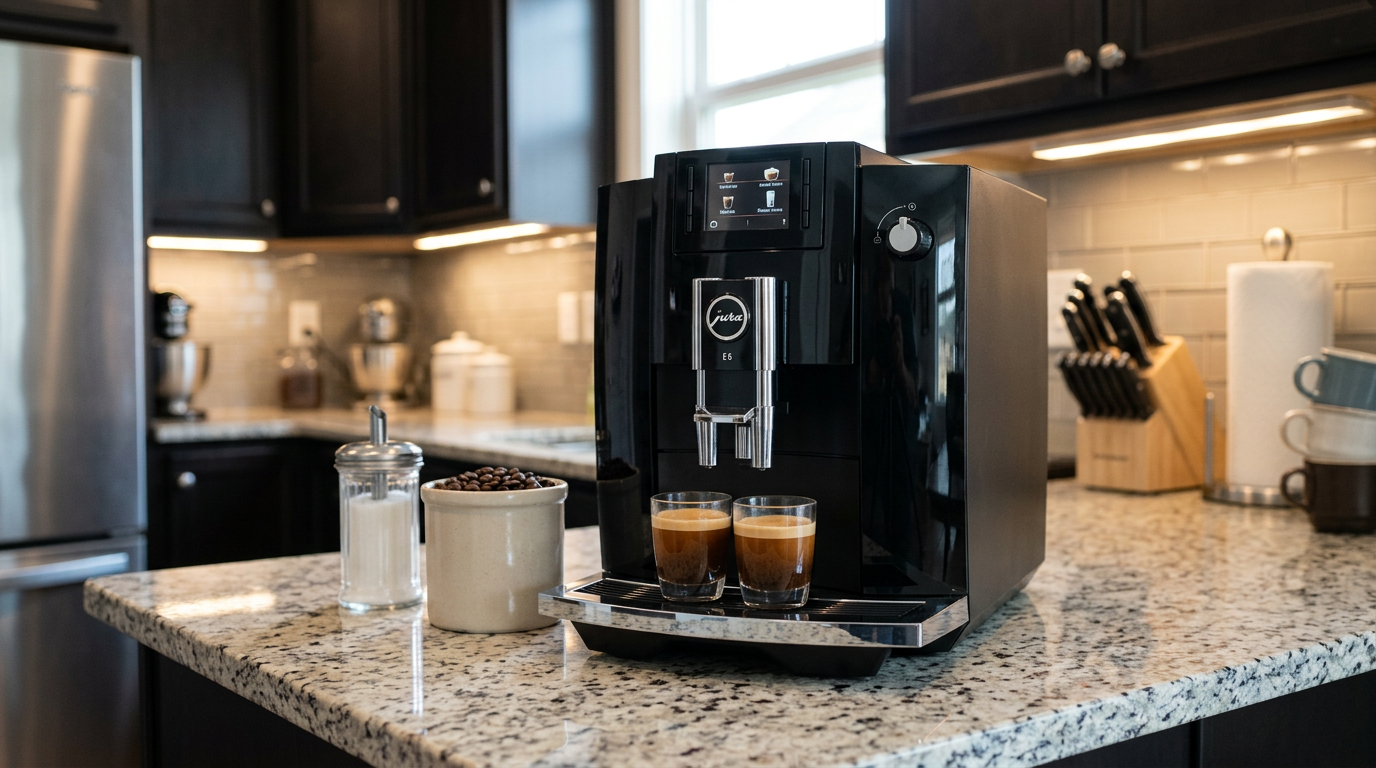
The E6's center outlet lines a single cup up perfectly with the coffee spouts.
What to know before you buy
Jura recommends replacing the silicone milk hose every three months, which is a small running cost to plan for. There are no user profiles, so a household with very different tastes will adjust drinks on the fly.
If you mostly drink espresso, americanos and tea, with a cappuccino now and then, the E6 gives you nearly everything for a sensible outlay.
- Rich espresso and a true two-step americano
- Hot water at three temperatures for tea
- One-touch cappuccino
- Smart Mode puts your favorite drinks first
- Milk foam has one fixed texture
- No user profiles
- Milk hose needs replacing every three months
- Americano and espresso drinkers
- Homes with a tea drinker
- Anyone who wants an occasional cappuccino
- Daily latte and flat white drinkers
- Big households wanting profiles
- Anyone who wants a large touchscreen
Choose this if you want a budget Jura that handles black coffee, tea and the odd cappuccino. Read my full Jura E6 review.
2. Jura C3
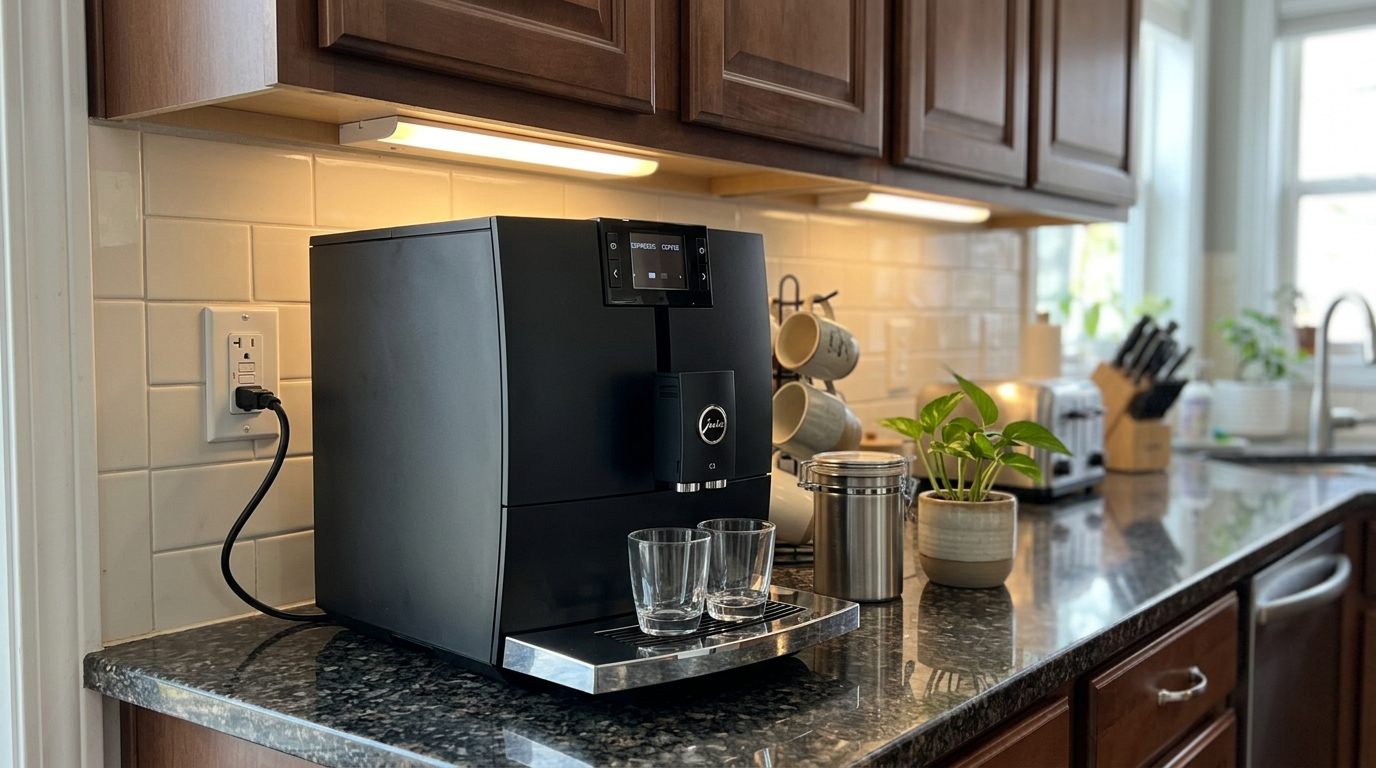
The Jura C3 is what happens when Jura keeps the expensive parts of a big machine and leaves out everything that doesn't touch black coffee. It makes espresso and coffee, singly or two at a time, and that's the whole menu.
It also made the best espresso of my five budget picks. My first shot came out dark and syrupy under a tight, hazelnut-brown crema that held its shape long after I put the cup down.
Espresso
With a medium-dark blend on the strongest setting, the crema was dense and velvety, and it didn't collapse into a thin ring after a minute. I tasted dark chocolate and roasted hazelnut, with gentle sweetness and a clean finish.
Because the machine repeats the same parameters every time, shot five tasted like shot one, day after day. A brighter medium roast kept its berry notes distinct rather than flattening them.
At its strongest setting, one C3 brew holds as much coffee as a traditional double shot.
The long coffee
There's no hot water outlet, so the Coffee button pushes the whole cup of water through the coffee in one continuous pour. At normal mug sizes, it was rounded and smooth, more like a big, gentle espresso than a filter coffee.
Push the volume very high, and the end of the pour turns dry and woody. That's the C3's main limitation, and there's an easy fix.
Two cups, done properly
Double-click either button, and the C3 runs two complete cycles: grind, compress, brew, eject, then grind fresh for the second cup. Both cups get the full dose, which is far better than splitting one dose between two cups.
While the grinder runs, the side buttons raise or lower the strength for that one drink, without touching your saved settings. It's handy for a guest who wants something milder.
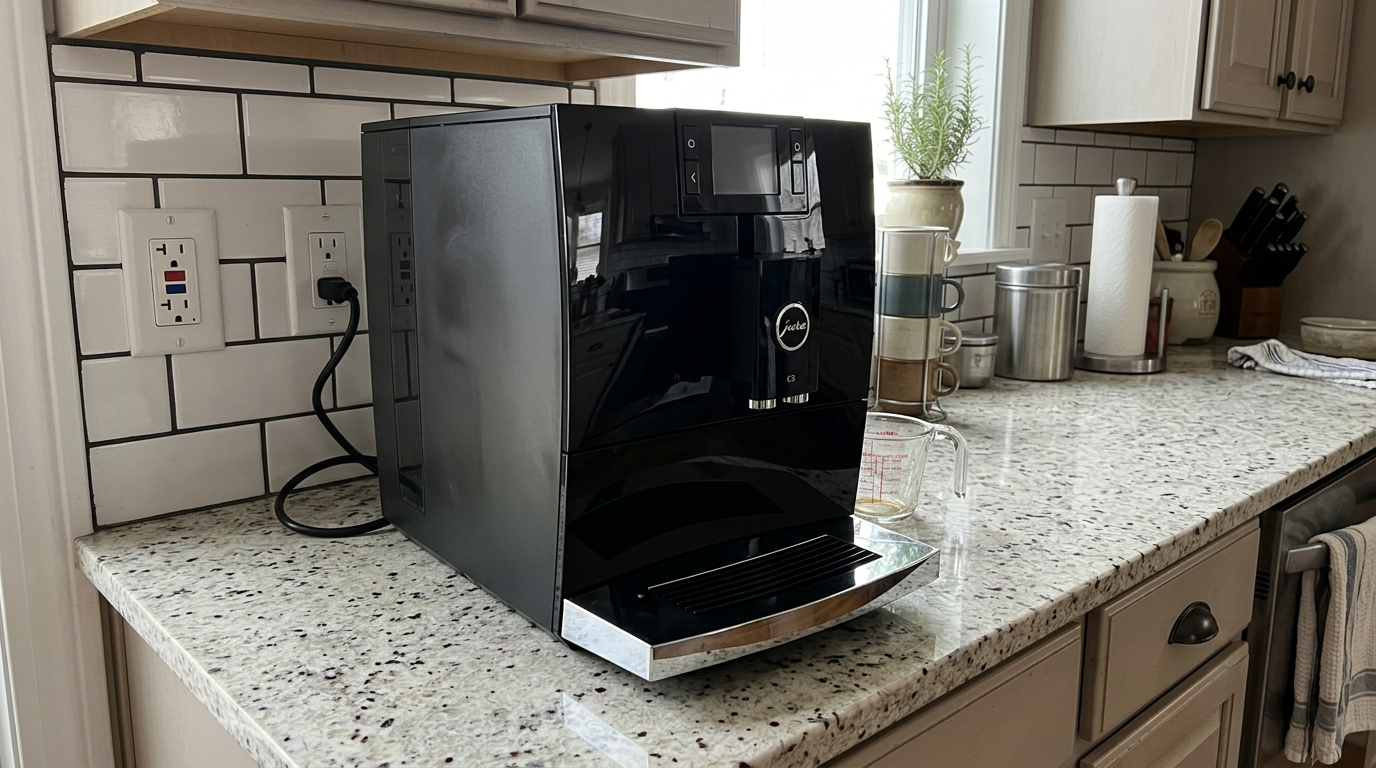
At 12.8 inches tall, the C3 slides under standard wall cabinets with room to spare.
What to know before you buy
There's no milk system, no steam wand and no hot water, so tea and americanos need a kettle. If you'd use a separate milk frother every day, a machine with a built-in milk system will save you steps.
The grind dial is stepless, with no numbers, so mark your favorite position with a tiny dot of tape. For pure espresso at the lowest outlay, the C3 is the one I'd buy.
- Rich espresso with thick, long-lasting crema
- Full-size brew unit doses up to 16 g
- Simple buttons and very little daily cleaning
- Compact and quiet
- No milk frothing of any kind
- No hot water for tea or a true americano
- Long coffee is softer than a filter-style mug
- Espresso lovers who drink their coffee black
- Small kitchens that still want a full-size brew unit
- Anyone tired of cleaning milk systems
- Daily latte or cappuccino drinkers
- Tea drinkers who want hot water from the machine
- Home baristas who want to tune every shot
Choose this if you drink espresso and black coffee and want the best shot for the least outlay. Read my full Jura C3 review.
3. Jura ENA 4
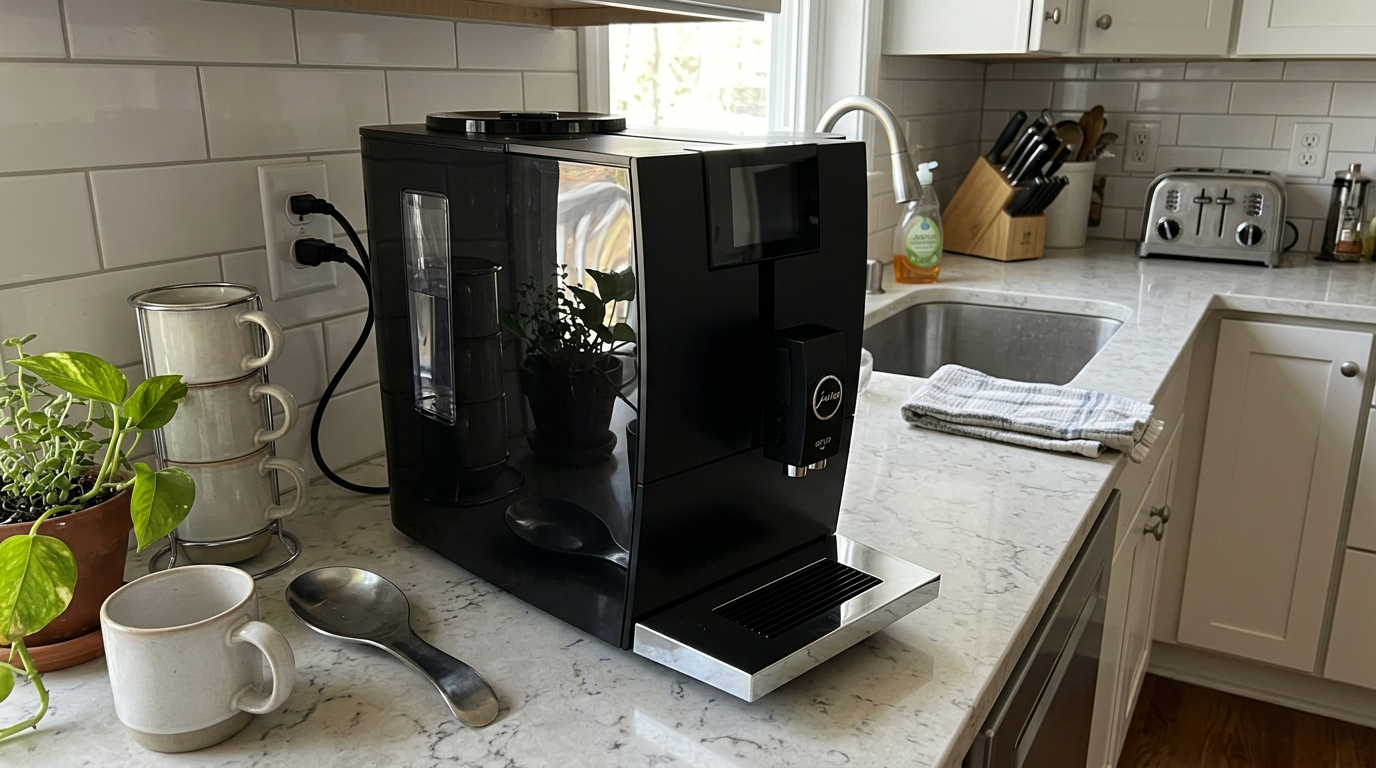
Most bean-to-cup machines take over a corner of the counter. The Jura ENA 4 barely takes up a corner of a corner, with a tall, clear water cylinder on the side that looks more like a carafe than a tank.
It's usually the most affordable way into a Jura, and it's built only for espresso and black coffee. There's a small icon display, a handful of tactile buttons and a pair of coffee spouts.
Espresso
Each shot starts with a short pre-infusion, then the pulsed extraction pushes water through in bursts. On the strong setting, the crema was dense, finely textured and golden, and it held for minutes.
What impressed me most was consistency. Once I'd found my settings, the tenth espresso of the week tasted like the first, across four different bean types.
The double-press habit
The brew unit takes about 6 to 10 grams per cycle. Press a drink button twice, and the machine grinds, brews, ejects the puck, then grinds and brews again into the same cup.
By week two, I was double-pressing almost everything. Two small cycles gave a much fuller lungo✕Lungoa long espresso where more water runs through the same coffee. It is milder and larger than an espresso but stronger than an americano. and a full-bodied double espresso without overloading the small brew unit.
Our tip: For a big mug on the ENA 4, make a double espresso and top it up from the kettle instead of running one long coffee.
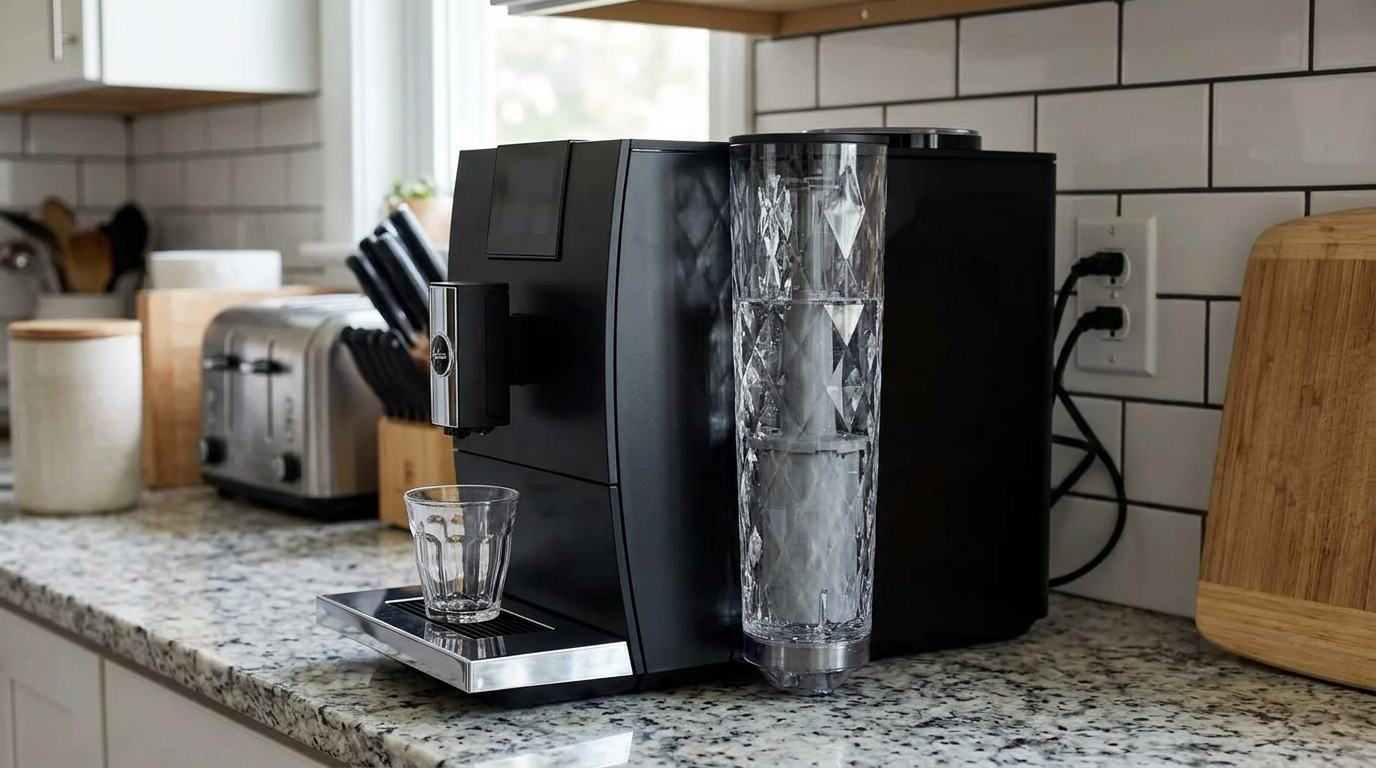
The clear cylinder makes the water level easy to check at a glance.
Quiet enough for a home office
The grinder is one of the quietest I've used, with a soft hum instead of a whine. I made coffee during calls without anyone noticing.
What to know before you buy
The small containers are the trade-off for the small footprint. The 1.1-liter tank lasted about 22 espressos and the grounds bin about 10 pucks, so for two espresso drinkers I refilled the tank once a day.
There's no milk system and no hot water. If you drink espresso or black coffee and space is tight, the ENA 4 is the easiest budget Jura to fit into your life.
- Sweet, balanced espresso with dense crema
- Very compact and quiet
- Easy cleaning with no milk system
- Usually the most affordable Jura
- Small tank, hopper and grounds bin
- No milk system and no hot water
- Small 6–10 g dose per cycle
- Singles and couples who drink black coffee
- Small kitchens, apartments and home offices
- Anyone stepping up from a capsule machine
- Families who drink many cups a day
- Latte and cappuccino drinkers
- Tea drinkers who want hot water from the machine
Choose this if you drink espresso or black coffee and want the smallest, simplest Jura. Read my full Jura ENA 4 review.
4. Jura E4
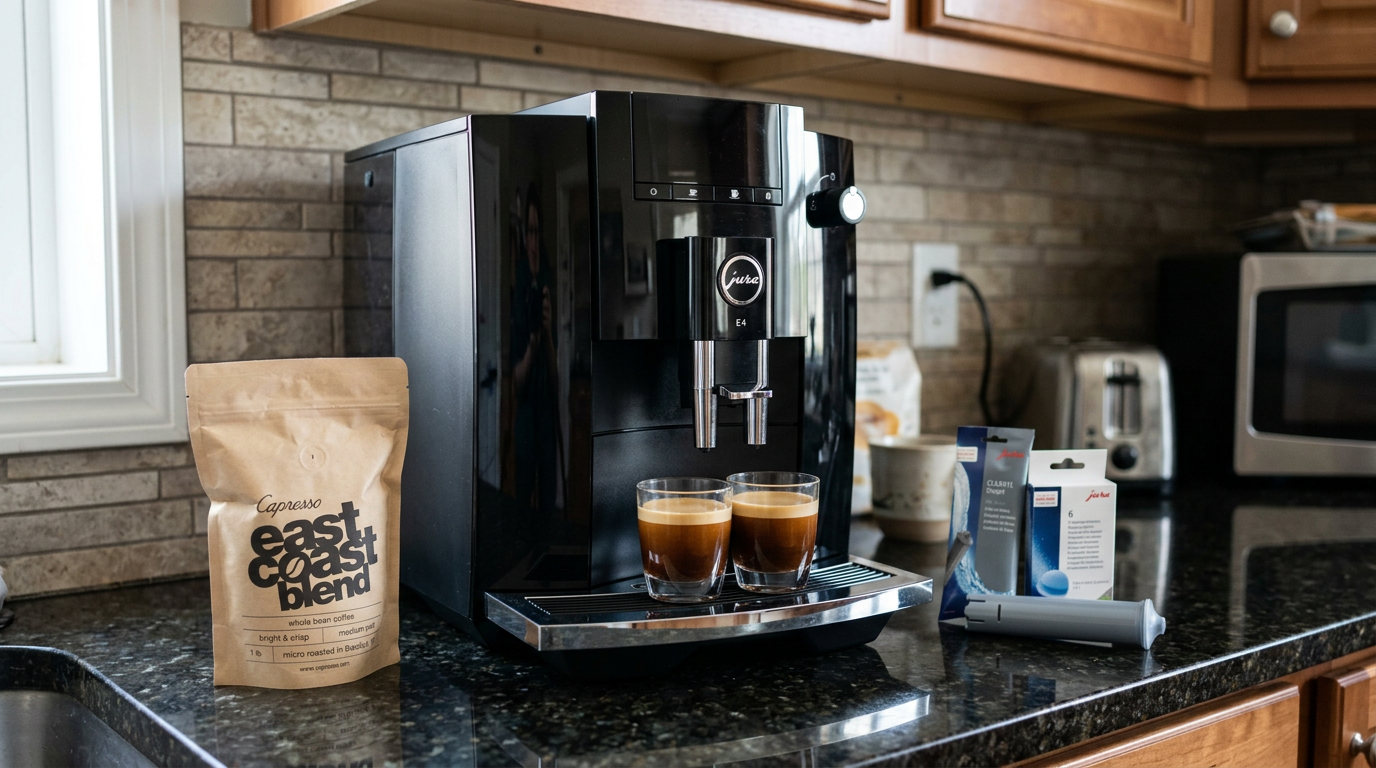
The Jura E4 earned the highest overall score of my budget picks, and it's the simplest machine here. It has a row of buttons, a few lit icons and a short menu: espresso, coffee and hot water.
That last one is the reason to choose it. A separate hot water spout means a true americano and tea water from the same black coffee machine.
Espresso
On three beans with a medium-dark blend, the espresso had a thick, stable crema✕Cremathe layer of fine, golden-brown foam on top of an espresso. It forms when pressure pushes oils and gases out of freshly ground coffee. A dense, lasting crema usually means fresh beans and good extraction.. The body was dense, with dark chocolate and roasted nut flavors and a bright, clean finish.
Jura's Intelligent Pre-Heating warms the brewing circuit first, so my first espresso of the morning was as hot as the third. That's not something every machine manages.
A proper americano
Brew an espresso into a tall mug, wait for the puck to drop, then move the mug under the hot water spout. Turn the rotary switch on the side to open it, and turn it back when the cup is full.
Because the extra water never passes through the coffee, the americano tasted cleaner and brighter than a long single pour. It's a manual twist, but it took me about three seconds.
Our tip: Warm your cup with a splash from the hot water spout first, because a cold cup steals heat from a short espresso.
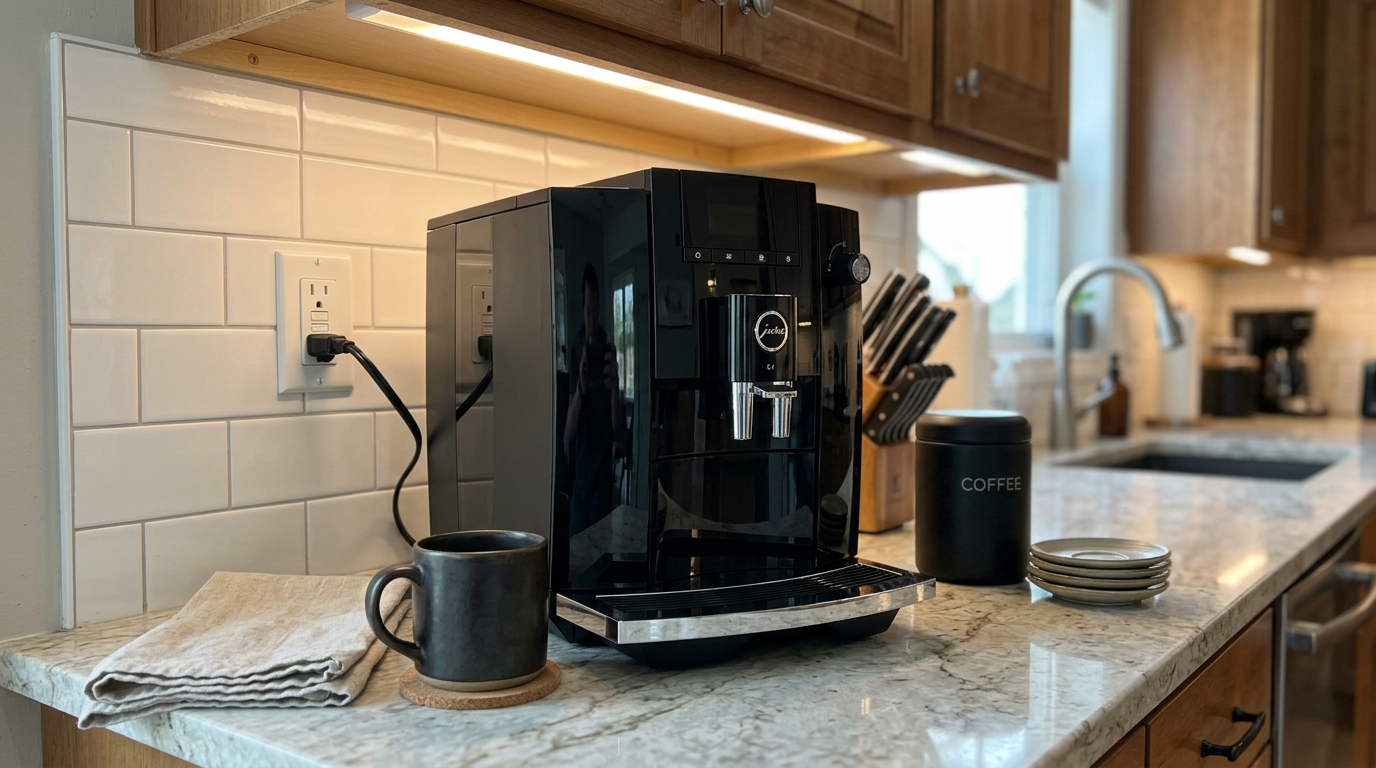
The E4's front-loading water tank means it can sit right up against the wall.
Buttons instead of a screen
There's no display at all. The strength button cycles through one, two and three beans, then pre-ground mode, and a flashing light tells you when to empty the tray or clean the machine.
At first, I missed a screen. After a few days, the lit icons were all I needed, and anyone who finds touchscreens fiddly will love it.
What to know before you buy
There's no milk frothing at all, and settings live in your memory rather than on a screen. The 1.9-liter tank slides out from the front, which I came to love.
If you drink americanos and share the kitchen with a tea drinker, the E4 is the best-value black coffee machine I've tested.
- Rich espresso with a thick, stable crema
- Separate hot water spout for americanos and tea
- Simplest cleaning I measured
- Front-loading tank and big hopper
- No milk frothing at all
- Hot water needs a manual twist
- No display, so settings live in your memory
- Espresso and americano drinkers
- Homes with a tea drinker
- Anyone who wants no learning curve
- Latte and cappuccino lovers
- People who want lots of drinks on a screen
- Shared homes wanting profiles
Choose this if you want black coffee plus hot water for tea and americanos, with the least fuss. Read my full Jura E4 review.
5. Jura C9
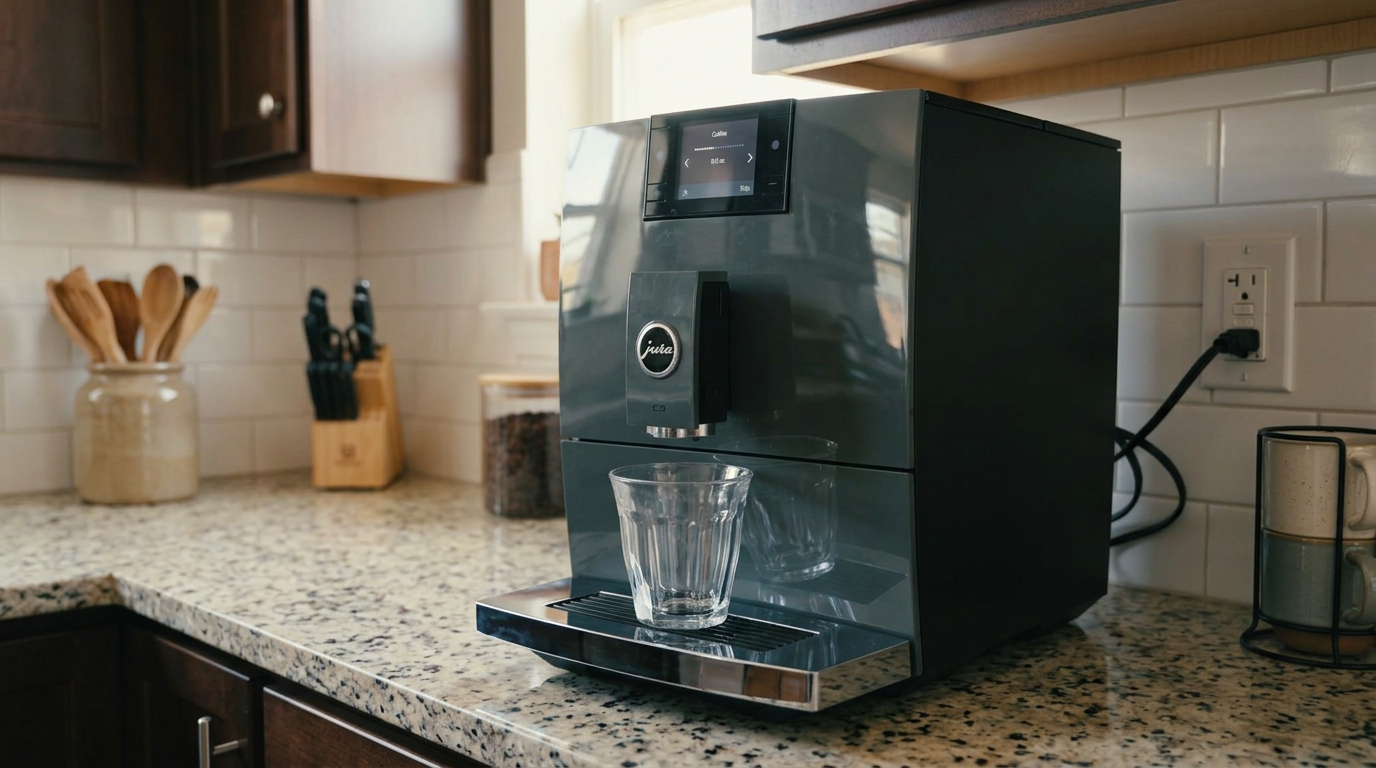
If milk drinks are your daily habit and you don't want a premium machine, the Jura C9 is the one to get. It sits a step above my other budget picks, but it's still well below Jura's touchscreen milk machines.
Its foam was among the finest I've had from a one-touch machine. It also keeps a full-size brew unit and makes 17 drinks in a body just over 10 inches wide.
Foam that punches above its class
A clear silicone hose draws milk from a glass, and steam pulls it up using the Venturi effect✕Venturi effectthe drop in pressure when steam speeds through a narrow gap. In a milk spout, it sucks milk up the tube and pulls in air, so the machine can froth without a separate pump.. A calibrated valve adds air, and the result is glossy microfoam with tiny bubbles.
My flat whites poured smoothly, and the foam held its shape in a latte macchiato. Barista oat milk foamed well too, scoring 8.2 in my tests.
Espresso and Light Brew
The espresso had a thick, deep-brown crema that held for minutes, with dark chocolate and roasted nut flavors. Three espressos in a row for guests tasted just as hot and full as the first.
Light Brew brews at around 60°C with less coffee, for a mild cup you can sip straight away. It tasted thin as a straight espresso, but in a cappuccino it became my gentle afternoon drink.
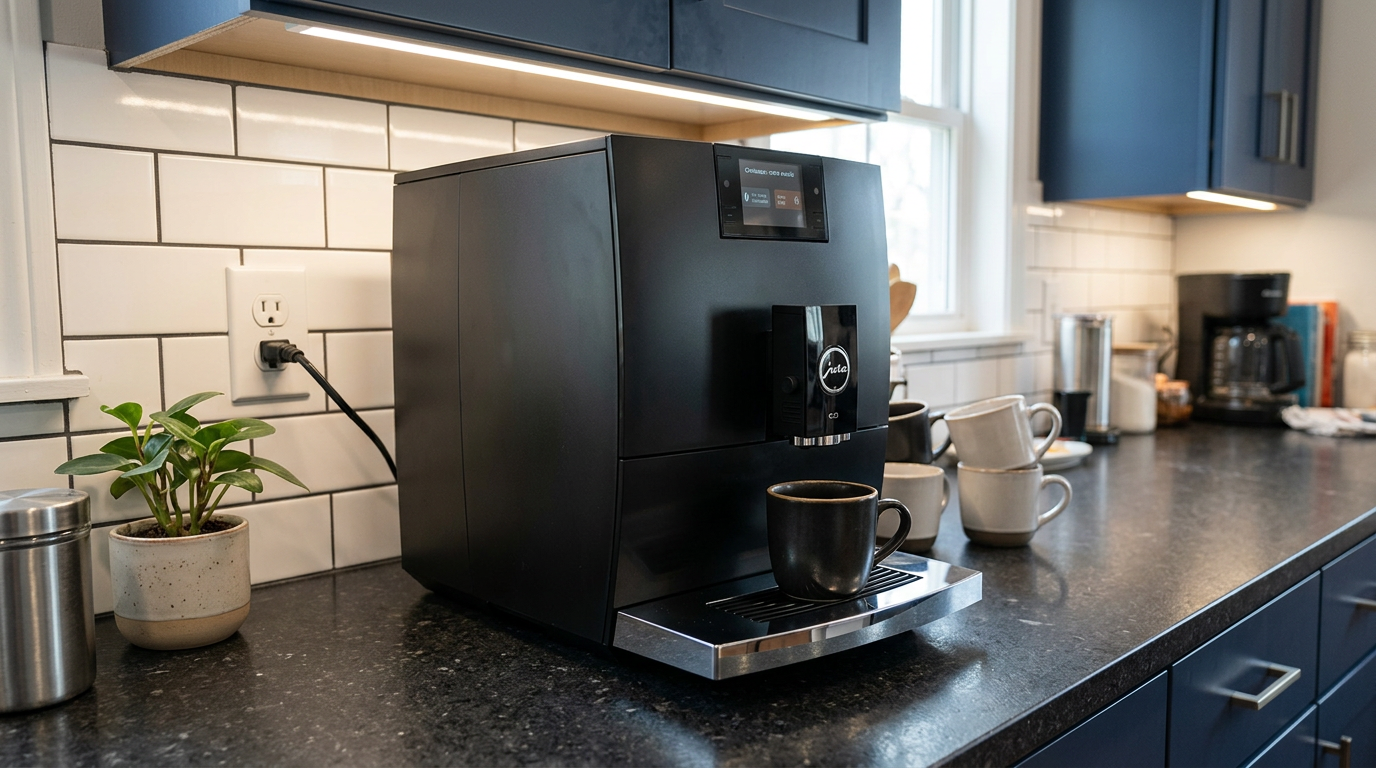
The C9's wave-patterned drip tray and curved front look more expensive than they are.
What to know before you buy
The menu scrolls in one direction only, there are no user profiles and the clear milk hose needs rinsing after every use. The 1.6-liter tank needed refilling almost every day with two of us making milk drinks.
If you can live with that, the C9 gives you café-quality foam without paying for touchscreens and flavored milk.
- Some of the finest one-touch foam I've tested
- Full-size 16 g brew unit in a compact body
- 17 drinks, including Light Brew versions
- Quiet for a bean-to-cup machine
- Menu scrolls one way only
- Small tank needs frequent refills
- Clear milk hose needs rinsing after every use
- Cappuccino and flat white drinkers on a budget
- Small kitchens
- Homes that like both strong and mild coffee
- Big families who need profiles
- Iced coffee fans
- Anyone who wants a touchscreen
Choose this if milk drinks are your daily habit and you want the best foam for your money. Read my full Jura C9 review.
My test data: capacity, cleaning and time
Budget machines save money up front, but the numbers that matter most are the ones you live with every day. These are the figures I collected during my four weeks with each pick.
How far one tank goes
Tank size decides how often you're at the sink. I counted roughly how many espressos each tank delivered, allowing for the rinse water every Jura uses when it switches on and off.
My estimates from daily use. Long coffees and milk drinks use more water per cup.
Daily cleaning time
All five machines rinse themselves when they switch on and off, and all of them prompt you for deeper cleaning. The real difference is the milk system: without one, daily care takes about two minutes.
My estimate of hands-on daily cleaning time.
Our tip: If you only want milk drinks at weekends, choose the E6 and leave the milk hose off during the week, so weekday cleaning stays at two minutes.
Bean hopper size
A small hopper isn't all bad, because beans don't sit around going stale. But on the ENA 4, I topped up the hopper every few days, while the E4 and E6 went most of a week.
Manufacturer figures. 280 grams is roughly 35 to 40 espressos.
Making a big mug
How each machine handles a big mug of black coffee varied more than anything else. This is what worked best on each pick.
| Machine | Best way to a big mug | Why |
|---|---|---|
| Jura E6 | Programmed two-step americano | Water bypasses the coffee |
| Jura E4 | Espresso, then the hot water spout | Clean, bright cup |
| Jura C3 | Double-click Coffee into one mug | Two fresh pucks share the water |
| Jura ENA 4 | Double espresso plus kettle water | Small brew unit stays strong |
| Jura C9 | 2 × Coffee into one mug | Avoids a flat, over-brewed finish |
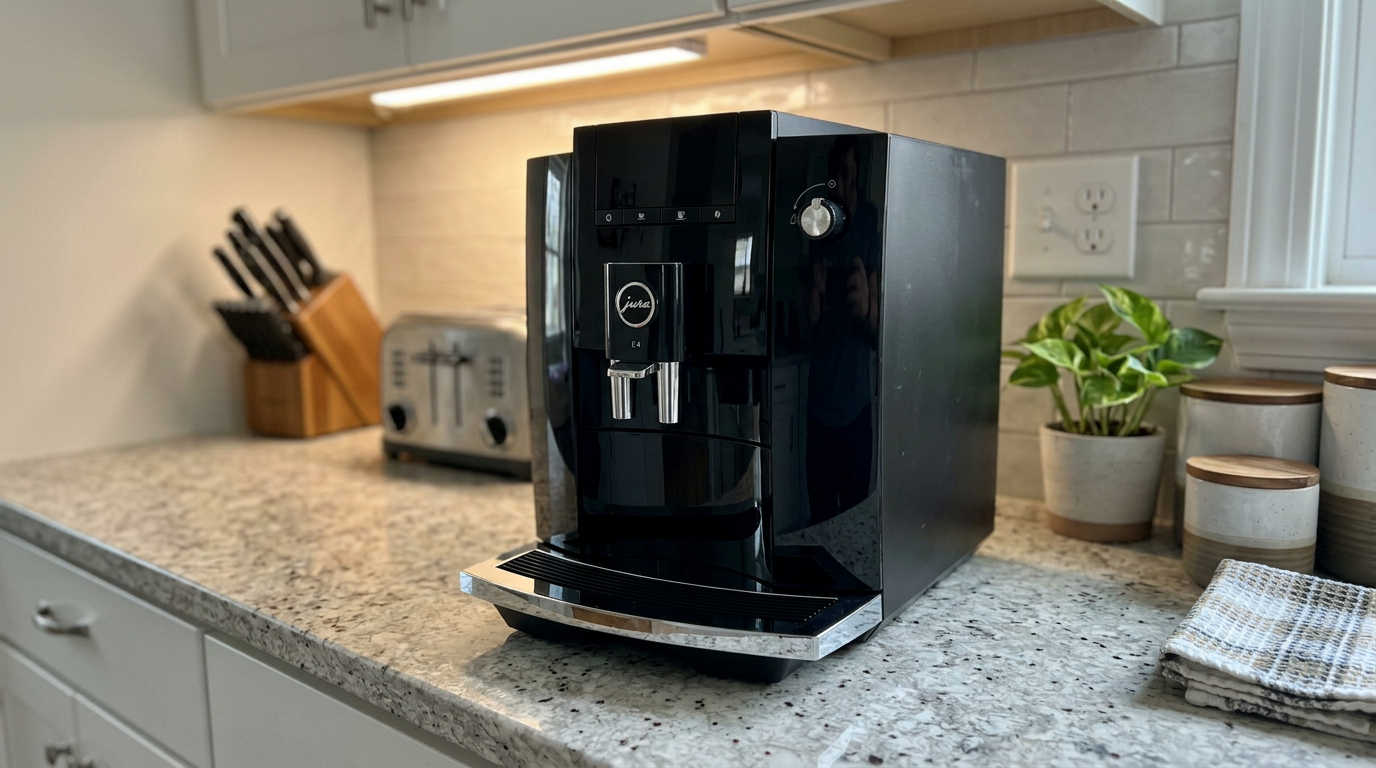
The E4's hot water spout sits just behind the coffee spouts, with its own switch on the side.
Which one is right for you?
4 quick questionsAnswer four questions about how you drink coffee, and I'll point you to the budget pick that fits best. It's the same reasoning I use when friends ask me for the most sensible Jura.
Or find your morning below
A two-step americano and three tea temperatures from one machine.
Double-click for two full-dose shots, side by side.
A sweet, crema-rich shot from a machine about 27 centimeters wide.
Espresso plus clean hot water, and the tea water comes from the same machine.
Glossy microfoam on a full-size espresso, without a premium price tag.
Leave the milk hose off until the weekend.
What to look for in a budget Jura
On a budget, every feature has to earn its place. These are the differences that changed my daily routine, in the order I'd check them.
What you drink
Start here, because it narrows the choice fastest. If you only drink espresso and black coffee, skipping the milk system saves money up front and a few minutes of cleaning every day.
If you want a cappuccino now and then, the E6 is the most sensible step up. If milk drinks are daily, go to the C9 or one of my milk picks.
| You mostly drink | Look for | My pick |
|---|---|---|
| Espresso | Full-size brew unit, strong crema | Jura C3 |
| Espresso in a tiny kitchen | Smallest footprint | Jura ENA 4 |
| Americanos and tea | Separate hot water spout | Jura E4 or Jura E6 |
| Black coffee and the odd cappuccino | Simple milk system | Jura E6 |
| Cappuccinos and flat whites | Fine-foam milk system | Jura C9 |
Brew unit size
A full-size 5-to-16-gram brew unit lets one brew hold a double shot's worth of coffee. That matters most for big mugs and strong drinks.
The ENA 4's 6-to-10-gram unit is perfect for espresso and ristretto, but you'll rely on the double press for anything bigger.
Hot water
This is the most overlooked feature on a budget machine. Without a hot water spout, you can't make a true americano or tea water, so you'll keep the kettle.
The E4 has a separate spout, and the E6 adds three temperatures. The C3 and ENA 4 have none.
Our tip: If you'd keep a kettle next to the machine anyway, don't pay extra for a hot water spout.
Tank, hopper and grounds container
Capacity is the biggest trade-off between compact and full-size budget machines. A 1.1-liter tank and a 10-puck grounds bin are fine for one person but turn into a daily chore for a family.
For a household that makes more than five drinks a day, I'd want at least a 1.9-liter tank and a 16-puck bin, like the E4 and E6.
The grinder
Every pick uses conical burrs✕Conical burrstwo cone-shaped grinding surfaces, one inside the other, that crush beans to an even size. They are quieter and more consistent than blade grinders. rather than blades. One rule applies to all of them: only change the grind setting while the grinder is running.
Turning it with the burrs stopped can jam bean fragments between them, and that's not a repair you want on any machine.
Water filter and water hardness
Every pick starts with a water hardness test, and you should do it properly. With Jura's CLEARYL Smart+✕CLEARYL Smart+Jura’s water filter cartridge. It sits in the tank, reduces limescale and is detected automatically, so the machine knows when to ask for a new one. filter fitted, the machine tracks water use and asks for a new cartridge, and descaling becomes rare.
Filters are a running cost, but they protect the machine, which matters more on a budget than anywhere else.
| Water hardness | Filter capacity, up to |
|---|---|
| 1–5 °dH (very soft) | 65 liters |
| 6–10 °dH | 60 liters |
| 11–15 °dH | 55 liters |
| 16–20 °dH | 50 liters |
| 21–25 °dH | 45 liters |
| 26–30 °dH (very hard) | 40 liters |
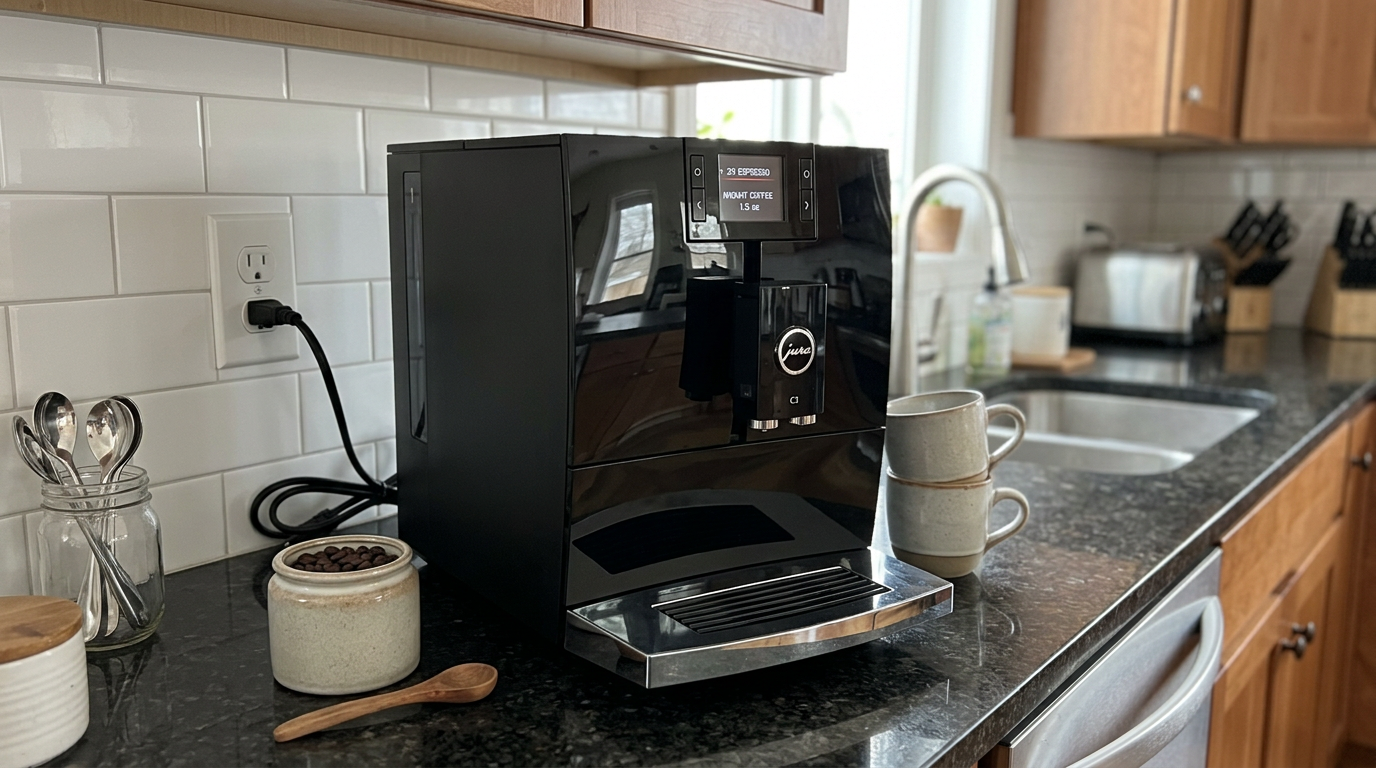
Leave a hand's width beside side-loading tanks like the C3's, so you can lift the tank out without moving the machine.
What you give up at each step
The easiest way to choose a budget Jura is to know exactly what you're not paying for. This is what each step up the range added in my tests, and whether it changed the coffee.
| Feature | On my budget picks | On premium Jura machines | Does it change the coffee? |
|---|---|---|---|
| Brew unit | Full-size 16 g on four of five | Full-size | No difference |
| Espresso | 8.6 to 9.0 in my tests | 8.9 to 9.2 in my tests | Small difference |
| Controls | Buttons or a small screen | Large touchscreens | No |
| Milk textures | None, or one fine foam | Smooth milk and foam, or adjustable | Yes, for lattes |
| Flavored foam | No | Sweet Foam on some models | Only if you like flavored drinks |
| Cold extraction | No | On a few flagships | Only for iced coffee fans |
| User profiles | No | Often | No, but handy for families |
| Wi-Fi | Optional adapter on some | Often built in | No |
The pattern is clear. A budget Jura gives up comfort and variety, not the quality of the espresso itself.
If you'd use a touchscreen and smooth latte milk every day, they're worth paying for. If not, a budget pick will make the same cup for less.
Budget Jura vs other ways to make coffee at home
If you're weighing a budget Jura against something cheaper, this is how it compares with the setups most people choose between.
| Budget Jura | Capsule machine | Manual machine and grinder | |
|---|---|---|---|
| Fresh-ground beans | Yes, seconds before brewing | No | Yes |
| Skill needed | None | None | A lot |
| Coffee choice | Any whole bean | The brand's capsule range | Any whole bean |
| Milk drinks | One touch on the E6 and C9 | Usually a separate frother | Steam wand, by hand |
| Waste | Compostable coffee pucks | Used capsules | Compostable coffee pucks |
| Time per drink | Under a minute | Under a minute | Several minutes |
| Running cost per cup | Low, beans | Higher, capsules | Low, beans |
For me, a budget Jura sits in the sweet spot. It costs more up front than a capsule machine, but every cup after that is just beans and water, and the coffee tastes far fresher.
A manual setup can be cheaper and offers more control, but it asks for time and skill every morning. A Jura asks for one button.
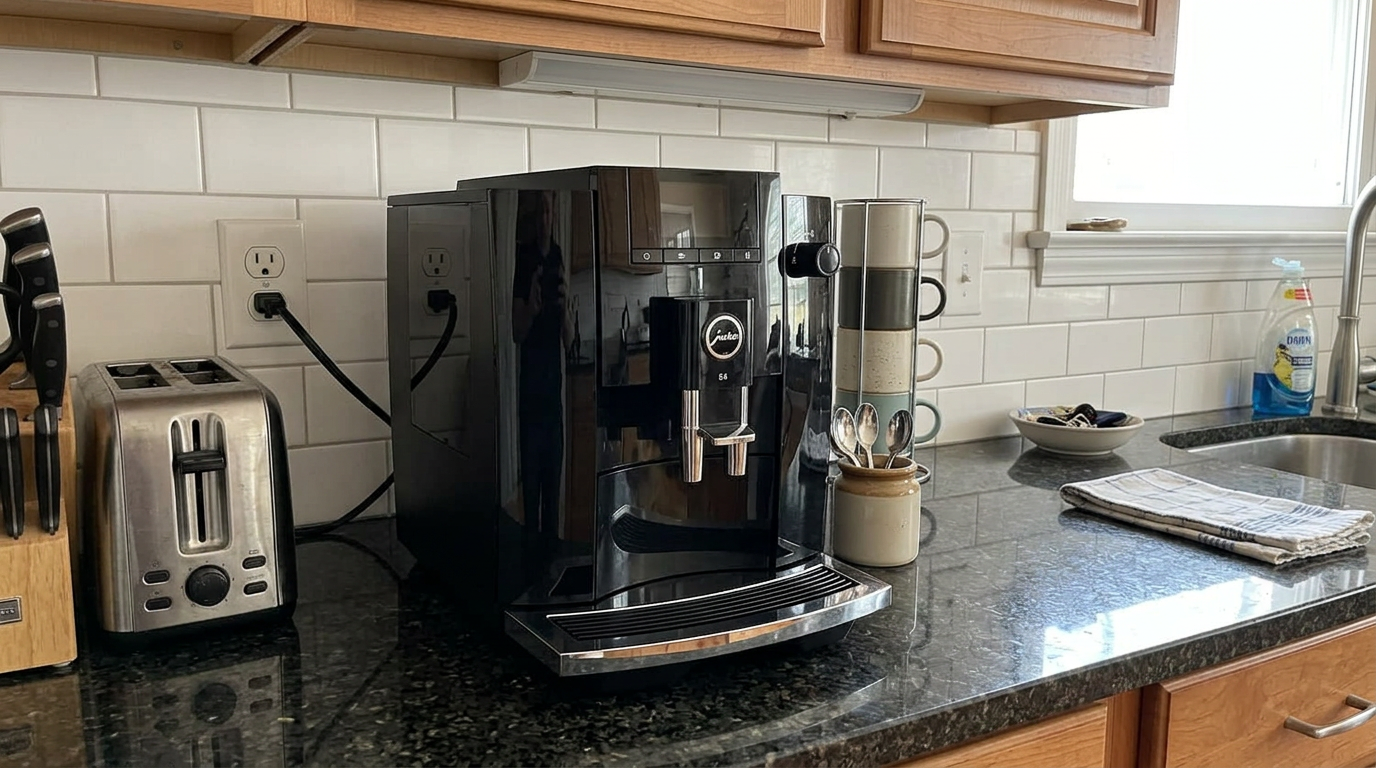
A budget Jura gives you fresh-ground coffee with capsule-level convenience.
Maintenance and running costs
A budget machine should stay cheap to own. These habits kept my picks tasting good and kept consumables to a minimum.
- Do the water hardness test properly
Enter the real result and fit the filter on day one. It sets how often the machine asks for a new cartridge or descaling.
- Run the cleaning programs when asked
The brew units on my picks are cleaned with tablets rather than removed and rinsed by hand. Don't skip them; coffee oils build up and dull the taste.
- Empty the grounds and drip tray regularly
On compact models, leave the tray out for a few seconds when you empty it, so the grounds counter resets.
- Rinse the milk system after milk drinks
On the E6 and C9, rinse when prompted and replace the milk hose every few months.
- Wipe the bean hopper every few weeks
Old oils turn new beans stale faster. A dry cloth is all you need.
| Consumable | Which picks | How often |
|---|---|---|
| Water filter cartridge | All five | When the machine asks |
| Coffee cleaning tablets | All five | When the machine asks |
| Milk cleaning tablets | Jura E6, Jura C9 | When the machine asks |
| Silicone milk hose | Jura E6, Jura C9 | About every three months |
Our tip: Buy filters and cleaning tablets in multipacks, because a budget machine's running costs are mostly consumables.
Beans that work best
Use fresh whole beans within a few weeks of the roast date, and avoid very oily, dark beans, which can clog an automatic grinder over time. Medium and medium-dark roasts suited every pick.
| Bean | How it worked | My tip |
|---|---|---|
| Medium-dark blend | Best all-rounder on every machine | Start a little finer than the middle |
| Medium roast | Balanced americano | Great on the E4 and E6 |
| Light single origin | Bright, can taste sharp | Grind finer and raise strength |
| Very dark, oily roast | Lots of crema, but risky for grinders | Avoid |
Common mistakes to avoid
I made most of these at least once during testing. They're easy to avoid once you know about them.
| Mistake | What happens | Better habit |
|---|---|---|
| Judging the first few drinks | Weak coffee while the grinder settles | Wait until the fourth cup |
| Changing the grind with the grinder stopped | Beans jam the burrs | Adjust only while it grinds |
| One huge long coffee | Thin or woody cup | Double espresso plus hot water |
| Paying for a hot water spout you won't use | Money spent on a feature | Keep the kettle and save |
| Filter-grind decaf in the chute | Watery coffee | Buy decaf ground for espresso |
| Skipping the filter | Scale builds up faster | Fit the filter on day one |
Our tip: After any grind change, wait two or three drinks before judging, because some old coffee is still in the chute.
Other Jura machines I tested
All 13 machines made good coffee, so these didn't miss out because they were bad. They simply cost more than this guide allows for, or another pick does the same job for less.
If you can stretch your budget, my guide to the best Jura automatic coffee machines covers the five best machines at any price. For direct comparisons of the cheaper models, read Jura C3 vs C9, Jura E4 vs E6, Jura C9 vs E6 and Jura ENA 4 vs E4, or see every model in my Jura comparison chart.
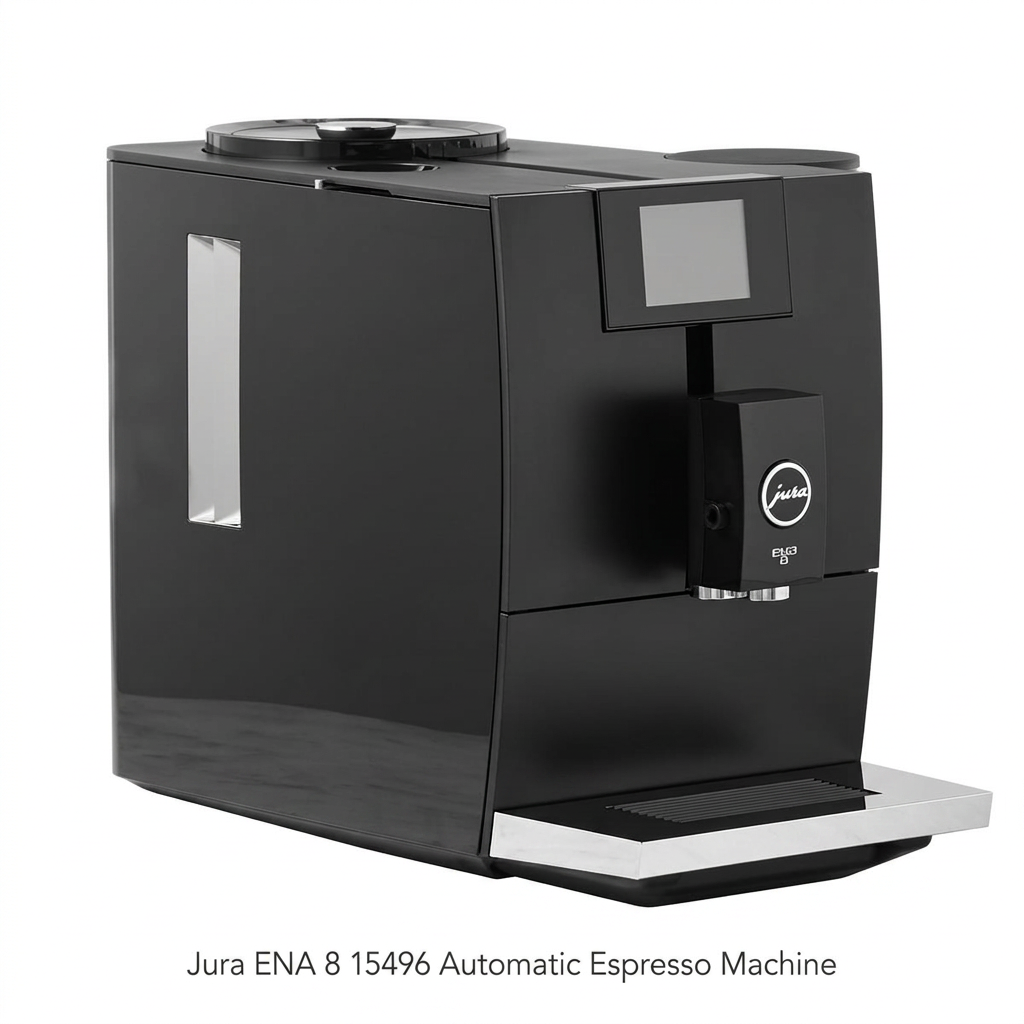
Velvety foam and a separate hot water spout in the ENA 4's tiny body. Worth the step up if you want milk in a small kitchen.
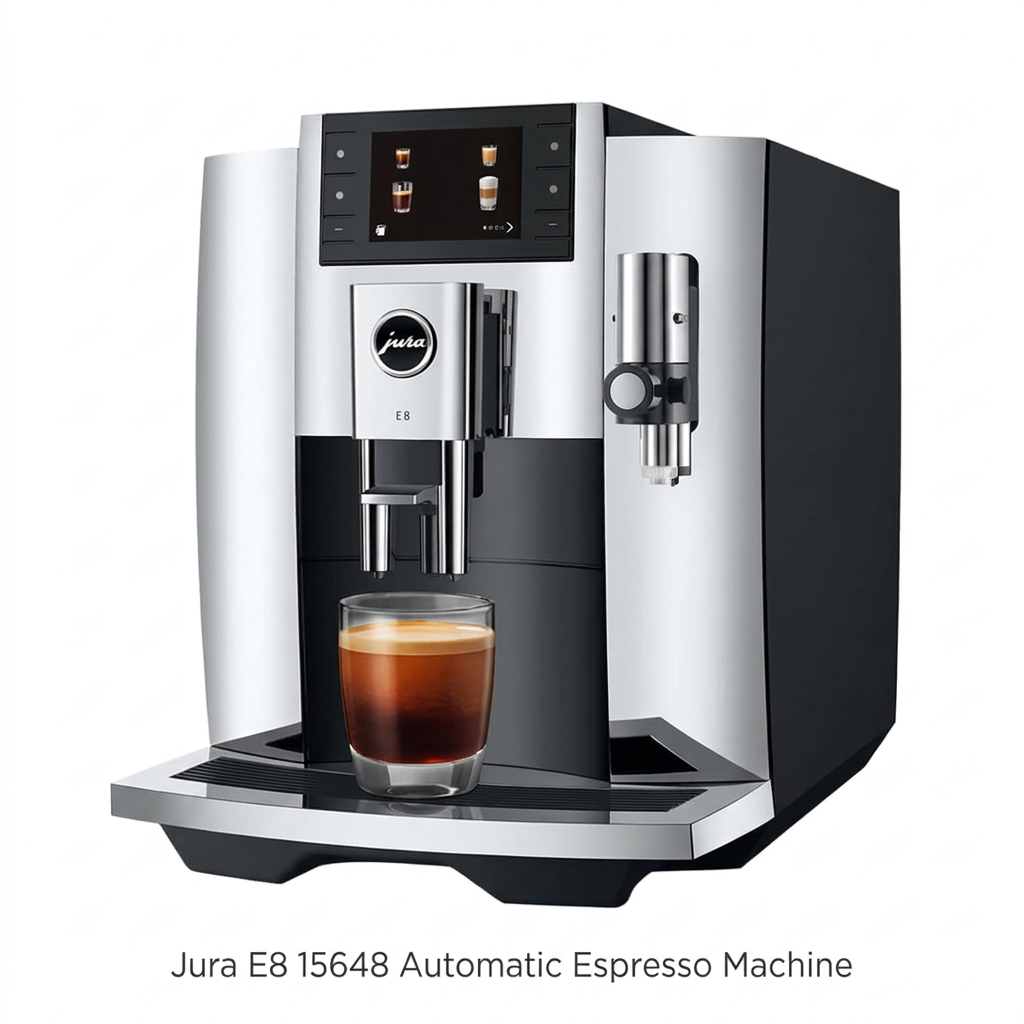
17 drinks and a maintenance dashboard. Its milk ran cool in my tests, at about 50°C.
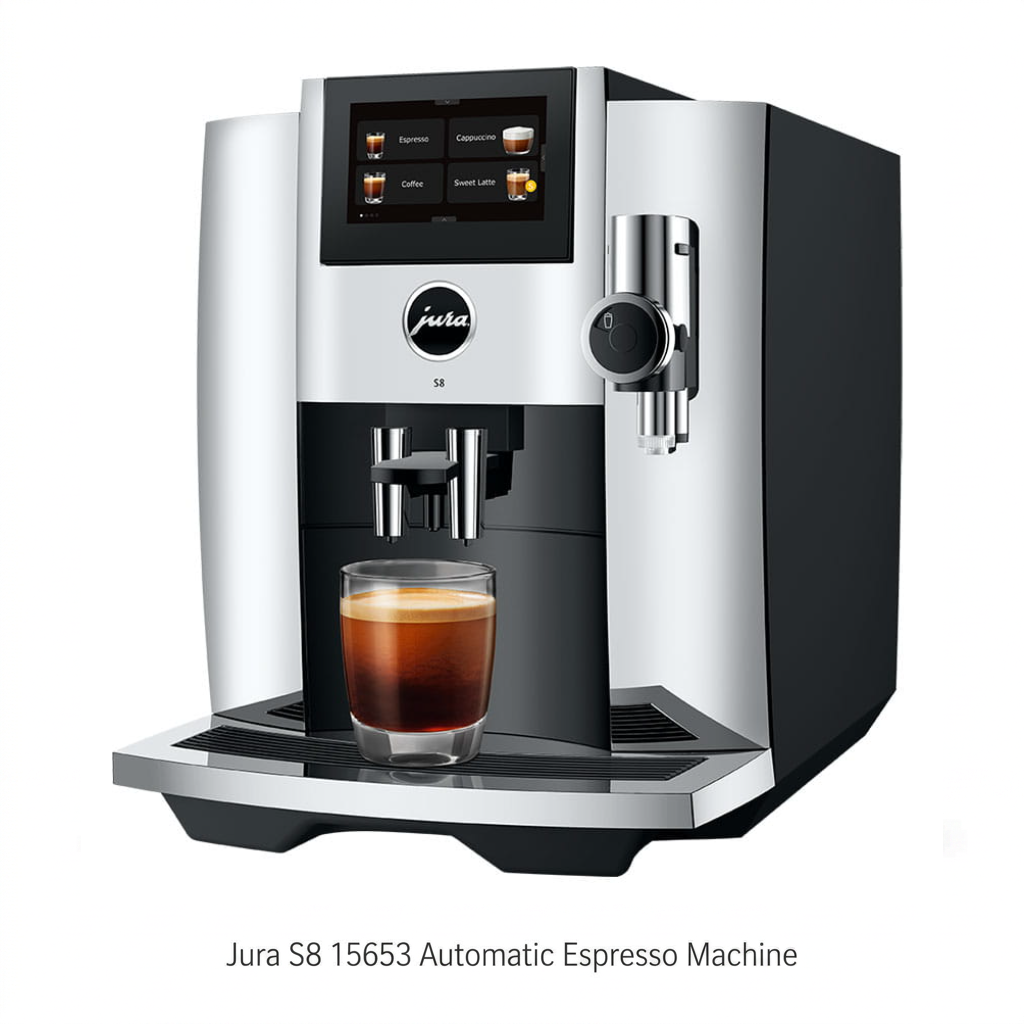
A lever for latte milk or cappuccino foam and a big touchscreen. A premium step up.
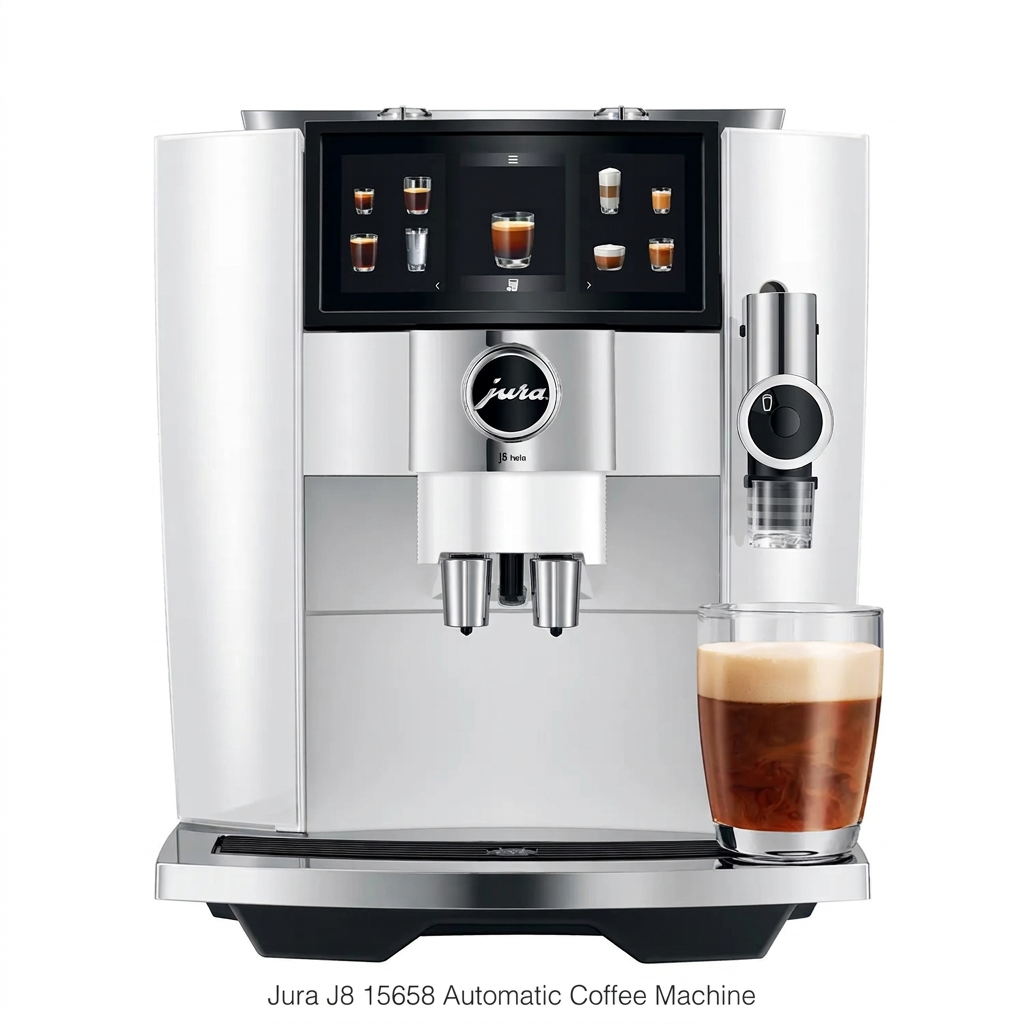
Sweet Foam and smooth milk for proper lattes. See my best Jura for milk drinks guide.
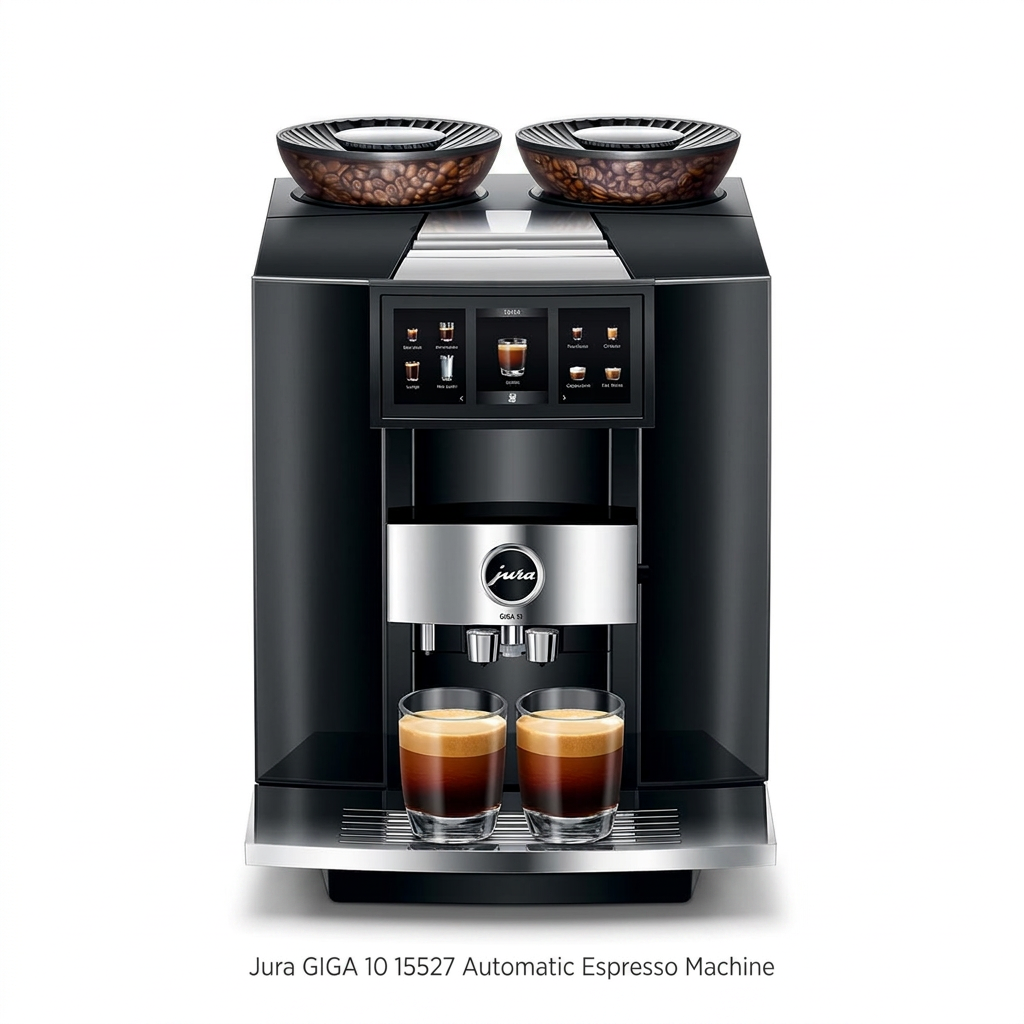
My highest-scoring Jura, with two beans on tap and cold extraction. Far beyond a budget.
Frequently asked questions
What is the cheapest Jura automatic coffee machine?
The ENA 4 and C3 sit at the entry point of Jura's range. Both make espresso and black coffee only. The C3 has a full-size 16-gram brew unit, while the ENA 4 is smaller and takes about 6 to 10 grams per cycle.
Is a budget Jura worth it?
Yes, if you drink two or more coffees a day and mostly want espresso, americanos or simple cappuccinos. In my tests, the budget picks made espresso scoring 8.6 to 9.0, close to Jura's premium machines.
Which budget Jura makes the best espresso?
The C3, which scored 9.0 for espresso in my tests. Its full-size brew unit holds up to 16 grams, as much coffee as a traditional double shot.
Which budget Jura has a milk frother?
The E6 and C9. The E6 makes one-touch cappuccinos with a single foam texture, and the C9 makes some of the finest one-touch foam I've tested. The C3, ENA 4 and E4 have no milk system.
Can a budget Jura make an americano?
The E6 makes a programmed two-step americano, and the E4 makes one with its separate hot water spout. On the C3 and ENA 4, brew an espresso and top it up from a kettle.
What's the difference between the Jura E4 and E6?
Both have a 16-gram brew unit and a hot water spout. The E6 adds a color screen, a one-touch cappuccino, a programmed americano and three hot water temperatures. The E4 is simpler, with buttons and no milk system.
What's the difference between the Jura C3 and ENA 4?
Both are compact black coffee machines. The C3 has a full-size 16-gram brew unit, a 1.6-liter tank and a 200-gram hopper. The ENA 4 is slightly smaller, with a 6-to-10-gram brew unit, a 1.1-liter tank and a 125-gram hopper.
Do budget Jura machines need a lot of cleaning?
No. Without a milk system, the C3, ENA 4 and E4 took about two minutes of daily care in my tests. The E6 and C9 took about four minutes on days I made milk drinks.
Can I use pre-ground coffee in a budget Jura?
Yes. All five picks have a pre-ground chute for one scoop of espresso-fine coffee, which is handy for decaf.
Do I need to descale a budget Jura?
Rarely, if you use the CLEARYL Smart+ filter. The machine detects it automatically and asks for a new one when it's used up. Depending on your water hardness, one cartridge filters about 40 to 65 liters.
Which budget Jura is best for a small kitchen?
The ENA 4 if you drink black coffee, and the C9 if you want milk drinks. The C9 and C3 are about 10.2 inches wide, and the ENA 4 is about 10.7 inches wide and 12.7 inches tall.
For most people, my budget pick is the Jura E6. It makes rich espresso, a true two-step americano, tea water at three temperatures and a one-touch cappuccino, with the same 16-gram brew unit as far pricier machines.
Choose the C3 for the best espresso, the ENA 4 for the smallest kitchen, the E4 for americanos and tea, or the C9 if milk drinks are your daily habit.
Whichever you choose, use fresh medium or medium-dark beans, set your water hardness and fit the filter on day one.
Kitchen & coffee tester
Michael spent six years as a line cook in restaurants in Chicago and New York, and he has tested kitchen appliances for HouseholdMe since 2018, from air fryers to coffee makers. He holds an SCA certificate in barista skills and used 13 Jura machines as his everyday coffee maker, four weeks each, for this guide.
- Four weeks of hands-on testing of each of 13 Jura machines by HouseholdMe
- HouseholdMe reviews of the Jura E6, C3, ENA 4, E4 and C9
- Jura product specifications, owner documentation and C line press information
- Jura CLEARYL Smart+ filter capacity guidance
- Consumer survey data on home coffee habits, 2024 to 2026
- The Aromas & Flavors of Coffee, The Nibble
- Which plant-based milk is best for the environment?, FoodPrint
- Using coffee grounds in the garden, The Old Farmer's Almanac
- Buying guide published, based on hands-on testing of 13 Jura machines.