AIRMSEN Portable Countertop Dishwasher TDQR03 review
The AIRMSEN Portable Countertop Dishwasher TDQR03 is a compact countertop dishwasher with a 5-liter built-in water tank, so it runs without any plumbing. You fill it with a pitcher or hook it to the faucet, pick one of five programs and it washes, rinses and dries with hot air. I used it every day for three weeks in a small apartment kitchen with no built-in dishwasher. It cleaned everyday plates, bowls, mugs and cutlery well on about 0.4 kWh and 5 liters of water a load, and the 72-hour air circulation kept it fresh when I forgot to unload. It's small, so pots and big pans stay in the sink, but for one or two people it's a genuine upgrade over hand-washing.

Emily Carter
Hands-on review
Hands-on testing, research, specs
3 weeks
26 minutes
Jargon helpNew to countertop dishwashers? Tap any dotted term to see what it means.
In this review
Yes, if you live alone or as a couple and don't have a dishwasher. The AIRMSEN TDQR03 needs no plumbing: you pour about 5 liters into its built-in tank, it beeps when it's full, and it washes, rinses and dries a small load on roughly 0.4 kWh. Everyday dishes came out clean and dry, the 72-hour air circulation stopped musty smells, and the fruit program was a nice extra. The trade-off is size: big pots, pans and baking trays don't fit, and a full day's dishes for a family won't either.
AIRMSEN TDQR03 at a glance
AIRMSEN TDQR03 pros and cons
- Runs from its own tank, no plumbing needed
- Uses about 5 liters of water a load
- Hot-air drying and 72-hour air circulation
- Small capacity for families
- Pots, pans and trays don't fit
- You refill the tank by hand each load
Who should buy the AIRMSEN TDQR03?
- One or two people
- Renters who can't install a dishwasher
- Small kitchens, RVs and dorms
- Families of four or more
- Big-batch cooks with lots of cookware
- Very small counters with no spare space
First impressions of the AIRMSEN TDQR03
The dishwasher arrived well packed and was lighter than I expected, easy to lift onto the counter on my own.
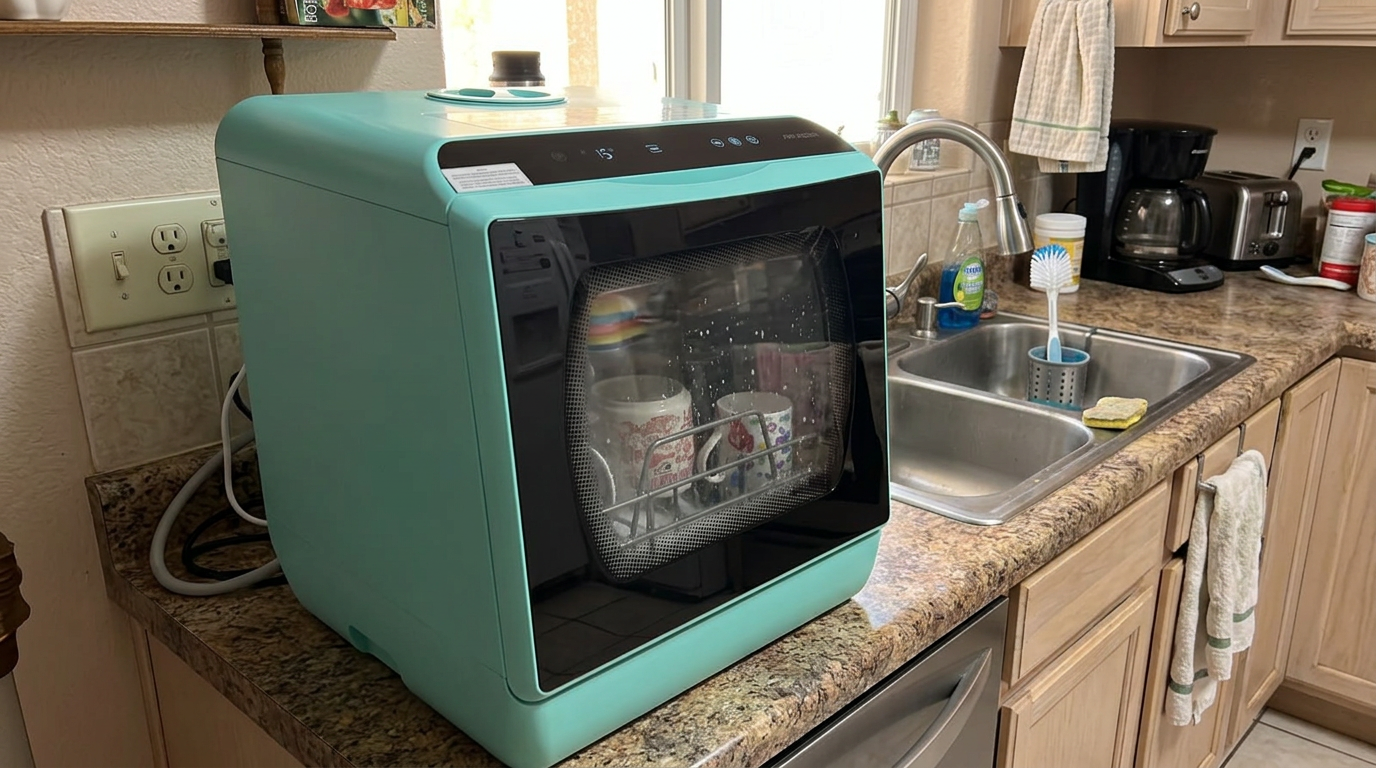
It's a neat box with a transparent double-layer glass door, so you can watch the spray arms work.
The controls are an angled LED touch panel on the front, easy to read from standing height.
Inside are an upper rack for cutlery and small items, a lower rack for plates and bowls, and a removable filter at the bottom.
In the box were an inlet hose, a drain hose, a fruit basket, a filling pitcher and the manual.
Everything felt solid, and the door closed with a reassuring seal.
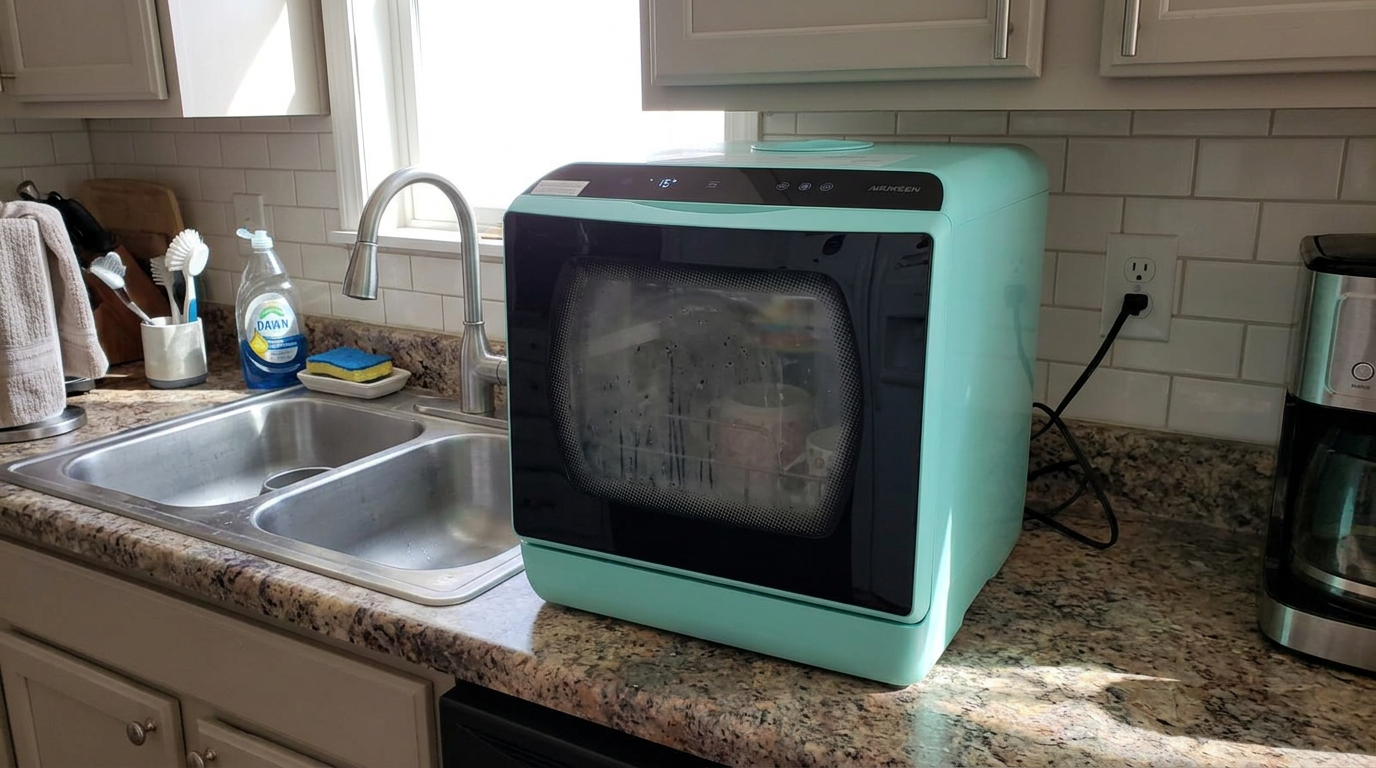
Two racks, a glass door and a touch panel.
Our tip: Run one empty Normal cycle with a little detergent before your first real load, because it rinses out any manufacturing residue and lets you learn the sounds and steps while nothing is at stake.
Size and where to put it
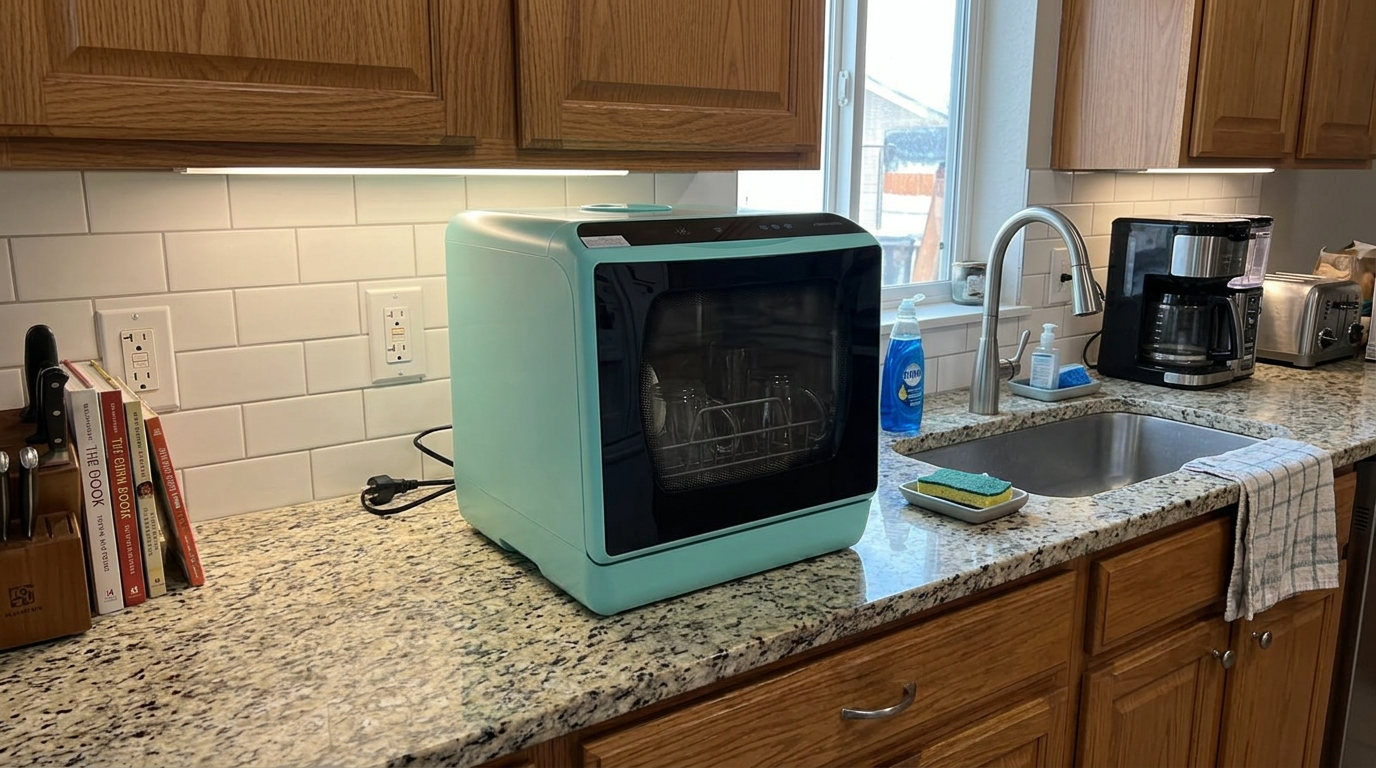
It measures about 16.75 inches wide, 16.86 inches deep and 18 inches tall.
On my counter, it took up roughly the space of a large microwave.
It fit under my upper cabinets with a little room to spare, which matters because you open the tank lid on top.
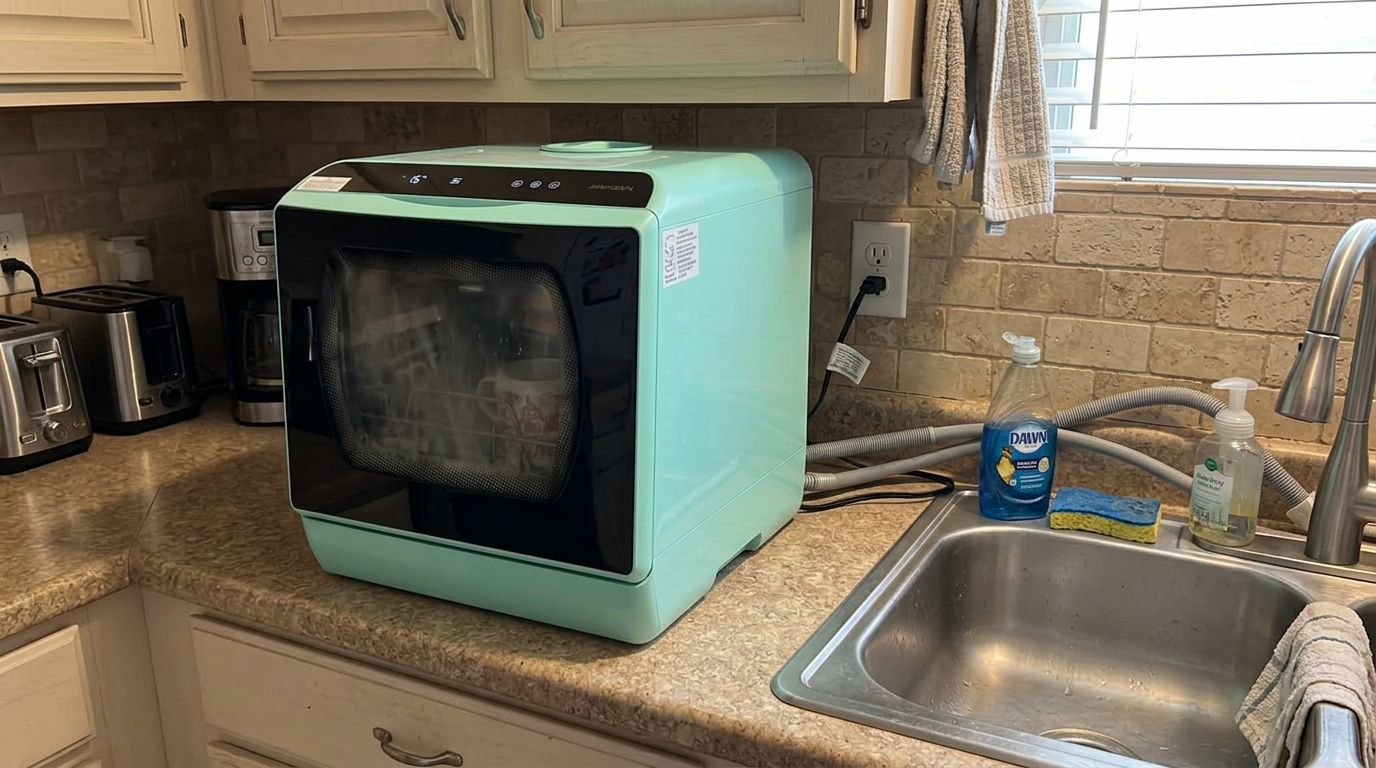
You need a nearby outlet and somewhere for the drain hose to reach the sink.
I put it right next to the sink so the drain hose hung straight in.
| Measurement | Size | What it means |
|---|---|---|
| Width | 16.75 in | About a large microwave |
| Depth | 16.86 in | Fits most counters |
| Height | 18.05 in | Check under cabinets |
| Tank | 5 liters | One full load |
Our tip: Measure the gap under your wall cabinets before you buy, because you need a few inches above the machine to open the tank lid and pour water in comfortably.
Two ways to fill it: tank or faucet
This is the feature that makes it so easy to live with.
There's a 5-liter water tank built in, filled through an opening on top.
I poured water in with the included pitcher, and it took about three pitcherfuls.
A water level indicator✕Water level indicatorA sensor in the tank that tells the machine when there is enough water for a cycle. On this model it beeps when the tank is full. beeps when there's enough, so you never have to guess.
If you prefer, the inlet hose connects to a kitchen faucet and fills it for you.
I mostly used the tank, because it meant no adapters and no changes to the plumbing in my rental.
| Fill method | Water used | Best for |
|---|---|---|
| Manual tank | About 5 liters | Renters, RVs, any counter |
| Faucet hose | A little more | Hands-free filling |
Draining the dirty water
The drain hose clips onto the back and goes into your sink.
After each cycle, the dirty water pumps out through it.
The hose needs to hang down into the sink without kinks, or water drains slowly.
I tested by draining a cycle into a bucket, and it collected about the same 5 liters I'd poured in.
A two-gallon bucket is plenty if you ever want to drain somewhere other than the sink.
Our tip: Keep the end of the drain hose below the bottom of the dishwasher and clip it to the sink edge, because a hose that rises or kinks makes the pump work harder and can leave water in the base.
Loading the racks
Capacity is the big limitation, so loading well matters.
The lower rack held four dinner plates, two side plates and two cereal bowls, angled so the spray reached them.
The upper rack took cutlery, a couple of small glasses and a measuring cup.
Mugs went upside down on the lower rack.
The listing says it handles 30-plus items and plates up to 12 inches when angled, and that matched my experience with smaller items.
A long spatula fit only diagonally.
| Item | Where it went | Fit |
|---|---|---|
| Dinner plates | Lower rack, angled | Good |
| Bowls | Lower rack | Good |
| Mugs | Lower rack, upside down | Good |
| Cutlery | Upper rack | Excellent |
| Small glasses | Upper rack | Good |
| Saucepan | — | Too big |
| Baking tray | — | Too big |
Our tip: Face the dirty side of plates toward the center of the machine, because the spray arms sit in the middle and plates facing outward get far less water on the side that needs it.
How it washes: spray arms and nozzles
There are spray arms✕Spray armsRotating arms that shoot water at the dishes from below and above. Water pressure spins them so the jets sweep across the whole load. above and below the racks, with 14 high-pressure nozzles between them.
Through the glass door, you can watch water fan out in every direction.
That two-level spray is why it cleaned the inside of bowls as well as the plates.
It also means overloading is the enemy, because blocked arms can't spin.
Before every cycle, I gave each arm a quick spin by hand to make sure nothing was in the way.
Cleaning coverage by position in my loads.
Our tip: Spin both spray arms by hand once you've loaded, because a plate edge or spoon handle sticking into their path stops them turning and leaves half the load dirty.
Detergent: use less than you think
The detergent cup is small, sized for about 10 grams.
That's less than you'd use in a full-size dishwasher.
I tried a standard pod first and found a little residue on the cups.
Switching to loose powder, measured to the line, solved it.
Too much detergent in a small machine leaves film and can foam.
| Detergent | My result |
|---|---|
| Measured powder | Best: clean, no film |
| Measured gel | Very good |
| Full-size pod | Some residue on cups |
| Half a pod (cut) | Messy, not worth it |
Our tip: Use powder or gel and measure it to the line in the cup, because a full-size pod is sized for a much bigger machine and can leave a film on glasses in a small tank.
The five wash programs
There are five programs: Normal, Speed, Glass, Baby Care and Fruit.
Normal is the everyday cycle, with a main wash, rinses, a hot final rinse and optional hot-air drying.
Speed takes about 29 minutes for lightly dirty dishes.
Glass is gentler for glassware.
Baby Care uses steam and reaches up to 167°F for bottles and feeding items.
Fruit is a short cold wash for produce.
| Program | Length in my use | Best for |
|---|---|---|
| Normal | About an hour | Everyday plates, bowls and cutlery |
| Speed | About 29 minutes | Lightly dirty dishes |
| Glass | Around an hour | Glasses and delicate items |
| Baby Care | Longest | Bottles, steam up to 167°F |
| Fruit | Short | Fruit and vegetables |
Our tip: Use Speed only for dishes you rinsed or used lightly, because it's short on heat and time and won't shift dried-on food the way Normal does.
The Normal cycle in detail
I used Normal for about 80 percent of my loads.
It heats the water, runs the main wash with detergent, then does several rinses, including a hot final rinse.
If drying is on, hot air then circulates for up to an hour.
In my kitchen, a full Normal cycle with drying took a little over an hour.
The dishes were clean, felt free of detergent and were mostly dry when I opened the door.
The stages of a Normal cycle.
Our tip: Scrape food into the trash but skip pre-rinsing, because the Normal cycle's hot rinse handles leftover sauce and the detergent works better with something to clean.
Cleaning results over three weeks
For everyday dishes, the cleaning was very good.
Cereal bowls, pasta plates, mugs with coffee rings and cutlery all came out clean.
Dried-on oatmeal needed a short soak first, then washed off fine on Normal.
Egg yolk on a fork came off when I placed it handle-down in the upper rack.
Greasy plastic containers were the hardest; they came out clean but a little filmy.
Overall, about 9 in 10 items were spotless on the first run.
| Food | Program | Result |
|---|---|---|
| Cereal and milk | Normal | Spotless |
| Pasta sauce | Normal | Spotless |
| Coffee rings | Normal | Spotless |
| Dried oatmeal | Normal after soak | Clean |
| Egg yolk | Normal | Clean |
| Greasy plastic | Normal | Slight film |
Share of items clean on the first wash in my three weeks.
Our tip: Put plastic containers on the upper rack and away from the heater, because they wash and dry best there and the heat at the bottom can warp thin plastic over time.
Hot-air drying
Drying is where many small dishwashers fall short, so I was pleased here.
After the wash, hot air circulates for up to 60 minutes.
Plates and cutlery came out dry, and the interior was dry to the touch.
Plastic tubs and mugs with deep bottoms held a few drops.
You can switch drying off if you'd rather save energy and air-dry with the door open.
| Item | Dry after hot-air drying? |
|---|---|
| Ceramic plates | Yes |
| Cutlery | Yes |
| Glasses | Mostly |
| Mugs | A few drops in the base |
| Plastic tubs | Some drops |
72-hour air circulation
After a wash, the machine can keep moving air through the compartment for up to 72 hours.
That's for the days you don't unload straight away.
I tested it by leaving a clean load inside over a long weekend.
When I came back, there was no musty smell and no condensation on the glass.
Without it, a small sealed box full of damp dishes can start to smell quickly.
Our tip: Leave air circulation on whenever you won't unload the same day, because it's the simplest way to stop that stale, damp smell from building up inside a closed dishwasher.
The fruit and vegetable program
This was the feature I expected to ignore, and I ended up using it a few times a week.
You put produce in the separate fruit basket and run the short Fruit program.
It uses circulating cold water, with no heat and no drying.
Strawberries, grapes and cherry tomatoes came out rinsed and cool.
When I washed vegetables from a friend's garden, the drained water was visibly dirty, so it does lift off soil.
I'd still scrub potatoes by hand.
| Produce | Result |
|---|---|
| Grapes | Excellent |
| Strawberries | Very good, gentle |
| Cherry tomatoes | Excellent |
| Garden lettuce | Good, check leaves |
| Potatoes | Scrub by hand instead |
The fruit basket keeps produce separate from the dish racks.
Our tip: Don't add detergent to the Fruit program, and remove the dish racks' cutlery first, because the program is meant only for clean water rinsing of produce.
Baby Care and steam
Baby Care uses steam and reaches up to 167°F.
I don't have a baby, but a friend lent me bottles, a breast pump kit and some small plastic feeding bowls to test.
Everything came out clean, and the bottles stood well in the upper rack.
The steam also helped with sticky residue on a silicone spatula.
It's the longest program and uses the most energy, so I'd keep it for items that need it.
Our tip: Take bottle nipples and small valves apart and put them in the cutlery area, because small parts can drop through the rack gaps and end up near the filter.
The Glass program
Glass is a gentler program for glassware.
I ran wine glasses and a couple of thin tumblers through it.
They came out clean and without the cloudy spots I sometimes get from hand-washing.
Tall wine glasses had to lie at an angle on the lower rack, so only two fit at a time.
Our tip: Space glasses so they don't touch each other or the door, because the spray makes them vibrate slightly and contact points can chip thin rims.
Water use: the standout number
A Normal cycle uses about 5 liters of water, roughly 1.3 gallons, from the tank.
Connected to the faucet, it used a little more because of the water pressure.
For comparison, I timed how long my faucet runs when I wash a similar small load by hand.
It ran for several minutes, which adds up to many times more water than the tank holds.
If you want to cut water use, this is a real saving.
Water for a small load in my kitchen.
Our tip: Run it only with a full small load, because the water and energy use are the same whether you wash four plates or twelve items, and full loads make every liter count.
Energy use
I measured energy with a plug-in meter.
A Normal cycle used about 0.38 kWh, close to the 0.4 kWh the maker lists.
A separate hour of hot-air drying added about 0.13 kWh.
So a full wash and dry came to roughly 0.5 kWh.
The pumps alone draw very little; most of the energy goes into heating the water and the drying air.
| Stage | Energy measured |
|---|---|
| Normal wash | About 0.38 kWh |
| Hot-air drying (1 hour) | About 0.13 kWh |
| Total wash and dry | About 0.52 kWh |
| Pumps running | Very low draw |
| Heating | Most of the energy |
Our tip: Switch off hot-air drying on warm days and just open the door after the cycle, because drying adds about a third to the energy use and the dishes air-dry quickly in a warm kitchen.
What it costs to run
Running costs depend on your local electricity rate.
To work out yours, multiply about 0.5 kWh by your rate for a wash with drying.
Without drying, use about 0.38 kWh.
If you run it once a day, that's around 15 kWh a month with drying.
In my home, that came to a small monthly amount, and the water saving made it feel worthwhile.
| Use | Energy per month (approx.) |
|---|---|
| Once a day, with drying | About 15 kWh |
| Once a day, no drying | About 11.5 kWh |
| Every other day, with drying | About 7.5 kWh |
Our tip: Check the energy rate on your power bill and multiply it by these numbers, because rates vary a lot between areas and that's the only way to know your real running cost.
Noise
It's not silent, but it's quieter than I expected.
The spray sounds like steady rain against the glass, with a hum from the pump.
I could hold a normal conversation in the kitchen while it ran.
The loudest moments were the drain pump and the beeps when the tank was full and the cycle ended.
In a small apartment, I ran it in the evening without any trouble.
How loud each stage felt.
Our tip: Start it just before you leave the kitchen for the evening, because the wash and drying run quietly in the background and the drain pump noise is over in a minute.
The glass door and LED light
The transparent double-layer glass door is a fun touch.
You can see the spray arms spinning and check whether something has fallen over mid-cycle.
An LED light inside switches on when you open the door, which makes loading in a dim kitchen easier.
The glass stayed clear and didn't fog badly, thanks to the double layer.
The rubber seal around the door kept everything dry outside.
The interior LED helps when loading in a dim kitchen.
Our tip: Glance through the glass a few minutes into each cycle, because if a mug flips or a bowl blocks a spray arm you can pause and fix it before the whole load is wasted.
The filter and keeping it clean
At the bottom of the tub is a removable mesh filter that catches food scraps.
It twists out and back in easily.
After a week, mine held rice, a few bits of pasta and some coffee grounds.
I rinsed it under the tap every few days and gave it a soft brush once a week.
A clogged filter slows draining and can make dishes come out dirtier.
| Task | How often | Time |
|---|---|---|
| Rinse the filter | Every 2–3 days | 1 minute |
| Brush the filter | Weekly | 2 minutes |
| Wipe the door seal | Weekly | 1 minute |
| Check spray arm holes | Monthly | 2 minutes |
| Empty cleaning cycle | Monthly | One cycle |
Our tip: Twist the filter back until it clicks or locks fully, because a loose filter lets scraps into the pump and can stop the water from draining properly.
Controls and ease of use
The angled LED touch panel is clear and simple.
You choose a program, toggle drying and press start.
The display shows the remaining time, which helped me plan when to unload.
There's no app or delay timer on this model.
After a day, I could set a cycle without thinking.
Our tip: Press start only after the tank beeps full, because the cycle relies on that water and starting with a half-filled tank can leave you with a weaker wash.
How it fit my daily routine
I ran one Normal cycle each evening after dinner.
Breakfast and lunch dishes went in during the day and sat with the door closed.
It held a day's dishes for one person with room to spare, and for two people with careful loading.
When a friend stayed for a week, I sometimes ran a Speed cycle at lunch too.
Big pots and the frying pan still got washed by hand.
| Household | Cycles per day | Pots by hand? |
|---|---|---|
| One person | 1 | A few |
| Two people | 1, loaded carefully | Yes |
| Three or more | 2 or more | Yes, most |
Our tip: Wash your one or two big pots by hand while the dishwasher runs, because they won't fit anyway and you'll finish the whole kitchen in the same hour.
Build quality and seals
For a compact machine, it feels well made.
The racks slide smoothly and the upper rack lifts out with release levers on each side.
The door has a rubber door gasket✕Door gasketThe rubber seal around the door that presses against the tub when closed, keeping water and steam inside. that presses tight against the tub.
In three weeks, I never saw a drip on the counter, even with the glass door steaming up.
The plastic of the tub is thick and the hinges didn't loosen with daily use.
My only quibble is that the tank lid feels a little thin compared with the rest.
| Part | How it held up after three weeks |
|---|---|
| Door and hinges | Solid, no sag |
| Door gasket | Tight, no leaks |
| Racks | Smooth, no rust |
| Tank lid | Fine, slightly flimsy |
| Touch panel | Responsive |
Our tip: Wipe the door gasket with a damp cloth once a week, because food crumbs that collect there can stop the door sealing fully and cause small leaks over time.
How much time it saved me
I timed myself for a week before the test, hand-washing the same daily dishes.
It averaged around 15 minutes a day, plus drying and putting things away.
With the dishwasher, loading took about three minutes, filling the tank about one, and unloading another three.
That gave me back close to ten minutes every day, or more than an hour a week.
It also meant the sink was clear, which made cooking dinner more pleasant.
Daily hands-on time for my dishes.
Our tip: Load as you go through the day rather than all at once after dinner, because a few seconds per meal turns the evening job into simply filling the tank and pressing start.
Using it in an RV, cabin or office
Because it runs from its own tank, it works where there's no plumbing.
I took it to a friend's cabin for a weekend, filled it from a water jug and drained it into a bucket.
It washed the weekend's dishes without any setup beyond an outlet.
In an RV, the low water and energy use make a real difference to off-grid✕Off-gridLiving or camping without a mains water or power connection, relying on tanks, batteries or generators instead. tank and battery capacity.
For an office kitchenette, it handles mugs and lunch tubs neatly.
| Place | What you need | Works well? |
|---|---|---|
| RV | Outlet, water jug or tank | Yes |
| Cabin | Outlet, bucket for draining | Yes |
| Dorm room | Outlet near a sink | Yes |
| Office kitchenette | Outlet next to the sink | Yes |
Our tip: Secure the drain hose and empty the base before moving it in a vehicle, because a few spoonfuls of water stay in the sump after draining and can slosh out on the road.
Mugs, coffee gear and lunch boxes
Mugs were the items I washed most, and they fit well upside down on the lower rack.
Coffee and tea stains came off on Normal.
A French press beaker and its filter came out clean, though the plunger needed to lie flat.
Bento-style lunch boxes washed well on the upper rack.
Travel mugs with deep, narrow bodies were the exception, because the spray couldn't reach the bottom.
| Item | Result |
|---|---|
| Ceramic mugs | Spotless |
| Tea-stained cups | Clean on Normal |
| French press beaker | Clean |
| Lunch boxes | Clean, a few drops |
| Narrow travel mugs | Base not fully reached |
Our tip: Hand-wash narrow travel mugs and water bottles, because the spray can't get to the bottom of tall, narrow containers in a machine this size.
Three weeks with the AIRMSEN TDQR03
Week one: I learned how to load it and settled on measured powder instead of pods.
The tank filling took a minute each time and quickly became routine.
Week two: I started using the Fruit program and the 72-hour air circulation.
I stopped hand-washing anything except big cookware.
Week three: A friend stayed over, and capacity became the main limit.
Two cycles a day handled it, but a family would need more.
How satisfied I felt each week.
Our tip: Keep the filling pitcher next to the sink rather than in a cupboard, because filling the tank becomes a ten-second job when the pitcher is always within reach.
Who gets the most from it
Renters gain the most, because it needs no installation and moves with you.
Singles and couples get the most out of the capacity.
People who care about water use will like the low consumption.
RV and cabin owners can run it from the tank where plumbing is limited.
Safety and good habits
It plugs into a normal outlet, and the maker lists it as ETL certified.
Keep the cord and the drain hose away from the hot side of the stove.
Don't open the door mid-cycle on Baby Care, because steam and hot water can scald.
Always let it finish draining before you move it.
Our tip: Let the dishes cool for a few minutes before unloading after Baby Care or a hot rinse, because metal cutlery and glass hold heat longer than you'd expect.
Troubleshooting what I ran into
A few small issues came up during testing.
None were serious, but they're worth knowing.
| Problem | Cause | Fix |
|---|---|---|
| Film on cups | Too much detergent | Measure to the line |
| Slow draining | Kinked drain hose | Straighten and lower hose |
| Dirty bowl insides | Blocked spray arm | Spin arms before starting |
| Water left in base | Filter not seated | Twist filter until locked |
| Wouldn’t start | Tank not full | Fill until it beeps |
Our tip: If something seems wrong, check the filter and spray arms first, because almost every washing problem in a small dishwasher comes back to blocked water flow.
Mistakes to avoid
Don't use full-size pods.
Don't overload the lower rack so the spray arm can't turn.
Don't let the drain hose kink behind the machine.
Don't forget the filter for weeks.
And don't put cast iron, wood-handled knives or non-dishwasher-safe plastics inside.
Our tip: Read the dishwasher-safe symbol on plastics before loading, because thin, non-rated plastic can warp from the heated rinse and drying in such a compact space.
Who it suits in real life
It's ideal for renters, singles and couples in small kitchens.
It also suits RVs, cabins, dorms and offices with a kitchenette.
Families who cook every night will find it too small as their only dishwasher.
If you have a full-size dishwasher, it's useful as a second machine for mugs and baby items, but most people won't need it.
| Household | Fit | Why |
|---|---|---|
| Single renter | Excellent | No plumbing, enough capacity |
| Couple | Very good | One careful load a day |
| RV or cabin | Excellent | Runs from its tank |
| Family of four | Fair | Too small as the only machine |
| Office kitchenette | Very good | Mugs and lunch tubs |
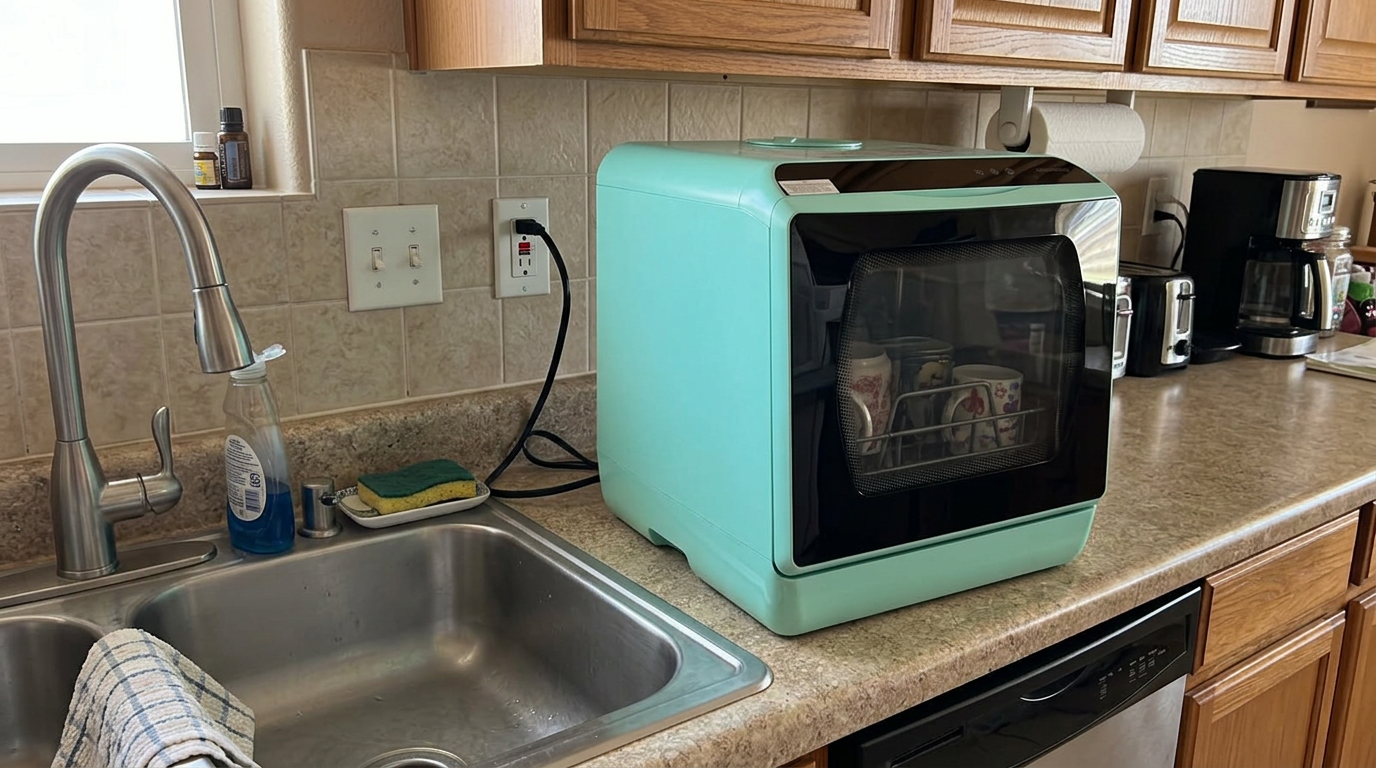
Sized for small kitchens and one or two people.
Our tip: Count how many plates, bowls and mugs you use on a typical day before buying, because if it's more than one load's worth you'll be running it twice daily.
Is the AIRMSEN TDQR03 worth the money?
For one or two people without a dishwasher, yes.
It saves water, saves time and needs no plumbing.
It cleaned everyday dishes well and dried them properly.
The capacity is the limit, so be honest about how many dishes you make.
Three questions to ask:
Do you have no built-in dishwasher?
Do you cook for one or two?
And do you have about two feet of counter next to the sink?
How it compares with other ways to wash dishes
| Feature | AIRMSEN TDQR03 | Hand-washing | Full-size dishwasher | Hose-only countertop |
|---|---|---|---|---|
| Plumbing needed | No | No | Yes | Yes, faucet |
| Water per load | About 5 liters | Much more | More | About the same |
| Capacity | Small | Any | Large | Small |
| Drying | Hot air | Towel | Heated | Varies |
| Effort | Low | High | Low | Low |
| Renter-friendly | Excellent | — | Poor | Good |
| Your priority | Is it a fit? | Why |
|---|---|---|
| No installation | Excellent | Built-in 5-liter tank |
| Low water use | Excellent | About 5 liters a load |
| Dry dishes | Very good | 60-minute hot-air drying |
| Big cookware | Poor | Pots and trays don’t fit |
| Large households | Fair | Small capacity |
Which one is right for you: is the AIRMSEN TDQR03 your match?
4 quick questionsAIRMSEN TDQR03 specifications
From manufacturer data, retailer listings and my own testing.
How I tested and scored the AIRMSEN TDQR03
For three weeks, the AIRMSEN TDQR03 was my only dishwasher in a small apartment kitchen.
I ran every program, logged what went in and how clean it came out, and tried pods, powder and gel.
I measured water by filling the tank with a marked pitcher and draining into a bucket, and energy with a plug-in meter for washing and drying separately.
- Ease of setup (9.0): no plumbing, beeping tank, simple controls.
- Water and energy use (8.8): about 5 liters and 0.4 kWh a wash.
- Cleaning (8.2): very good on everyday dishes; slight film on greasy plastic.
- Capacity (6.2): fine for one or two; no room for cookware.
The overall score of 8.0 is an editorial rating that reflects those four areas.
AIRMSEN TDQR03 FAQ
Does the AIRMSEN TDQR03 need plumbing?
No. It has a 5-liter built-in water tank you fill by hand. You can also connect it to a faucet with the included inlet hose.
How much water does it use?
About 5 liters, or roughly 1.3 gallons, per Normal cycle from the tank. It uses a little more when connected to a faucet.
How much energy does it use?
About 0.4 kWh per cycle. In my tests, a Normal wash used about 0.38 kWh and an hour of hot-air drying added about 0.13 kWh.
What programs does it have?
Normal, Speed, Glass, Baby Care and Fruit, plus hot-air drying and 72-hour air circulation.
How long does a cycle take?
Speed takes about 29 minutes. Normal with drying took a little over an hour in my kitchen.
Does it dry the dishes?
Yes. Hot air circulates for up to 60 minutes. Plates and cutlery came out dry; mugs and plastics held a few drops.
How many dishes fit?
It holds 30+ items, including plates up to 12 inches when angled. That was enough for one or two people per day.
Can I wash pots and pans in it?
Small items only. Saucepans, frying pans and baking trays didn't fit in my testing.
What detergent should I use?
Measured powder or gel, about 10 grams to the line. Full-size pods left residue in my tests.
Does it wash fruit and vegetables?
Yes. The Fruit program uses a separate basket and a short cold rinse with no detergent.
Is it loud?
It's moderate while washing, quiet while drying, and loudest for a minute when draining.
How do I clean the filter?
Twist it out, rinse it every few days, brush it weekly and twist it back until it locks.
Senior home appliance tester
Emily has tested home appliances for a living since 2016, first as a test coordinator at a national consumer advocacy group and, since 2021, at HouseholdMe. She has a degree in industrial design from Ohio State, so she looks at how a product is built, not just how it performs. She used the AIRMSEN TDQR03 as her only dishwasher for three weeks for this review.
- Three weeks of hands-on testing of the AIRMSEN TDQR03
- AIRMSEN product information and user manual